The relationship between corporate treasury management and cryptocurrency has long been defined by MicroStrategy (referred to in market segments as Strategy), the enterprise software firm that famously transformed itself into a de facto corporate Bitcoin proxy. When the company recently disclosed a sale of 32 Bitcoin (BTC), the transaction sent minor shockwaves through the digital asset markets, sparking intense debate among retail investors, institutional observers, and market analysts.
Appearing on CNBC’s Power Lunch, MicroStrategy CEO Phong Le addressed the transaction directly, pushing back against speculations that the sale signaled a shift in the company’s aggressive, long-term acquisition strategy. Le clarified that the transaction was not born out of liquidity pressures, but was instead a deliberate, tactical maneuver designed to test internal execution frameworks and prepare the broader market for the reality of corporate treasury management.
Main Facts of the Transaction
The controversy centered on MicroStrategy’s disposal of 32 BTC, which represented the company’s first sale of digital assets since late 2022. While the absolute volume of the sale was negligible relative to the firm’s massive multi-billion-dollar treasury, the symbolic weight of the transaction triggered outsized reactions.
The primary details of the transaction and its immediate market context include:
The Sale and Rebound Purchase: Roughly a week after disposing of the 32 BTC, MicroStrategy aggressively re-entered the market, purchasing more than 1,500 BTC. This rapid buyback underscored the company’s self-characterization as a "net purchaser" of the digital asset.
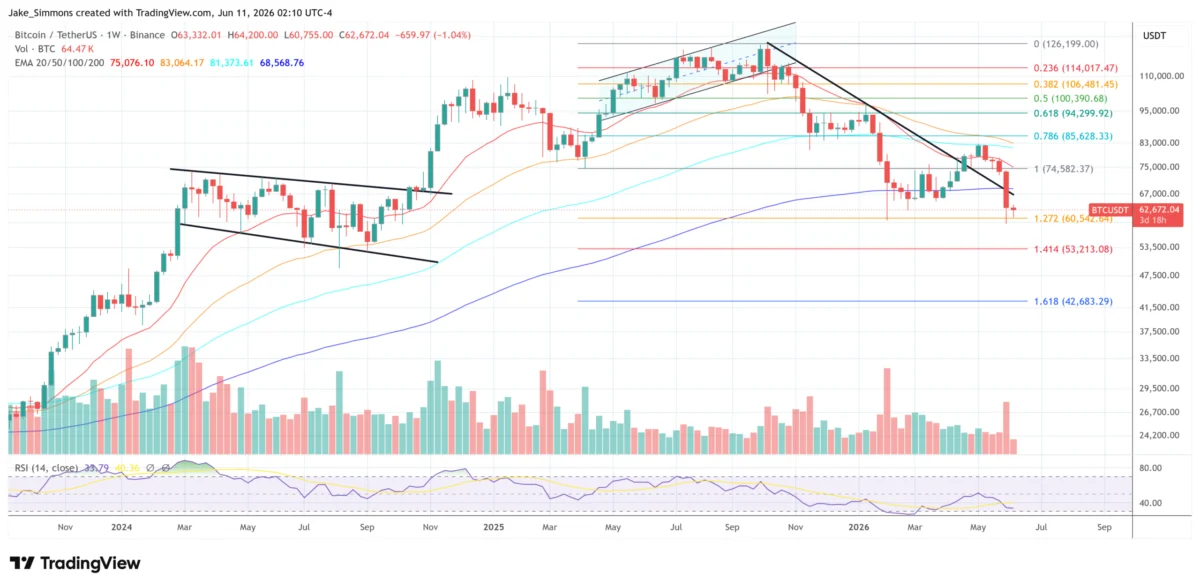
Prevailing Market Conditions: During Phong Le’s CNBC appearance, Bitcoin was trading at approximately $61,000, representing a flat intraday performance but a steep decline of more than 20% over the preceding month. The market had recently witnessed Bitcoin slipping below the critical $60,000 support level for the first time since October 2024. At press time, the asset had staged a modest recovery, trading at $62,672.
Execution Objectives: Le stated that the transaction served two primary purposes: "market inoculation"—disabusing the public of the notion that the firm is structurally incapable of or restricted from selling—and an operational "live fire" test of the firm’s internal custody and liquidation pipelines.
Dividend Independence: Crucially, Le confirmed that the liquidation was not executed to fund corporate dividends. He emphasized that MicroStrategy remains fully capable of satisfying its dividend obligations and other operational capital needs through its traditional capital-raising activities, including equity and debt issuance.
Chronology of MicroStrategy’s Bitcoin Treasury Operations
To understand the significance of the 32 BTC sale, it is necessary to examine the chronological evolution of MicroStrategy’s balance sheet strategy, which pioneered the corporate adoption of Bitcoin as a primary treasury reserve asset.
[August 2020: Initial Treasury Adoption]
                 │
                 ▼
[December 2022: First Tax-Loss Sale (Est. Precedent)]
                 │
                 ▼
[2023 – Early 2026: Multi-Billion Dollar Debt & Equity-Funded Accumulation]
                 │
                 ▼
[Mid-2026: Tactical Sale of 32 BTC (Operational & Market Test)]
                 │
                 ▼
[One Week Later: Acquisition of 1,500+ BTC (Reaffirming Net-Buyer Status)]
The Genesis of the Playbook (August 2020)
Under the leadership of then-CEO and current Executive Chairman Michael Saylor, MicroStrategy adopted Bitcoin as its primary treasury reserve asset to hedge against fiat inflation and maximize long-term shareholder value. The company began purchasing Bitcoin using excess corporate cash, quickly transitioning to more aggressive acquisition methods.
Debt-Fueled Accumulation (2021–2022)
The company evolved its strategy by leveraging the capital markets, issuing convertible senior notes and corporate debt to fund large-scale Bitcoin purchases. This period established the company as the largest corporate holder of Bitcoin globally.
The First Tactical Sale (December 2022)
In late 2022, MicroStrategy executed its first-ever sale of Bitcoin, disposing of approximately 704 BTC to generate capital losses for tax-offsetting purposes under prevailing corporate tax laws. The company quickly repurchased 810 BTC days later, establishing a precedent of tactical trading within a broader accumulation framework.
Massive Expansion and the 2026 Test (Mid-2026)
Following years of uninterrupted buying that saw the company accumulate hundreds of thousands of BTC, MicroStrategy executed the controversial 32 BTC sale. The sale occurred amid a broader market correction where Bitcoin had dipped below $60,000. Within approximately one week of the sale, the company completed a fresh acquisition of over 1,500 BTC, erasing the volume of the sale and expanding its net holdings.
Supporting Data: Financial Architecture and Market Impact
The financial mechanics behind MicroStrategy’s balance sheet explain why a 32 BTC transaction—valued at just under $2 million at prevailing prices—became a major talking point for Wall Street and crypto analysts alike.
The Divergent Cost Basis
MicroStrategy’s Bitcoin acquisition campaign has spanned multiple market cycles. Phong Le noted that the company’s historical purchase prices range from as low as $10,000 per BTC to as high as $125,000 per BTC.
This wide distribution of cost bases provides the company with unique accounting opportunities. By selectively liquidating specific high-cost-basis tranches during market downturns, the company can capture tax-loss assets on its balance sheet to offset future taxable gains, optimizing its overall corporate tax liabilities.
Market Reaction and the "JPMorgan Effect"
Despite the small size of the sale, the psychological impact on the market was notable. According to research reports from investment banks like JPMorgan, the rare sale temporarily spooked retail markets and algorithmic trading desks, which are highly sensitive to any shift in MicroStrategy’s holding patterns.
The broader crypto community, long accustomed to Michael Saylor’s "never sell" rhetoric, interpreted the transaction as a potential crack in the company’s conviction, contributing to the short-term downward pressure that pushed BTC below $60,000 before Le’s public clarification.
Capital Structure and Constituents
MicroStrategy’s corporate capital structure is highly complex, comprising multiple classes of securities. The company must balance the interests of several distinct stakeholder groups:
Stakeholder Group
Security / Instrument
Primary Alignment & Objectives
Common Stockholders
MSTR Shares
Exposure to Bitcoin price appreciation amplified by corporate leverage; equity growth.
Preferred Stockholders
STRC Shares
Structured yield, capital preservation, and priority claims on assets.
Debt Holders
Convertible / Senior Notes
Fixed income return profile, downside protection, and principal safety.
Bitcoin Holders
Direct Asset Exposure
Long-term appreciation of the underlying digital asset; market liquidity.
Official Responses: Phong Le’s Rationale and CNBC Defense
During his interview on CNBC’s Power Lunch, Phong Le offered a clear defense of the company’s decision-making, emphasizing corporate pragmatism over ideological purity.
On "Inoculating" the Market
Le explained that the sale was a deliberate effort to manage market expectations and break the dogma surrounding the company’s treasury.
"Why the sale? A few reasons. One, we thought it was good to inoculate the market to understand that we are willing to sell Bitcoin when we need to. We haven’t needed to, but it’s an important thing to do."
By executing a tiny, harmless sale during a quiet period, the company sought to establish a precedent of liquidity without causing systemic panic.
On Operational Testing
Le pointed out that while purchasing Bitcoin through OTC desks and corporate brokers has become a routine, highly automated process for MicroStrategy, executing a sale involves entirely different custody, compliance, security, and settlement pipelines.
"We sold because we wanted to test our processes," Le said. When pressed by host anchors on what the treasury team learned from the live-fire test, Le responded:
"We learned that everything works."
Addressing "Crypto Anarchists" and Retail Backlash
Le drew a sharp distinction between the institutional investors who fund MicroStrategy’s debt and equity and the ideological retail community. He noted that the anxiety surrounding the 32 BTC sale was almost exclusively confined to retail observers who advocate for an uncompromising "HODL" (Hold On for Dear Life) philosophy.
"The question is, why does the sale of 32 BTC get so much attention? Our institutional shareholders that we talk to don’t seem to be unnerved by it. I think the unnerving is the retail community that has views on never selling your Bitcoin that are crypto anarchist. And frankly, we have a lot more than just them as constituents."
Le reiterated that as a publicly traded corporation, MicroStrategy’s ultimate fiduciary duty is to its common stockholders (MSTR), preferred stockholders (STRC), and debt holders, rather than the broader ideological cryptocurrency community.
Strategic and Market Implications
The fallout and subsequent clarification of MicroStrategy’s transaction offer several insights into the maturing intersection of public equities and digital assets.
The Evolution of Corporate Treasury Management
Historically, corporate treasuries have treated Bitcoin as an "all-or-nothing" proposition. MicroStrategy’s willingness to treat its holdings as a dynamic treasury asset—subject to tax-loss harvesting, operational testing, and tactical adjustments—marks a shift toward corporate normalization.
By demonstrating that a public company can sell small amounts of Bitcoin without abandoning its core investment thesis, MicroStrategy is setting a blueprint for other corporations that may want to adopt Bitcoin but are hesitant due to the perceived liquidity lock-in.
Fiduciary Duty vs. Ideology
The incident highlights the tension between public market realities and crypto-native philosophies. While retail investors often view Bitcoin through an ideological lens of absolute scarcity and permanent holding, corporate executives like Phong Le must operate within the bounds of corporate governance, tax optimization, and shareholder returns.
The 32 BTC sale reminds the market that MSTR is a corporate enterprise managed by fiduciaries, not a decentralized autonomous organization (DAO) governed by community consensus.
The "MSTR Premium" and Market Stability
For years, MicroStrategy has traded at a premium relative to its Net Asset Value (NAV)—the value of the actual Bitcoin it holds on its balance sheet. This premium is driven by investors who value the company’s ability to use intelligent debt issuance to acquire more Bitcoin per share.
By proving that its liquidation and execution systems are fully functional, and that it can navigate complex corporate tax optimization strategies, MicroStrategy reinforces the value proposition of its active management, protecting its premium over passive investment vehicles like spot Bitcoin ETFs.
Long-Term Outlook
MicroStrategy’s prompt acquisition of 1,500 BTC shortly after the sale confirms that the company’s long-term outlook has not changed. The firm remains a committed, structurally leveraged buyer of Bitcoin.
As the digital asset market continues to mature and institutional participation grows, tactical transactions like the 32 BTC sale are likely to become routine operational events rather than market-moving headlines.