
Crypto Trading Volumes Hit the Brakes: Centralized Exchanges See Sharp Decline in April
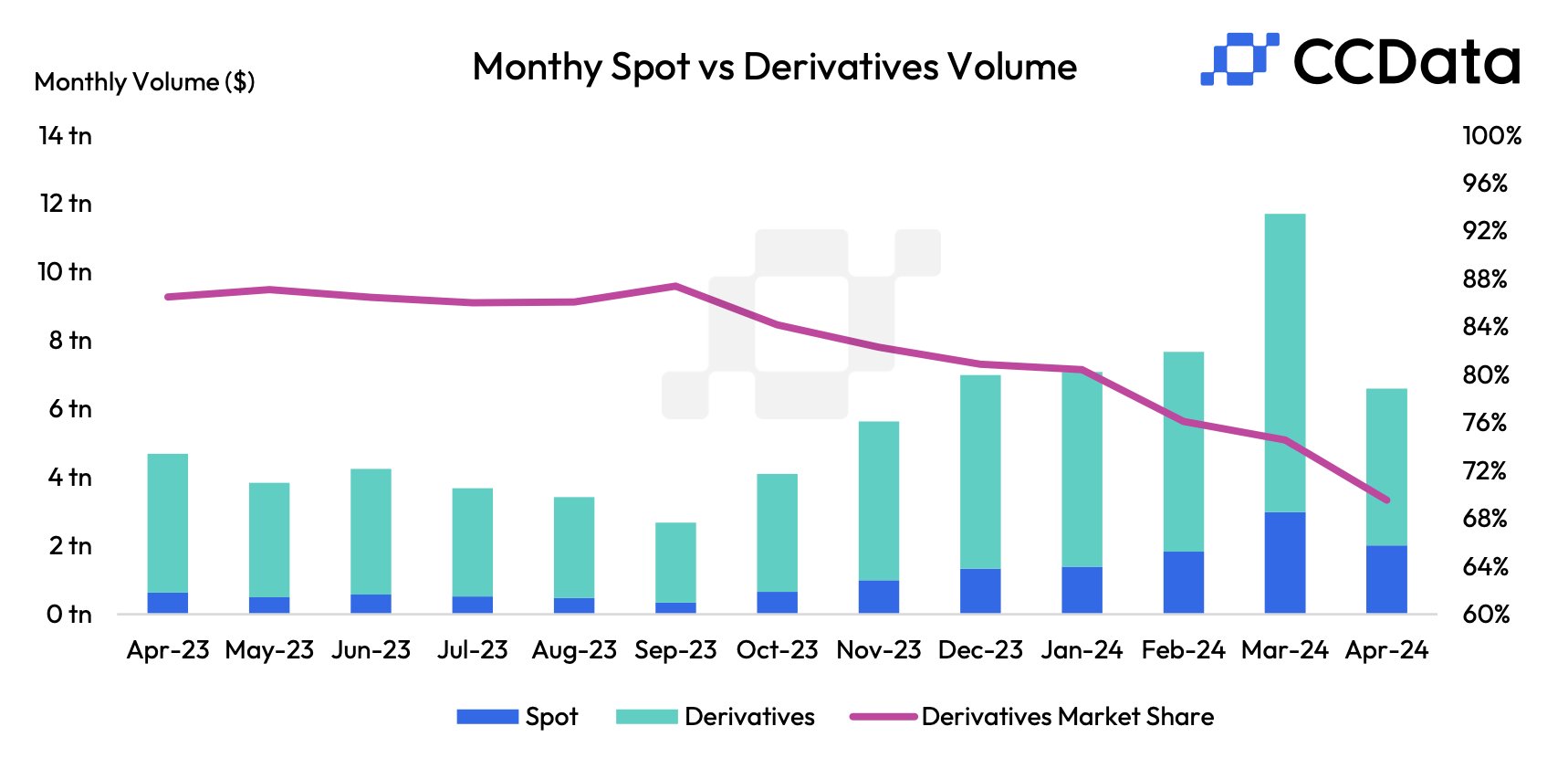
The explosive momentum that defined the first quarter of 2024 for the cryptocurrency market has encountered a significant speed bump. After six consecutive months of aggressive growth, centralized crypto exchanges (CEXs) witnessed a substantial cooling period in April. According to the latest data provided by blockchain analytics firm CCData, the combined trading volume across both spot and derivatives markets on centralized platforms cratered by 43.8%, settling at a total of $6.58 trillion for the month.
This sharp reversal marks a critical juncture for the industry, suggesting that the initial fervor surrounding the Bitcoin spot ETF approvals and the highly anticipated Bitcoin halving may have reached a point of exhaustion, leading to a period of consolidation among global investors.
The Chronology of a Market Shift
To understand the magnitude of the April decline, one must look at the broader trajectory of the crypto market throughout the early months of 2024.
Q1: The Growth Phase
The first three months of the year were characterized by unprecedented institutional interest and retail FOMO (fear of missing out). In February, the market recorded a robust $8 trillion in combined trading volume. This upward trend accelerated rapidly as the market approached the Bitcoin halving, culminating in a record-breaking March that saw volumes swell to approximately $11 trillion. This six-month winning streak was fueled by a confluence of macroeconomic optimism, the maturation of crypto-financial products, and a general bull-market sentiment that saw major assets testing historic price ceilings.
April: The Retracement
April, however, brought a stark shift in market dynamics. As the calendar turned, the "halving hype" began to subside, and market participants moved toward a more cautious posture. The 43.8% drop from March to April represents one of the most significant month-over-month contractions in recent memory. While the $6.58 trillion figure is still objectively high compared to the sluggish performance seen throughout most of 2023, the speed and scale of the decline have caught many market observers off guard.

Supporting Data: A Deep Dive into Exchange Performance
The CCData report provides a granular breakdown of how individual exchanges navigated the turbulent landscape of April. The contraction was not isolated to minor platforms; rather, the "big players" in the industry felt the brunt of the volatility and reduced liquidity.
The Impact on Industry Titans
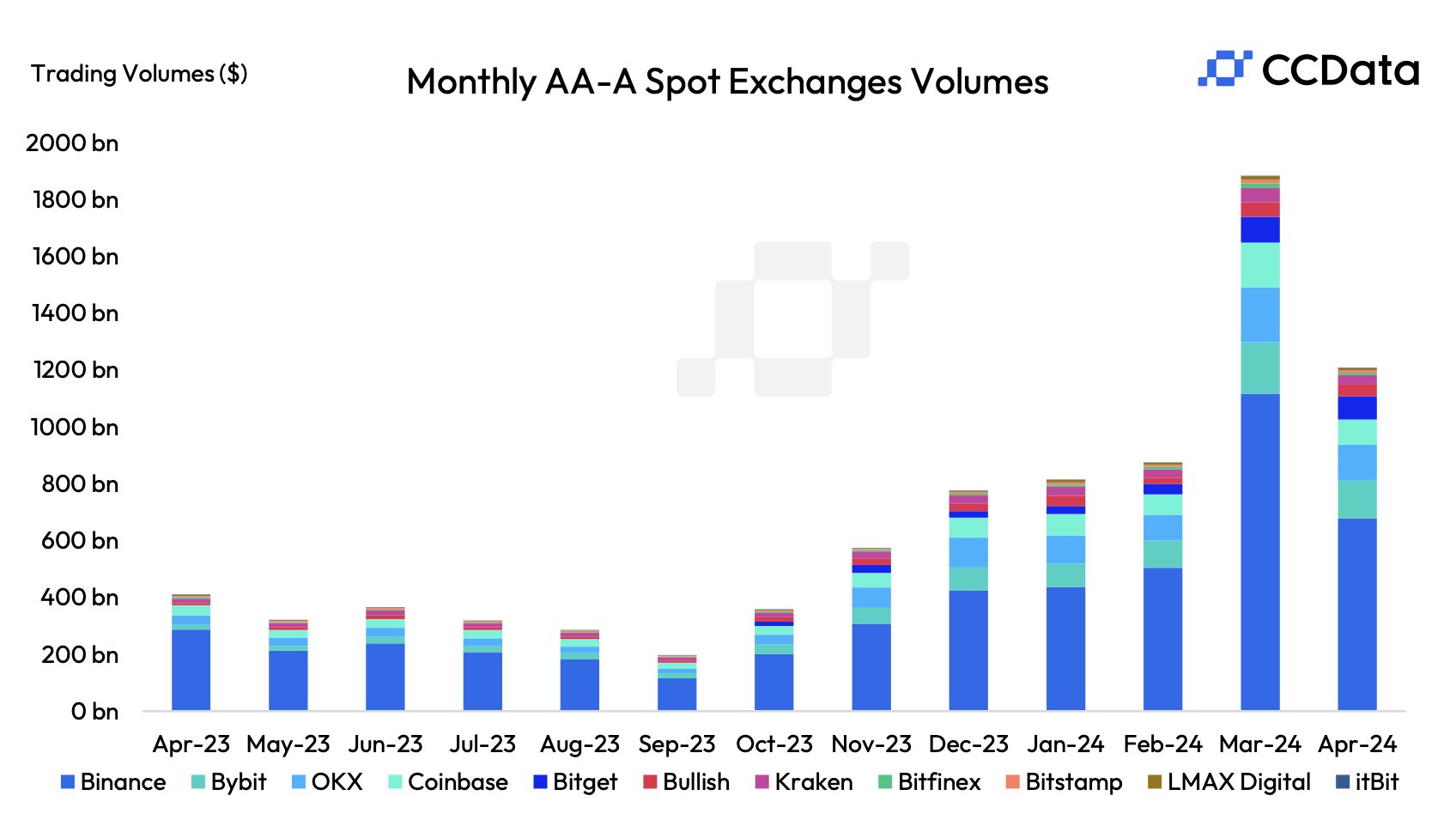
The report highlights that the world’s largest exchanges—Binance, Bybit, and OKX—suffered the most notable volume losses.
- Binance: As the undisputed leader in market share, Binance’s performance acts as a bellwether for the entire ecosystem. In April, the exchange recorded $679 trillion in spot volume, representing a 39.2% decrease. Despite this, it maintained its position as the premier "Top-Tier" exchange by volume.
- Bybit: Ranking second among the top-tier exchanges, Bybit experienced a 26.9% drop in activity, with total volumes reaching $133 billion.
- OKX: Closely following the trend, OKX saw its trading volume contract by 34.8%, tallying $126 billion for the month.
The fact that these specific exchanges—which hold the highest "AA-A" grades for security and transparency—saw such double-digit declines suggests that the slowdown is a systemic trend across high-volume professional trading desks, rather than a failure of any single platform.
Sector-Specific Performance: Where the Capital is Moving
While centralized exchange volumes have contracted, the data reveals that capital has not necessarily exited the market entirely; rather, it has shifted into more specific, high-risk, or high-reward sectors. CCData’s analysis of basket performance returns through May 10th paints a fascinating picture of investor sentiment in the post-April landscape.
Winners and Losers
- Metaverse & Gaming (32.4%): This sector saw the most significant growth, suggesting that investors are increasingly betting on the long-term utility and adoption of blockchain-based gaming and virtual world environments.
- Artificial Intelligence (17.4%): AI-linked crypto assets remain a dominant narrative, continuing to capture capital as investors link the growth of decentralized compute and data networks to the broader global AI revolution.
- Meme Tokens (16.2%): Despite their inherent volatility and lack of fundamental utility, meme coins continue to demonstrate a resilient, if not speculative, appeal, outperforming most infrastructure-based projects.
- Layer-2 Scaling Solutions (-4.2%): Perhaps most tellingly, Layer-2 (L2) solutions, which were the darlings of the market in Q1, saw a decline in value. This shift might indicate that the initial excitement surrounding the Dencun upgrade and other scalability milestones has reached a plateau.
Official Perspectives and Market Implications
While there have been no formal statements from the exchanges regarding the sudden drop in volume, market analysts generally point to three primary drivers for this contraction.
1. Macro-Economic Headwinds
The global economic environment has remained strained, with persistent inflation and high interest rates. When central banks maintain a "higher-for-longer" approach to interest rates, liquidity in speculative markets—including cryptocurrencies—tends to dry up.
2. The "Sell the News" Phenomenon
In financial markets, the "sell the news" effect is a well-documented psychological phenomenon. The Bitcoin halving, which occurred in April, was the most anticipated event of the year. Historically, such events are "priced in" weeks or months ahead of time. Once the event finally occurred, many traders took the opportunity to realize gains, leading to the sharp decline in trading activity.
3. Regulatory Uncertainty
Continued scrutiny from global regulators, particularly the SEC in the United States, remains a constant variable. Exchanges are operating in an environment of extreme caution, which often results in stricter compliance measures, temporary suspension of certain trading pairs, and a general reduction in high-frequency trading activity.
The Future Outlook: What Does This Mean for Investors?
The decline in centralized trading volume is not necessarily a harbinger of a "crypto winter." It is more accurately viewed as a period of "breathtaking" consolidation. The market, which had been running at a fever pitch for six months, needed to reset its valuation models.
Why the Current Level is Significant
It is vital to note that even with the 43.8% drop, April 2024’s total volume remains higher than any single month in 2023, with the sole exception of December. This indicates that the floor for crypto activity has been raised significantly. The industry is operating at a much higher baseline than it was a year ago, which suggests that while retail excitement may have cooled, institutional infrastructure is holding firm.
Strategic Considerations
For investors and traders, this period of lower volume often provides a unique opportunity to evaluate the "signal" from the "noise." As capital moves away from speculative trading and toward sectors with long-term potential like AI and gaming, the market is signaling a shift toward projects that offer genuine utility.
Investors are advised to:
- Diversify: Don’t rely solely on the major exchange volume metrics to gauge market health.
- Prioritize Due Diligence: With the market showing signs of volatility, research into specific project fundamentals (AI, gaming, etc.) is more important than ever.
- Practice Risk Management: The significant decline in volume is a reminder that liquidity can vanish quickly. Ensure that your portfolio is structured to handle periods of lower market participation.
As the industry moves into the latter half of the year, all eyes will be on whether trading volumes begin to recover or if this marks the beginning of a prolonged period of stagnant liquidity. For now, the market is in a "wait and see" mode, recalibrating expectations in the wake of a historic, albeit cooling, spring.
Disclaimer: The analysis provided above is for informational purposes only and does not constitute financial or investment advice. Cryptocurrency investments involve a high degree of risk. Always conduct your own due diligence and consult with a professional financial advisor before making any investment decisions.