The Great Capitulation: Why Bitcoin Miners Are Liquidating at Record Rates in 2026
The Bitcoin mining industry, once characterized by its “HODL” mentality and long-term capital accumulation, is undergoing a painful transformation in the first half of 2026. Caught in a perfect storm of technical efficiency demands and macroeconomic headwinds, approximately 20% of the industry is now operating at a loss. This fiscal desperation has triggered a massive, record-breaking sell-off among publicly traded mining firms, as they scramble to generate the liquidity required to cover operational expenses and debt obligations.
As the industry grapples with the fallout, the divergence between the desperate, liquidity-starved miners and the aggressive, cash-rich corporate treasury buyers has never been more pronounced.
The Economics of Distress: Profits Squeezed to the Bone
The fundamental metric driving this volatility is "Hashprice"—the daily revenue a miner earns per unit of computing power. Since July 2025, this figure has been in a persistent, downward spiral. According to data from Hashrate Index, the hashprice currently hovers around $33 per petahash per second (PH/s) per day.
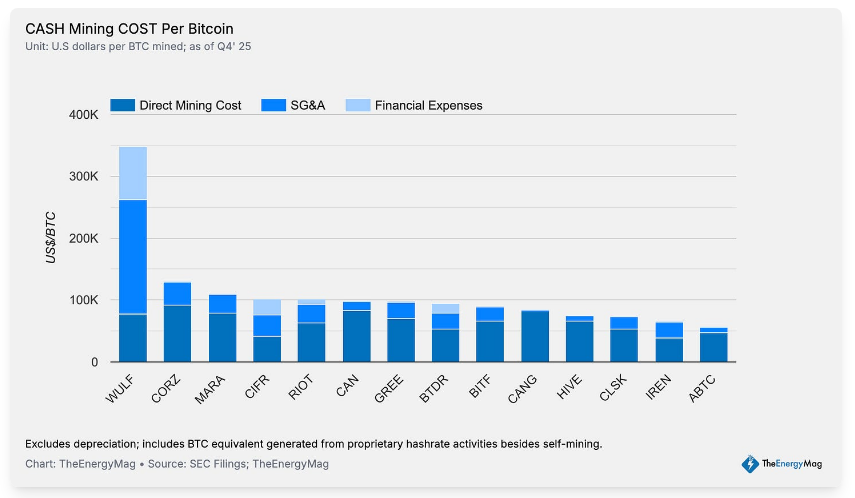
For the average operator, this is a crisis point. The breakeven threshold for many mining facilities—particularly those relying on older generation hardware—is estimated at approximately $35 per PH/s. This $2 gap represents the difference between sustainable growth and insolvency. While it may appear marginal on a balance sheet, for industrial-scale operations consuming gigawatts of electricity, it is a chasm.

The Q1 2026 Liquidity Crunch
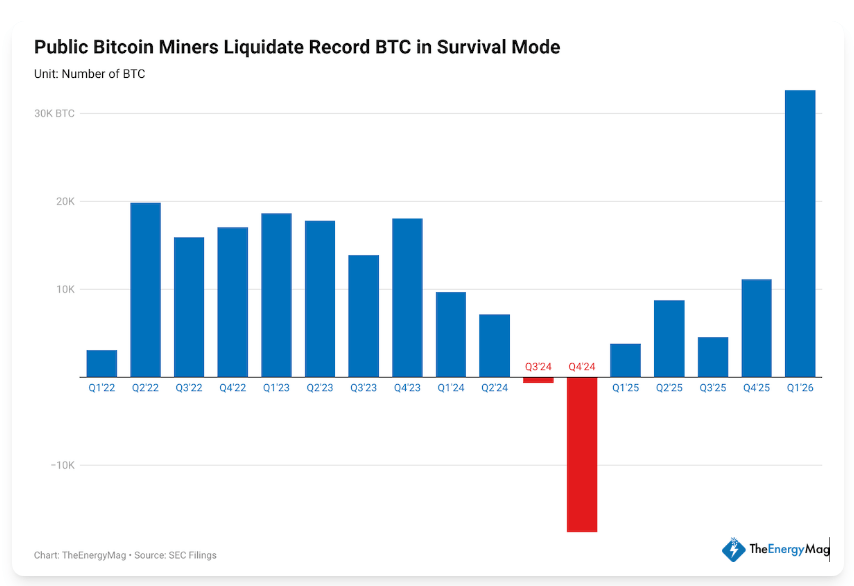
The data regarding the sector’s recent behavior is startling. According to TheEnergyMag, a collective of major publicly traded miners—including industry titans such as MARA, CleanSpark, Riot, Cango, Core Scientific, and Bitdeer—offloaded more than 32,000 BTC in the first three months of 2026 alone.
To understand the severity of this figure, one must look at historical context. This quarterly volume surpasses the total sales these companies executed across all four quarters of 2025 combined. Furthermore, it eclipses the previous quarterly record of 20,000 BTC set in Q2 2022, a period defined by the catastrophic collapse of the Terra-Luna ecosystem and the subsequent contagion that swept through the crypto markets.
A Chronology of Declining Reserves
The current wave of selling is not an isolated event but the culmination of a multi-year trend. Data from CryptoQuant confirms that the aggregate Bitcoin holdings of the mining sector have been steadily depleting since the start of 2023.
- 2023: The Peak of Accumulation. At the close of 2023, the mining industry collectively held approximately 1.86 million BTC. This was a period of optimistic expansion, fueled by low interest rates and the anticipation of the next bull cycle.
- 2024: The Gradual Erosion. As interest rates began to bite and the network difficulty began its climb, the treasury balance started to show signs of strain, dipping slightly as miners began to balance operational costs against their holdings.
- 2025: The Efficiency Trap. The industry faced significant challenges throughout 2025 as the post-halving reality set in, coupled with an unprecedented rise in global hashrate, which made the network more secure but significantly more expensive to compete on.
- 2026: The Liquidation Phase. By the end of Q1 2026, the collective balance dropped to approximately 1.8 million BTC. The aggressive pace of Q1 2026 suggests that the “safety net” of accumulated Bitcoin is being exhausted, forcing miners to rely on spot-market sales to survive.
Compounding Forces: Why the Math No Longer Works
The crisis facing miners is not the result of a single factor, but rather the convergence of three distinct, compounding forces:
- The Hashrate Arms Race: The total network hashrate has reached record highs. As more, increasingly efficient hardware enters the network, the difficulty of mining a single block increases. Smaller, or less capitalized, miners are effectively being priced out of the competition.
- Reduced Block Rewards: The most recent halving event slashed the amount of new Bitcoin entering circulation. While this is a foundational aspect of Bitcoin’s deflationary design, it creates immediate revenue pressure for miners who have not yet upgraded to the most energy-efficient hardware.
- Macroeconomic Headwinds: The broader economic environment has remained persistently challenging. High energy costs, combined with a tightening of credit markets, mean that miners can no longer easily borrow against their Bitcoin holdings to pay for electricity. They are effectively forced to sell their "product" to pay for their "utility."
Official Perspectives and Market Implications
The industry is now bracing for a period of consolidation. CoinShares, in its Q1 2026 Bitcoin Mining Report, issued a stark warning: the "capitulation" is not yet over. The firm noted that high-cost operators should expect continued financial distress throughout the first half of the year.
Unless the price of Bitcoin stages a significant, sustained recovery to bolster the hashprice above the $35 break-even point, we are likely to see a wave of mergers and acquisitions. Weaker, less efficient mining firms will inevitably be absorbed by larger, more vertically integrated players who have access to cheaper electricity and more advanced cooling and computing infrastructure.
The Institutional Shift: Treasury Buyers Step In
While the miners are acting as a net sell-side pressure on the market, the narrative of "Bitcoin accumulation" remains alive elsewhere. Corporate treasury strategies continue to evolve, with entities like Strategy—the largest institutional holder of Bitcoin—continuing their aggressive acquisition streak.
Michael Saylor, whose social media presence has become a bellwether for institutional sentiment, signaled earlier this week that further acquisitions are imminent. By sharing the company’s acquisition history chart, Saylor signaled to investors that the firm views the current market volatility as a "buy the dip" opportunity. This creates a fascinating market dynamic: the miners, forced by physics and economics to sell, are effectively providing the liquidity for corporate giants to increase their long-term stakes.
Conclusion: The Path Forward
The situation in 2026 serves as a reminder that Bitcoin mining is, at its core, a brutal, industrial-scale competition. It is an industry where efficiency is the only currency that matters. The current "Great Capitulation" will ultimately result in a more efficient, hardened, and decentralized network as the least-capable operators exit and their market share is redistributed to more competitive entities.
For the retail investor, the record-breaking sales from miners may create short-term price pressure, but the underlying fundamentals remain unchanged. As mining difficulty continues to adjust and inefficient hardware is decommissioned, the "stronger hands"—those with low-cost energy and efficient hardware—will survive.
The mining sector is currently clearing out its excess baggage. Once the dust settles on the first half of 2026, the industry will likely emerge leaner and more prepared for the next cycle. In the meantime, the market remains a tug-of-war between those who must sell to keep the lights on and those who choose to buy to secure the future.