
The Great Cooling: Centralized Crypto Exchanges Face Steep Declines in Trading Volume
After an explosive six-month period of unprecedented growth, the global cryptocurrency market has hit a significant speed bump. According to the latest data from the prominent blockchain analytics firm CCData, the trading volume across centralized exchanges (CEXs) experienced a sharp contraction in April. This shift marks a notable cooling-off period for the industry, raising questions about market sentiment, investor participation, and the broader macroeconomic factors influencing digital asset liquidity.
Main Facts: A Staggering 43.8% Contraction
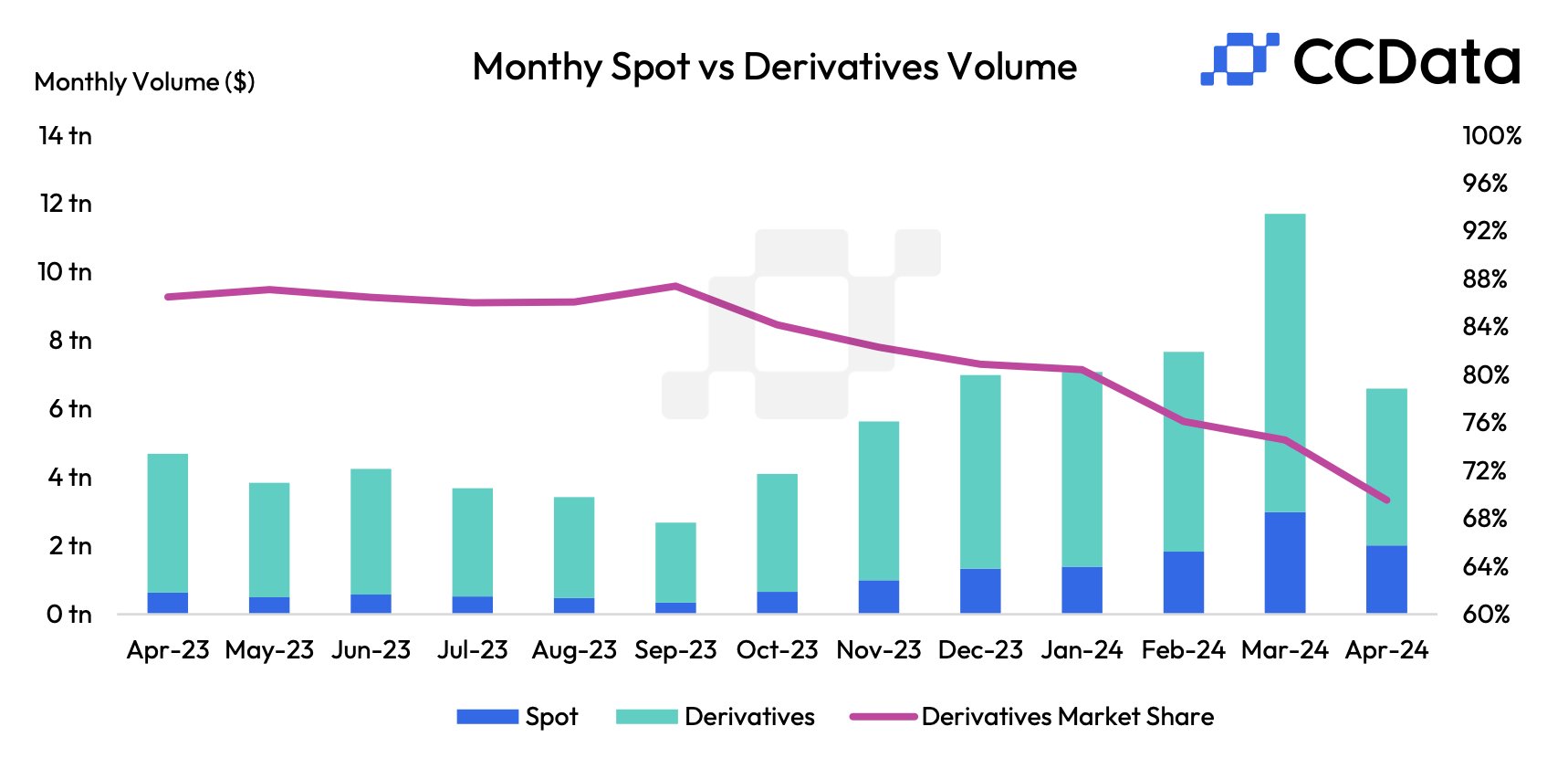
The data released by CCData highlights a dramatic reversal in fortune for centralized platforms. In April, the combined trading volume for spot markets and derivatives across CEXs plummeted by 43.8%, settling at $6.58 trillion. This represents a massive withdrawal of capital activity compared to the preceding months of 2024.
To put this decline into perspective, the crypto market had been on a meteoric ascent throughout the first quarter. In March, the combined volume of spot and derivatives reached an impressive $11 trillion, following an $8 trillion showing in February. The April slump brings the market back to a more tempered state, though analysts are quick to point out that even with this decline, the current volume remains significantly higher than the vast majority of months throughout 2023. Aside from the surge observed in December of last year, the April 2024 figures still represent a robust, albeit scaled-back, level of activity.
Chronology: The Arc of the 2024 Bullish Momentum
To understand the severity of the April decline, one must look at the trajectory of the market since the start of the year.
- January 2024: The market entered the year with renewed optimism, buoyed by the historic approval of spot Bitcoin Exchange-Traded Funds (ETFs) in the United States. Institutional interest began to bleed into retail sentiment, sparking a consistent upward trend in trading volumes.
- February 2024: The momentum accelerated, with trading volumes hitting approximately $8 trillion. This period was characterized by a "risk-on" environment as Bitcoin approached and eventually surpassed its previous all-time highs.
- March 2024: This month proved to be the peak of the recent rally, with volumes reaching a staggering $11 trillion. The market was characterized by intense speculation and high-frequency trading as investors reacted to the upcoming Bitcoin "halving" event and sustained institutional inflows.
- April 2024: The "cooling off" period. Following the frenzied activity of March, April saw a correction in market enthusiasm. This period coincided with a stabilization phase in the price of Bitcoin, leading to a reduction in volatility and, consequently, a sharp drop in trading volume as traders shifted toward a "wait-and-see" approach.
Supporting Data: Impact on Industry Titans
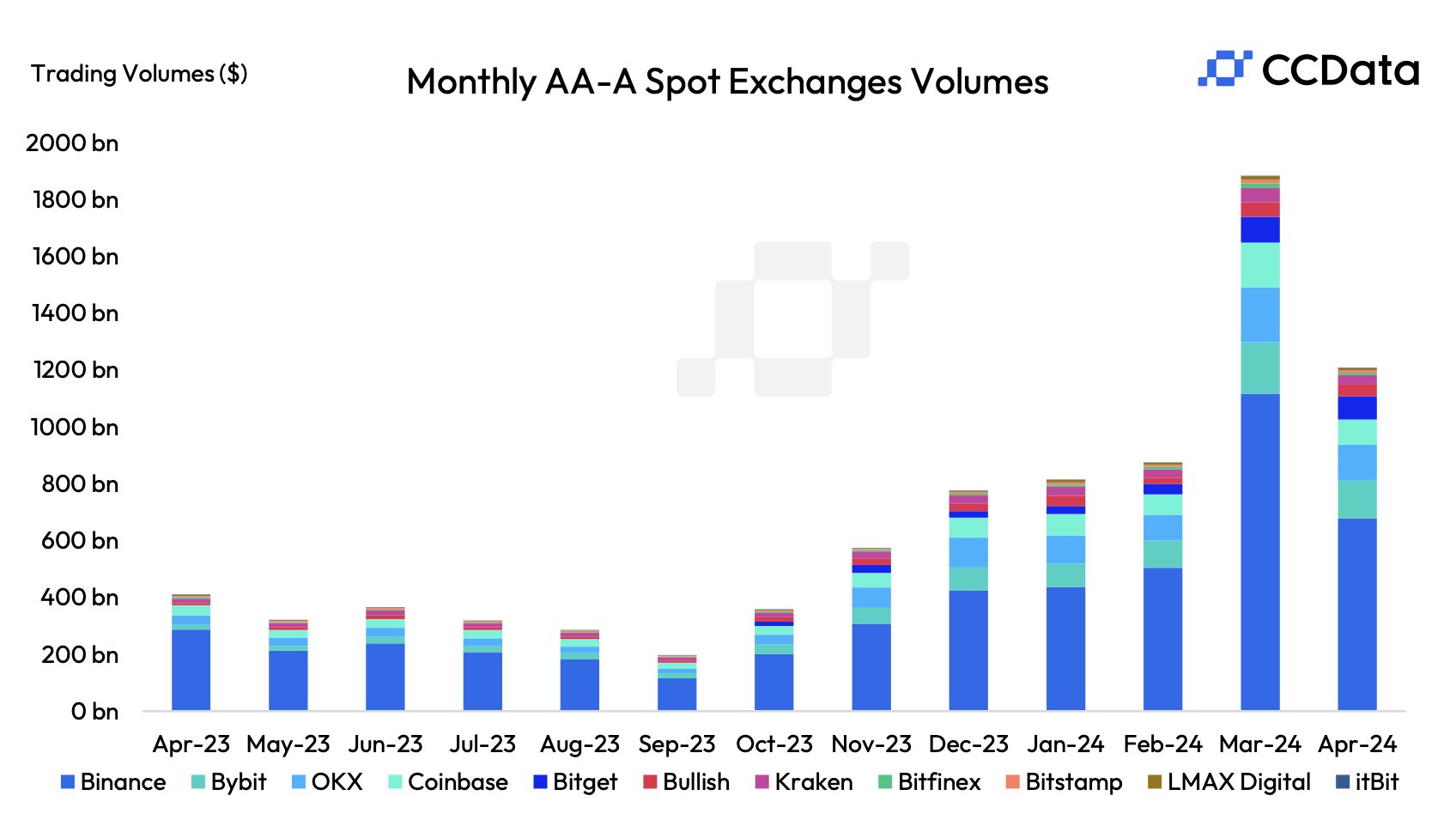
The contraction in volume was not evenly distributed; rather, it hit the largest players in the industry the hardest. CCData’s breakdown of individual exchange performance provides a clear view of how the market’s leading venues fared during this downturn.
Binance
As the world’s largest cryptocurrency exchange by volume, Binance felt the brunt of the market slowdown. The platform reported a spot trading volume of $679 billion, representing a 39.2% decrease. Despite the decline, Binance remains the dominant "Grade A" entity in the spot market, maintaining a significant lead over its competitors.

Bybit and OKX
Other major players, including Bybit and OKX, mirrored this downward trend. Bybit, categorized as a "Grade AA" exchange, saw its volume dip to $133 billion—a 26.9% decline. Meanwhile, OKX, a "Grade A" platform, recorded $126 billion in volume, marking a 34.8% drop.
This widespread reduction across the top-tier exchanges suggests that the decline was not specific to any single platform’s internal issues or regulatory struggles, but rather a macroeconomic shift in market-wide liquidity and retail participation.
Sector-Specific Performance: Divergence in the Crypto Landscape
While exchange volumes fell across the board, the underlying asset classes within the crypto ecosystem showed a fascinating divergence. CCData’s analysis of basket performance returns up to May 10th reveals that while general exchange trading slowed, certain sectors remained highly active.
The Rise of Metaverse and Gaming
Surprisingly, the Metaverse and Gaming sectors led the market with a 32.4% return month-to-date. This suggests that despite the decline in speculative trading on CEXs, there remains a resilient interest in the development and adoption of blockchain-based gaming and virtual worlds.
The Meme Token Frenzy
Meme tokens, which are often highly volatile and driven by social sentiment, maintained their relevance with a 16.2% return. This indicates that while "serious" institutional trading may have slowed, the retail appetite for high-risk, high-reward meme assets remains a constant force in the market.
AI-Driven Assets
Artificial Intelligence continues to be a dominant narrative in both traditional tech and crypto. AI-related tokens saw a 17.4% return, confirming that investors are still aggressively allocating capital to projects that bridge the gap between AI and decentralized infrastructure.
The Laggards: Layer-2 Scaling Solutions
Conversely, Layer-2 scaling solutions struggled, posting a -4.2% return. This decline could be attributed to the successful completion of the Ethereum Dencun upgrade, which lowered gas fees significantly, potentially leading to a temporary saturation or a "sell the news" event for tokens associated with scaling infrastructure.
Implications: What Does This Mean for the Market?
The sharp decline in trading volume serves as a critical indicator for the health of the crypto ecosystem. Several key implications arise from this shift:
1. Market Normalization
The massive volume seen in March was largely fueled by record-breaking speculation surrounding Bitcoin ETFs and the halving. A decline was, in many ways, inevitable as the market sought a more sustainable price discovery phase. The April drop should be viewed as a normalization of market activity rather than a systemic collapse.
2. Institutional vs. Retail Behavior
The fact that top-tier exchanges like Binance and OKX saw such steep declines suggests that high-frequency traders and institutional market makers—who drive the bulk of volume—stepped back from the market. This pause often occurs when major assets enter a period of consolidation.
3. Shift in Focus
The performance of the Metaverse, AI, and Meme sectors suggests that investors are pivoting their capital toward specific narratives. When the broader market liquidity dries up, capital often concentrates in sectors with high retail engagement and strong speculative potential.
4. Regulatory Vigilance
As volumes fall, the scrutiny on exchanges often increases. During periods of lower revenue, exchanges may face pressure to maintain security and compliance standards. It is critical for investors to remain cautious and conduct their own due diligence, as market downturns are historically when vulnerabilities in exchange infrastructure become most apparent.
Conclusion
The 43.8% decline in centralized exchange volume in April 2024 is a significant development, but it must be viewed within the context of a hyper-active first quarter. The industry is currently in a state of consolidation, balancing the massive inflows from the Bitcoin ETF era with a necessary cooling of retail and speculative fervor.
As we move forward, the divergence in sector performance—with AI and gaming leading while scaling solutions lag—highlights that the crypto market is maturing into a multi-faceted ecosystem. Investors should interpret these volume metrics not as a sign of decay, but as a reflection of a market that is transitioning from a period of euphoric speculation to one of strategic sector-specific investment.
Disclaimer: The information provided in this article is for educational and informational purposes only and does not constitute financial, investment, or legal advice. Cryptocurrency investments carry a high level of risk and may not be suitable for all investors. The Daily Hodl is not responsible for any financial losses incurred based on the content provided. Always conduct your own research before engaging with any digital asset or exchange.