
The Mining Paradox: Bitcoin’s Record Difficulty Meets Market Volatility
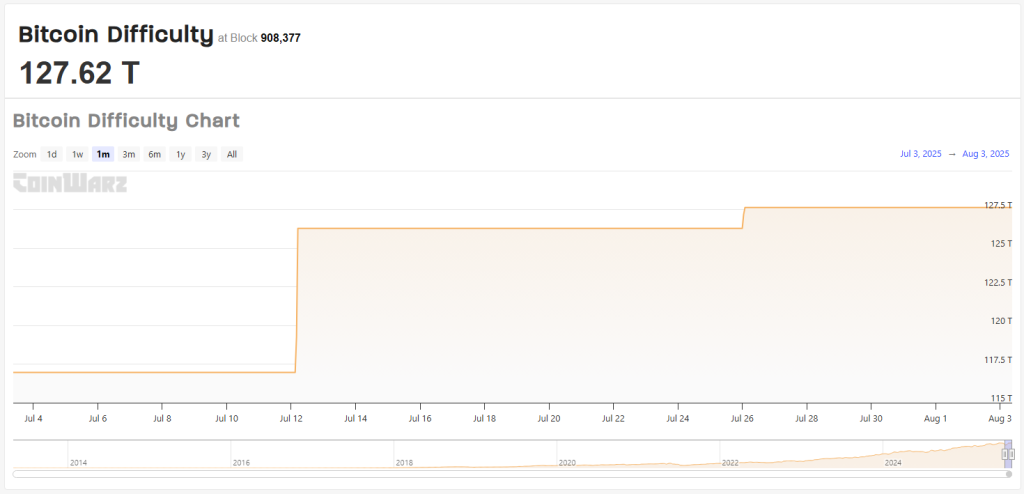
In a striking convergence of technical complexity and market sensitivity, the Bitcoin network reached an unprecedented milestone this week, even as the asset’s price faced significant downward pressure. Data from industry analytics firm CoinWarz confirms that Bitcoin’s mining difficulty has surged to a record-breaking 127.6 trillion, signaling an era of intense competition among the global network of miners. Simultaneously, the flagship cryptocurrency experienced a 3% intraday decline, dipping to a low of $113,005 before exhibiting a modest recovery to $113,250.
This intersection of record-high computational demand and price volatility creates a challenging environment for market participants, raising critical questions about the long-term sustainability of smaller mining operations and the underlying health of the network’s decentralized security model.
Main Facts: A Network at Peak Complexity
At the heart of the Bitcoin protocol is a self-regulating mechanism known as the difficulty adjustment. Designed to ensure that blocks—the containers for transaction data—are generated at a consistent pace of approximately ten minutes, the difficulty scales in response to the aggregate computing power, or "hashrate," contributed by miners globally.
The recent ascent to 127.6 trillion represents the highest level of difficulty in the history of the protocol. This metric serves as a barometer for network security; the higher the difficulty, the more energy and computational investment is required to secure the blockchain. However, this technical security comes at a cost to the industry. When difficulty hits record highs, the "cost per coin" for miners increases, as they must dedicate more electricity and more advanced hardware to solve the cryptographic puzzles required to validate blocks.
Despite this technical peak, the price of Bitcoin has not kept pace with the rising cost of production. The 3% dip observed this week serves as a stark reminder that while the network is becoming more robust, the market environment remains highly susceptible to macroeconomic shifts and investor sentiment.
Chronology: The Road to the 127 Trillion Mark
To understand the current state of the network, one must look at the recent trajectory of mining activity. In June, the network experienced a period of relative relief, with difficulty sliding to a low of 117 trillion. This dip was largely attributed to a temporary exodus of less efficient hardware from the network as miners recalibrated their strategies in response to fluctuating market conditions.
However, July signaled a shift in the trend. As institutional interest persisted and mining firms continued to deploy next-generation ASIC (Application-Specific Integrated Circuit) rigs, the hashrate began a steady climb. By late July, the momentum had shifted, leading directly to the record-breaking figures observed this week.

Looking ahead, analysts project a slight correction. Estimates suggest that on August 9, the protocol will execute its routine adjustment, which occurs every 2,016 blocks—roughly every two weeks. Current projections indicate a 3% decrease in difficulty, bringing the metric down to approximately 124 trillion. This "breathing room" is a natural feature of the system, intended to correct for minor deviations in block times, which have recently been averaging 10 minutes and 20 seconds—a slight lag behind the protocol’s ideal target.
Supporting Data and Technical Context
The relationship between price, hashrate, and difficulty is the engine that drives Bitcoin’s economic model. The data provided by platforms like CoinWarz and TradingView illustrate a feedback loop that is currently being tested.
- The Hashrate Correlation: The hashrate is essentially the aggregate measure of the world’s mining power. When the price of Bitcoin is high, miners are incentivized to invest in more powerful machines, driving the hashrate up and consequently increasing difficulty.
- The 2,016-Block Cycle: The periodic adjustment ensures that even if miners suddenly leave the network or millions of new machines are added, the time it takes to produce a block remains stable. This stability is critical for the predictability of the Bitcoin monetary supply.
- The Cost of Entry: As of mid-2025, the barrier to entry for solo miners has essentially vanished. The current difficulty level requires industrial-scale operations equipped with cooling infrastructure and access to low-cost electricity to maintain profitability.
The recent price swing—dropping to $113,005 before rebounding—highlights the vulnerability of this ecosystem. When the price of Bitcoin drops, the revenue (in fiat terms) for miners decreases, while the cost to mine remains high due to the current difficulty peak. This creates a "profitability squeeze" that forces inefficient miners to capitulate, essentially selling off their BTC to cover operational costs or switching off their rigs entirely.
Industry Perspectives: The Mining Squeeze
The current climate has drawn significant attention from industry analysts and mining executives. The general consensus is that the industry is undergoing a "survival of the fittest" phase.
"When you have record-high difficulty paired with a stagnant or falling price, the marginal cost of production quickly eclipses the market price for many smaller players," says one independent market analyst. "This isn’t necessarily bad for the network—in fact, it ensures that only the most efficient, well-capitalized firms survive—but it does centralize the mining landscape toward those with the best access to energy."
Reports from major mining operations suggest that firms are increasingly focusing on "hashrate efficiency." Rather than just adding more machines, companies are pivoting toward upgrading to more energy-efficient models that can deliver higher yields per watt of electricity consumed. For the average observer, this signifies that Bitcoin mining is transitioning from a speculative endeavor into a highly sophisticated, capital-intensive infrastructure play.
The anticipated 3% drop in difficulty on August 9 is viewed as a minor reprieve. While it will technically make it easier for marginal players to remain operational, it is unlikely to change the broader market trajectory. The consensus among institutional observers is that miners will continue to face thin margins until the next major upward move in Bitcoin’s market valuation occurs.
Implications for the Future
The current situation carries several long-term implications for the Bitcoin ecosystem:
1. Network Security and Decentralization
While the record difficulty makes the network more secure than ever against potential 51% attacks, the increasing barrier to entry could lead to concerns regarding geographic and corporate centralization. If mining becomes an activity that only massive, publicly traded corporations can afford, the decentralized nature of the network could be tested.
2. Market Sentiment and Price Volatility
The symbiotic relationship between price and mining difficulty suggests that we may see further short-term volatility. If a large number of miners are forced to power down, the resulting drop in hashrate could lead to a temporary slowdown in transaction processing, which—while corrected by the protocol—often triggers speculative selling in the wider market.
3. The Energy Transition
As mining firms come under pressure, the demand for sustainable and cheap energy becomes the primary competitive advantage. Expect to see an increase in mining operations co-locating with renewable energy projects, such as hydroelectric dams or solar farms, as a means of insulating themselves from the volatile costs of traditional energy markets.
4. Long-term Stability
Despite the current "squeeze," the protocol’s ability to self-correct remains its strongest feature. The fact that the network can handle a record-breaking load of 127.6 trillion in difficulty while still processing transactions with only a 20-second deviation from the target time is a testament to the robustness of Satoshi Nakamoto’s original design.
Conclusion
The latest data from the Bitcoin network paints a picture of a resilient, self-correcting system operating under immense pressure. As the mining industry navigates this record-high difficulty, the market remains in a state of watchful waiting. While the immediate outlook involves thin margins and potential consolidation for miners, the fundamental mechanics of the protocol continue to function exactly as intended.
For investors and enthusiasts alike, the current landscape serves as a reminder that Bitcoin is not just a digital asset, but a complex, global computational machine. The fluctuations in price and the shifts in mining difficulty are not signs of weakness, but rather the visible symptoms of a system continuously optimizing itself for the future. As we look toward the next difficulty adjustment on August 9, the global mining community will be watching closely to see if the market provides the relief needed to sustain the current pace of innovation.