The Gaming Frontier: Andreessen Horowitz Identifies Web3 Gaming as the Catalyst for Mass Crypto Adoption
In the rapidly shifting landscape of decentralized technology, venture capital giant Andreessen Horowitz (a16z) has positioned itself as a leading voice in articulating the next phase of digital asset evolution. In its comprehensive 2023 "State of Crypto" report, the firm’s dedicated crypto division, a16zcrypto, suggests that the key to unlocking mainstream adoption does not lie in complex financial instruments or abstract decentralized governance, but in the immersive, high-engagement world of Web3 gaming.
As the industry navigates the "crypto winter" and looks toward long-term sustainability, a16z argues that the convergence of play-to-own mechanics and blockchain infrastructure creates a unique bridge for billions of traditional gamers to enter the digital asset ecosystem.
Main Facts: The Web3 Gaming Thesis
The core thesis presented by a16z is that Web3 gaming acts as the ultimate "on-ramp" for the next generation of crypto users. Unlike DeFi, which often presents a steep learning curve regarding liquidity pools, staking, and impermanent loss, gaming provides an intuitive entry point.
The report underscores that Web3 games are not merely digital pastimes but sophisticated economic engines. By utilizing NFTs (Non-Fungible Tokens) to grant players true ownership of in-game assets—such as skins, weapons, or virtual land—developers are transforming the traditional "walled garden" model of gaming into open, interoperable economies. A16z posits that this shift fundamentally alters the power dynamic between developers and players, fostering a community-driven ecosystem where users are incentivized to participate, contribute, and trade.
Chronology: From Niche Experiments to Mainstream Ambition
The evolution of Web3 gaming has been rapid, moving from simplistic experiments to high-fidelity experiences over the last few years.
- 2017–2019 (The Genesis): The space began with early experiments like CryptoKitties, which demonstrated the viability of NFT-based digital collectibles on the Ethereum blockchain. These initial projects were largely speculative and lacked deep gameplay loops.
- 2020–2021 (The "Play-to-Earn" Boom): The emergence of projects like Axie Infinity brought the concept of "Play-to-Earn" (P2E) into the mainstream. While it proved that gamers could derive economic value from their time, it also highlighted the sustainability challenges of token-based models.
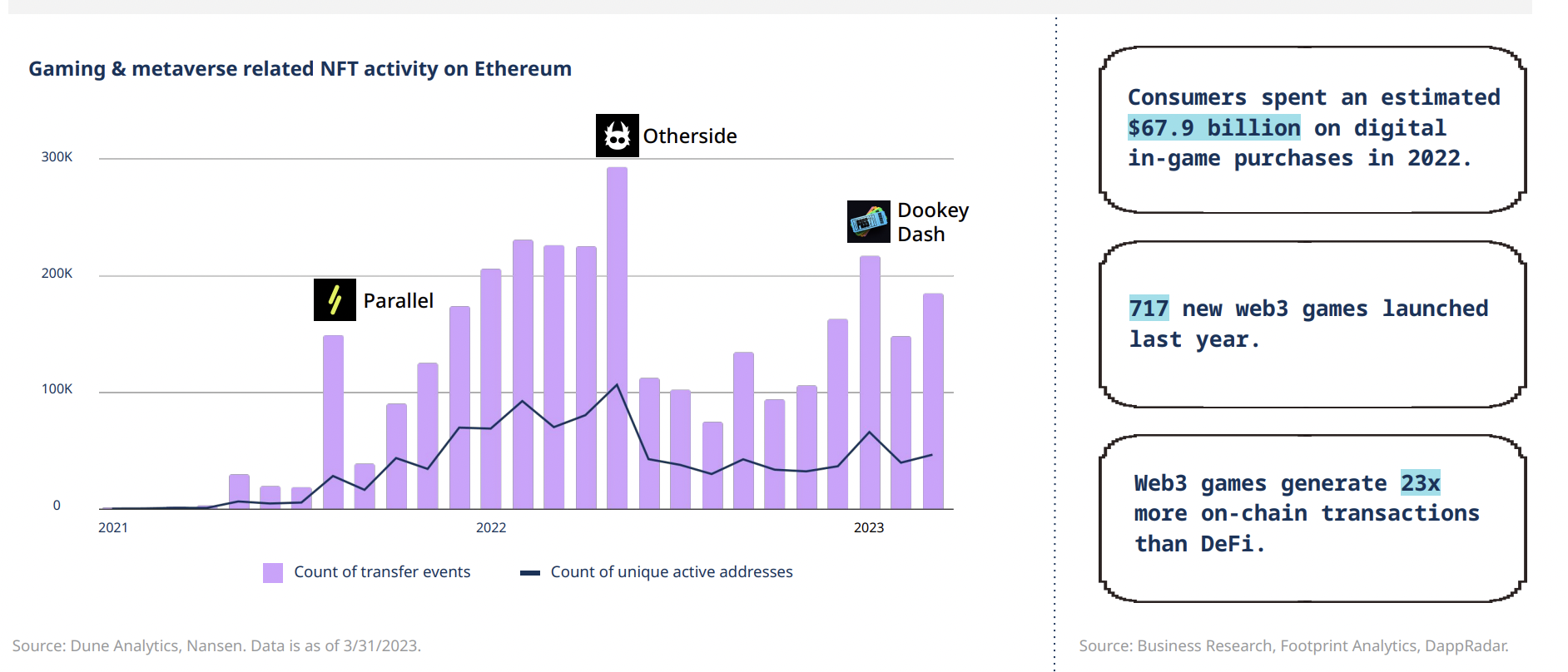
- 2022 (The Professionalization Phase): The industry saw a massive shift toward "Play-and-Own" models. Developers moved away from prioritizing financial yield and toward building high-quality, "fun-first" games. 2022 saw the launch of 717 new Web3 titles, signaling a shift in developer capital toward long-term engagement rather than short-term token extraction.
- 2023–Present (The Infrastructure Era): The current phase is focused on scalability. With the launch of Layer-2 scaling solutions and improved gaming SDKs, the industry is preparing for a wave of high-fidelity games designed to compete with traditional AAA titles.
Supporting Data: Why Gaming Outperforms DeFi
A16z’s report provides compelling metrics to support the assertion that gaming is the primary driver of on-chain activity. Perhaps the most striking statistic is that Web3 games currently generate 23 times more on-chain transactions than Decentralized Finance (DeFi) protocols.
This disparity highlights a crucial trend: while DeFi is critical for the "plumbing" of the crypto economy, gaming is the "front-end" that actually drives daily active usage.

Furthermore, the scale of the traditional gaming market serves as the ultimate justification for this focus. In 2022 alone, consumers spent an estimated $67.9 billion on digital in-game purchases. These transactions are currently trapped within centralized platforms like Steam, PlayStation, or Xbox. By converting even a fraction of this spend into Web3-native assets, the crypto industry stands to capture a massive segment of the global entertainment economy.
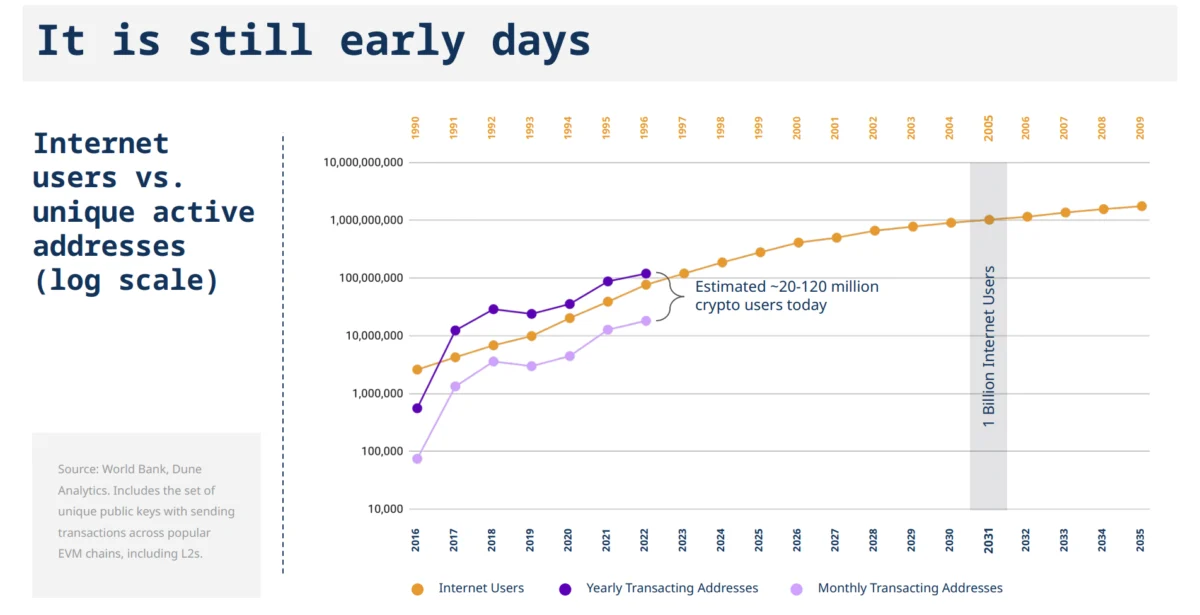
The report also offers a historical parallel, comparing the growth trajectory of crypto to the adoption of the internet in the 1990s. While current metrics show approximately 20 million monthly transacting addresses and 120 million yearly transacting addresses, a16z suggests that we are at an inflection point similar to 1996, when the internet had roughly 100 million users. If the growth patterns of the internet hold true for blockchain, the next decade could see an exponential surge in user counts as infrastructure matures.
Official Responses and Strategic Outlook
Representatives from a16zcrypto have maintained that the "State of Crypto" report is intended to cut through the noise of market volatility. By focusing on developer activity, transaction volume, and user growth, the firm aims to highlight that the underlying "computer science" of blockchain remains robust.
In discussions surrounding the report, analysts have noted that a16z is not just an observer but a major participant in this trend. The firm has invested heavily in studios building the next generation of games that utilize blockchain not as a gimmick, but as a layer of trust and provenance for digital items.
"We are moving from the era of ‘speculation’ to the era of ‘utility,’" one analyst remarked. "The official stance from top-tier VCs is that the games that survive will be those that prioritize fun, social connectivity, and a seamless wallet experience—where the user doesn’t even realize they are interacting with a blockchain."
Implications: A Paradigm Shift for Digital Economies
The implications of this transition are profound, both for the gaming industry and the broader crypto ecosystem.
1. The Death of the "Walled Garden"
For decades, the gaming industry has relied on centralized servers where players spend thousands of dollars on items they do not technically own. If a game’s servers shut down, the investment vanishes. Web3 gaming forces a paradigm shift: assets become portable, tradeable, and permanent. This creates secondary markets that benefit both the player and the developer.
2. Regulatory Clarity
By moving toward gaming, the industry may find a more favorable regulatory landscape. Unlike DeFi, which faces constant scrutiny over its role in finance and banking, Web3 gaming is framed primarily as an entertainment product. This distinction could provide a buffer, allowing developers to iterate on tokenomics without immediately triggering the same level of concern from regulators like the SEC.
3. Sustainable User Acquisition
The report suggests that "gamers" are the perfect demographic for crypto. They are already comfortable with digital currencies (in-game gold, gems, V-bucks), digital asset ownership, and online community participation. Transitioning them to crypto-wallets is a matter of UI/UX improvement rather than a change in consumer behavior.
4. The Future of the Metaverse
While the term "metaverse" has faced skepticism, the growth in Web3 gaming is essentially the early-stage construction of the metaverse. By creating digital worlds where assets are interoperable, the industry is building the infrastructure for a persistent, shared digital reality.
Conclusion: The Road Ahead
Andreessen Horowitz’s "State of Crypto" report serves as a roadmap for an industry currently in a state of maturation. By identifying Web3 gaming as the primary engine for adoption, the firm is signaling that the era of "finance-first" crypto is waning, to be replaced by an era of "utility-first" applications.
As developers continue to launch high-quality games and infrastructure becomes more invisible to the end-user, the barrier to entry for the next 100 million crypto users will continue to drop. The transition from the 1990s-style "early adopter" phase to the "mass adoption" phase appears, according to a16z, to be paved with game controllers rather than trading terminals.
Investors and enthusiasts alike are now watching to see which studios and protocols will define this new frontier. If history is any guide, the winners will be those who manage to hide the complexity of the blockchain behind the sheer joy of the game, proving that the most successful technological revolutions are often the ones that feel like fun.
Disclaimer: This report is for informational purposes only and does not constitute investment advice. The cryptocurrency market is highly volatile and carries significant risk. Investors are encouraged to conduct their own due diligence and consult with a financial professional before committing capital to digital assets. The views expressed by third-party reports, including those from Andreessen Horowitz, do not necessarily reflect the official stance of this publication.