
The Bitcoin Mining Crucible: Record Difficulty and the Approaching Halving Storm
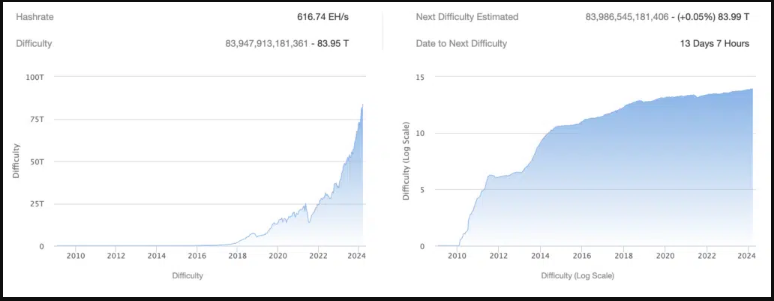
The global digital asset landscape is currently undergoing a period of intense structural transformation. As Bitcoin continues to command the attention of institutional investors and retail traders alike, the underlying architecture of the network is responding to unprecedented levels of competitive pressure. On March 14, 2024, the Bitcoin network reached a significant technological milestone, with mining difficulty soaring to a record-breaking 84 trillion hashes. This surge, while a testament to the robust security of the network, arrives at a critical juncture: the countdown to the quadrennial Bitcoin halving, scheduled for April 2024.
Main Facts: The Scaling Network
The data provided by BTC.com paints a picture of a network operating at peak capacity. Since the previous difficulty adjustment, the network has seen an upward shift of approximately 5.80%. This metric, which recalibrates roughly every two weeks, is the network’s way of maintaining the equilibrium of block production—ensuring that, regardless of the amount of computational power deployed, new blocks are mined at an average cadence of ten minutes.
Concurrent with this difficulty spike is the rise of the Bitcoin hashrate, which has reached a staggering 617 EH/s (exahashes per second). This indicates a massive influx of computational resources, as professional mining firms and individual operators alike race to secure their share of the network rewards. This surge in participation is inextricably linked to the price action of Bitcoin, which, on the same day the difficulty record was set, climbed to a historic peak of $73,800.
Chronology: The Road to the 2024 Difficulty Record
To understand the significance of this moment, one must look at the trajectory of the network throughout early 2024:

- Early January: The approval of spot Bitcoin ETFs in the United States triggered a wave of institutional liquidity, creating a bullish sentiment that began to draw more capital into mining infrastructure.
- February: Mining firms, anticipating the halving, began upgrading their fleets to more efficient hardware, such as the Antminer S21 series, leading to a steady, consistent climb in hashrate.
- Early March: As Bitcoin’s price began to flirt with its previous all-time highs, mining profitability surged, causing a feedback loop: higher prices encouraged more mining, which increased the hashrate, ultimately leading to the mid-March difficulty adjustment.
- March 14, 2024: The network hit the 84-trillion-hash difficulty threshold, marking the most challenging environment for Bitcoin miners in the asset’s fifteen-year history.
Supporting Data: The Economics of Hashrate
The relationship between price and mining difficulty is essentially a function of economic viability. When the price of Bitcoin rises, the "hashprice"—a term used to describe the expected revenue per unit of hashrate—increases.
According to recent reports, daily mining rewards have climbed to nearly $79 million. This figure represents the sum of the fixed block reward (currently 6.25 BTC per block) and transaction fees. For a brief window, this windfall allowed even older, less efficient hardware to operate profitably. However, the 84-trillion-hash difficulty level acts as a natural filter. It effectively prices out participants with higher electricity costs or outdated, inefficient machines, forcing a consolidation of the mining industry. This consolidation is not necessarily a negative for the network; it creates a more professionalized, resilient, and energy-efficient mining ecosystem over time.
The Halving Effect: Scarcity as a Catalyst
The upcoming halving is not merely a technical event; it is the fundamental economic "heartbeat" of the Bitcoin protocol. Every 210,000 blocks—roughly every four years—the reward given to miners for validating transactions is reduced by 50%. In April 2024, this reward will drop from 6.25 BTC to 3.125 BTC per block.
This mechanism is the core of Bitcoin’s deflationary monetary policy. By artificially capping the supply of new coins entering the market, Satoshi Nakamoto ensured that Bitcoin would function as a digital store of value. Historically, this event has served as a supply-side shock. If the demand remains constant or increases—driven by the aforementioned ETFs and institutional adoption—the reduction in the supply of newly minted Bitcoin is widely theorized to exert upward pressure on the asset’s price.

However, this creates a "miners’ dilemma." While the price appreciation might compensate for the reduced block reward, the doubling of the relative difficulty, combined with the halving of revenue, means that only the most efficient miners will survive the post-halving landscape.
Implications: The Long-Term Sustainability Debate
The record-breaking difficulty of the Bitcoin network has sparked a wider conversation about the viability of Proof-of-Work (PoW).
1. The Energy Consumption Question
Critics frequently point to the immense energy requirements of the Bitcoin network as a primary concern. As the difficulty climbs, the total electricity demand rises in lockstep. While proponents argue that this energy is increasingly sourced from stranded renewable energy or methane-capture projects, the environmental optics remain a significant hurdle for widespread ESG-compliant institutional investment.
2. Market Centralization
There is a growing concern that the combination of high difficulty and the looming halving will lead to further centralization of mining power. If only large, publicly traded mining corporations can afford the latest hardware and lowest electricity rates, does this compromise the decentralized nature of the network? While the distribution of hashrate remains geographically diverse, the trend suggests a move toward industrial-scale operations rather than the hobbyist setups of the early 2010s.
3. The Future of Transaction Fees
As block rewards continue to diminish through subsequent halvings, the long-term security of the network will eventually rely heavily on transaction fees. If the network becomes too expensive to use, transaction volume could drop. Conversely, if the network experiences high demand (as seen with the rise of Ordinals and Layer-2 scaling solutions), transaction fees could replace the block reward as the primary incentive for miners, ensuring the network’s security without requiring an infinite supply of new BTC.
Conclusion: A Network in Flux
The events of March 2024 represent a watershed moment for Bitcoin. The record-high mining difficulty is not just a statistic; it is a manifestation of the network’s immense strength and the high stakes involved in its operation. As the industry approaches the April halving, the ecosystem is preparing for a "great shakeout."
The miners who survive this period will likely be those who have optimized their operations for maximum efficiency and secured the lowest energy costs. Meanwhile, the broader market will be watching to see if the historical pattern of post-halving price appreciation holds true in an era of unprecedented institutional involvement.
Ultimately, Bitcoin continues to prove its resilience. By navigating these cycles of difficulty, supply constraints, and market volatility, the network reaffirms its position not just as a speculative asset, but as a robust, immutable, and globally distributed monetary system. As we move closer to the halving, the focus remains on the balance between technological security, economic sustainability, and the relentless pursuit of decentralization.