
Crypto Adoption Set to Explode: Raoul Pal Predicts 4 Billion Users by 2030, Surpassing Early Internet Growth
Main Facts: The Roadmap to Mass Global Adoption
Cryptocurrency adoption is currently tracking on an aggressive upward trajectory that could see Bitcoin and the broader digital asset ecosystem onboard more than one billion users by the end of 2025. According to macro-guru and Real Vision CEO Raoul Pal, historical data models comparing early internet adoption with the explosive growth of blockchain technology indicate that the world is well on its way to achieving a staggering milestone: four billion crypto users—representing roughly half of the global population—by the year 2030.
Pal, a former Goldman Sachs executive turned prominent crypto strategist, recently updated his long-term macroeconomic thesis in a video presentation. His findings suggest that the digital asset class is not merely surviving cyclical bear markets, but is actually outperforming the foundational growth rates of the internet during its formative years in the mid-to-late 1990s.
Key takeaways from Pal’s projections include:
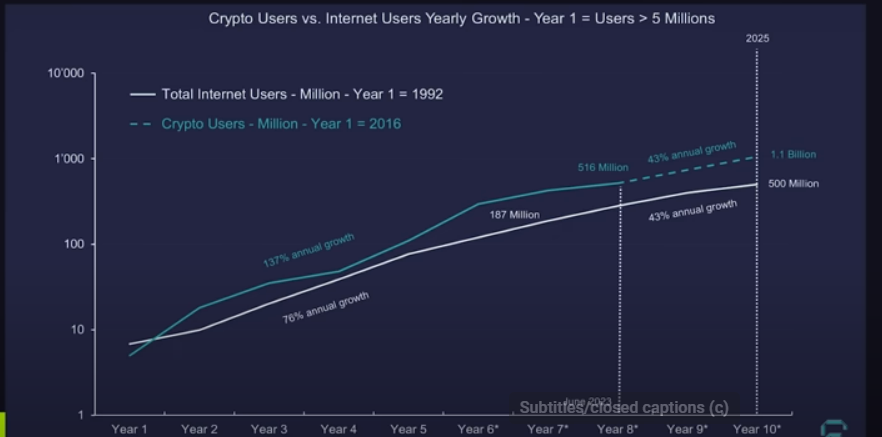
- Current Standing: The cryptocurrency market currently boasts approximately 516 million users globally.
- Near-Term Milestone: By the close of 2025, user adoption is projected to surpass the 1.1 billion mark.
- Long-Term Target: Utilizing a conservative growth-decay model aligned with the internet’s historical maturation, crypto is positioned to reach 4 billion users by 2030.
- Comparative Velocity: While the internet grew at an impressive compound annual growth rate (CAGR) of 76% during its initial rapid-expansion phase, crypto has maintained an astonishing 137% annual growth rate since hitting its one-million-user milestone in 2016.
Chronology: How Crypto Outpaced the Information Superhighway
To understand the weight of Pal’s predictions, it is essential to examine the chronological timeline of how technology adoption models are built and evaluated.
2016: The Baseline Inflection Point
In technology forecasting, measuring user growth requires a standardized starting line. For the internet, this baseline was established when global connectivity began scaling beyond academic and military institutions into commercial households. For cryptocurrency, Pal’s model anchors its timeline in 2016—the year the digital asset ecosystem reliably crossed the threshold of one million active users worldwide. At this stage, Bitcoin was recovering from its early infancy, Ethereum had recently launched its mainnet, and blockchain technology was beginning to capture the imagination of developers globally.
2016–2021: The First Five Years of Exponential Scaling
During its first five years of tracked mass adoption (2016 to 2021), the crypto market experienced parabolic waves of retail and institutional interest. Driven by the 2017 ICO (Initial Coin Offering) boom and the subsequent 2020–2021 DeFi (Decentralized Finance) and NFT (Non-Fungible Token) summers, the asset class expanded at a rate that left traditional technology metrics in the dust.
Pal notes that at a comparable stage in its lifecycle, the internet had amassed roughly 187 million users. In stark contrast, cryptocurrency reached over 500 million users during a similar duration of early-stage scaling, fueled by borderless digital networks, frictionless smartphone onboarding, and global macroeconomic uncertainty.
2021–Present: The Maturation and Retracement Phase
Following the 2021 bull market peak, the crypto industry weathered a brutal multi-year crypto winter characterized by macroeconomic tightening, regulatory crackdowns, and high-profile industry bankruptcies. Yet, despite these headwinds, underlying user metrics, wallet creations, and layer-2 scaling activities continued to climb. Pal’s tracking charts—which he has publicly maintained and tested for the past five years—demonstrate that user acquisition did not suffer structural impairment during the bear market; rather, it continued to respect the macro adoption curve.
Supporting Data: Crunching the Numbers Behind the Metcalfe Curve
Pal’s bullish thesis is not built on pure speculation, but rather on quantitative comparative analysis. By overlaying the S-curve of internet adoption onto crypto’s historical data, analysts can project future milestones with a degree of mathematical consistency.

Comparing Internet vs. Crypto Growth Rates
The internet is historically celebrated as the fastest-adopting technology in human history. During its explosive growth phase, the internet expanded at an average rate of 76% per year. After reaching year eight of its hyper-growth cycle, that rate naturally decelerated to roughly 43% annually as market saturation approached.
Cryptocurrency, however, has obliterated those benchmarks. According to Pal’s data:
- Crypto’s Annual Growth Rate: 137% per year since 2016.
- Current User Base: 516 million users.
- Historical Benchmark: The internet sat at just 187 million users at an equivalent developmental milestone.
The Deceleration Factor (Modelling Conservatism)
Even the most optimistic analysts recognize that an annual growth rate of 137% is mathematically unsustainable forever, as it would theoretically consume the entire population of the planet within a few short years. To account for this, Pal’s model introduces a conservative dampening factor.
By assuming that crypto’s growth rate will inevitably slow down to match the exact trajectory and maturation curve of the early internet, the model projects the following milestones:
- End of 2025: 1.1 billion users.
- 2030: 4 billion users (representing approximately 50% of the projected global population).
"Will this be perfect?" Pal asked rhetorically in his video update. "It’s been pretty perfect so far, and I’ve been showing this chart for five years now. But let’s assume not. Either way, these numbers are simply staggering."
Official Responses and Industry Perspectives
Raoul Pal’s macro projections have struck a chord across the digital asset industry, prompting reactions from economists, fintech founders, and institutional market analysts who are evaluating what a billion-plus user base means for global finance.
Institutional Validation
Traditional financial institutions have increasingly shifted their tone from skepticism to active integration. The approval and subsequent multi-billion-dollar inflows into Spot Bitcoin Exchange-Traded Funds (ETFs) in the United States throughout 2024 served as a watershed moment. Major asset managers like BlackRock and Fidelity have echoed sentiments that digital assets are transitioning from a speculative niche asset class into a recognized macroeconomic store of value.
Fintech and Consumer Onboarding
Industry leaders point to the evolution of user experience (UX) as the primary catalyst enabling this projected surge to 1.1 billion users by 2025. In crypto’s early days, interacting with blockchains required technical proficiency, command-line interfaces, and complex seed-phrase management.
Today, decentralized applications (dApps) are increasingly abstracted behind sleek, mobile-first fintech applications, social logins, and account abstraction technologies. Payment giants like Visa, Mastercard, PayPal, and Stripe have all rolled out stablecoin settlement capabilities or crypto-linked debit cards, effectively bridging the gap between traditional fiat rails and decentralized ledgers.
Skeptics and Counter-Arguments
Despite the enthusiasm, regulatory bodies and traditional economists remain cautious. Central bankers worldwide continue to voice concerns regarding consumer protection, Anti-Money Laundering (AML) compliance, and the potential displacement of sovereign monetary policy by decentralized or privately-issued stablecoins. Furthermore, critics argue that "total wallet addresses" or "active users" can often be misleading metrics, as a single individual may control dozens of distinct wallets across multiple blockchains, potentially inflating true human adoption figures.
Implications: What a 4-Bit-Coin World Means for Society
If Pal’s model holds true and the world transitions to a reality where half of the global population utilizes cryptocurrency by 2030, the societal, economic, and geopolitical implications will be profound.
1. The Death of Friction in Global Remittances
A user base scaling toward 4 billion people means that cross-border payments, remittances, and international trade will no longer rely on legacy correspondent banking networks (such as SWIFT) that take days to settle and incur hefty intermediary fees. Instantaneous, borderless, and peer-to-peer value transfer will become the global standard for commerce.
2. Financial Inclusion for the Unbanked
Billions of people across developing economies in Africa, Latin America, and Southeast Asia lack access to traditional banking infrastructure but possess smartphones and internet access. Cryptocurrencies and decentralized finance protocols provide an open, permissionless financial layer that allows anyone with an internet connection to save, borrow, lend, and transact without requiring permission from a legacy financial institution.
3. Redefining Sovereign Monetary Sovereignty
As stablecoins and decentralized assets gain widespread adoption, nation-states—particularly those suffering from hyperinflation and failing local fiat currencies—will face immense pressure. We are already witnessing citizens in countries like Argentina, Venezuela, and Nigeria aggressively dollarizing or crypto-fying their savings to protect their purchasing power against domestic currency devaluation.
4. Regulatory Convergence and Global Standards
An industry encompassing 4 billion users cannot exist in a legal gray area. The march toward mass adoption guarantees that regulatory frameworks will mature. Governments will be forced to establish clear, interoperable, and sensible global standards for digital asset taxation, consumer safety, and data privacy, ultimately cementing crypto as a permanent fixture of the modern global economy.
Disclaimer: The information provided in this article is for informational and educational purposes only and does not constitute financial or investment advice. Cryptocurrency investments carry a high degree of risk, and readers should conduct thorough due diligence and consult with a qualified financial advisor before deploying capital into digital assets.