Web3 Gaming Poised to Spark Mass Cryptocurrency Adoption, According to Andreessen Horowitz’s New Report
SAN FRANCISCO — Prominent Silicon Valley venture capital titan Andreessen Horowitz (a16z) has positioned Web3 gaming as the primary catalyst capable of driving the next monumental wave of mainstream digital asset adoption.
In its comprehensive and highly anticipated "State of Crypto" report, the firm’s dedicated crypto division, a16z crypto, details how blockchain-based video games are uniquely positioned to bridge the gap between traditional entertainment and decentralized finance. While the broader cryptocurrency market often hyper-focuses on speculative trading, institutional yield-farming, and complex decentralized finance (DeFi) protocols, a16z argues that gaming offers a seamless, highly engaging entry point for everyday consumers who may otherwise never interact with a blockchain.
The insights arrive at a critical inflection point for the digital asset industry, which has spent the past several years attempting to transition from a niche speculative playground into a utility-driven global financial and technological ecosystem.
Main Facts: The Web3 Gaming Phenomenon and Crypto’s Growth Trajectory
At the core of the a16z report is a compelling thesis: gaming is the Trojan horse of blockchain adoption. Unlike traditional financial instruments, which require dense educational curves regarding private keys, gas fees, and liquidity pools, games naturally incentivize users to acquire, trade, and utilize digital assets through immersive gameplay and digital ownership.
According to the data compiled by a16z crypto, the metrics supporting the Web3 gaming thesis are substantial:
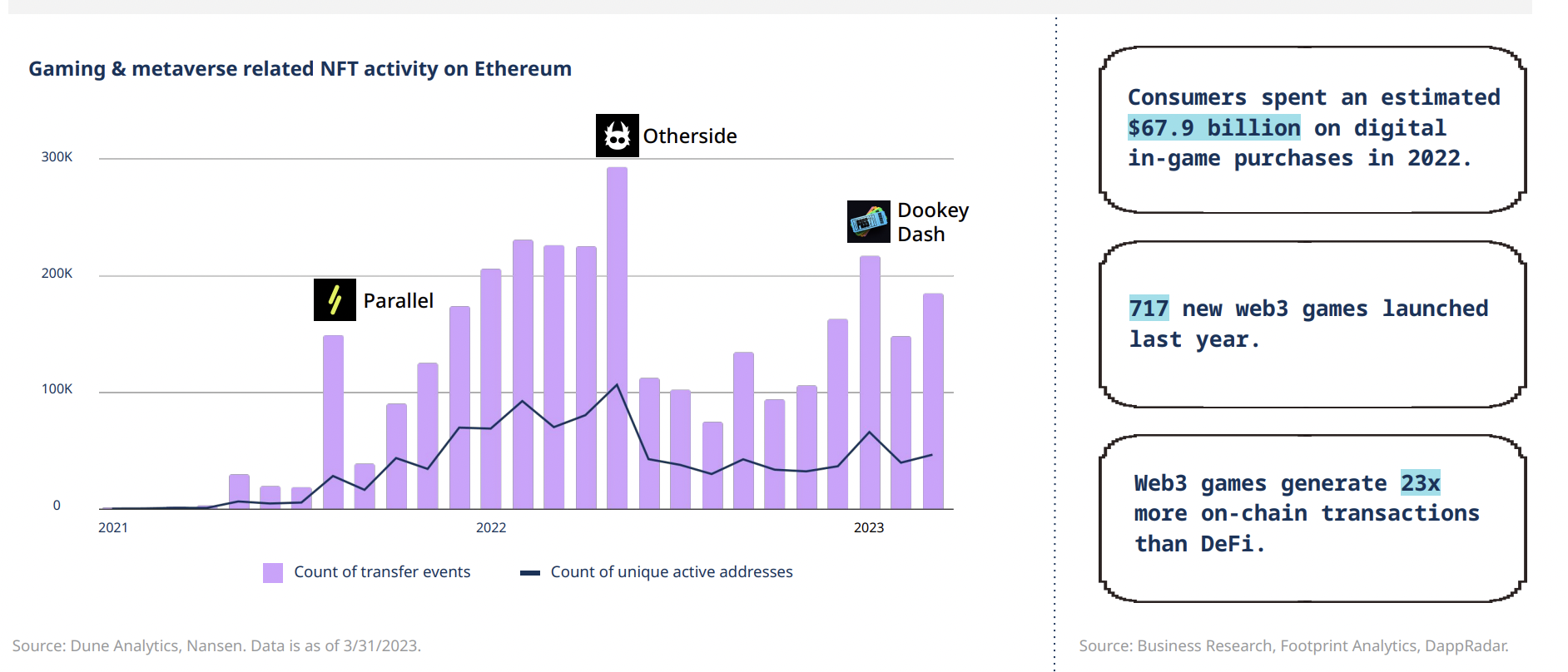
- Massive Market Appetite: Consumers spent an estimated $67.9 billion on digital in-game purchases globally in 2022 alone, demonstrating a deep-seated economic willingness among gamers to spend real-world capital on virtual goods.
- Explosive Development: Despite regulatory headwinds and market cycles, developers have poured into the space, launching 717 new Web3-integrated games over the past year.
- Overwhelming On-Chain Activity: Web3 games are currently generating an astonishing 23 times more on-chain transactions than the entirety of the decentralized finance (DeFi) sector, highlighting deep, persistent user engagement rather than passive holding.
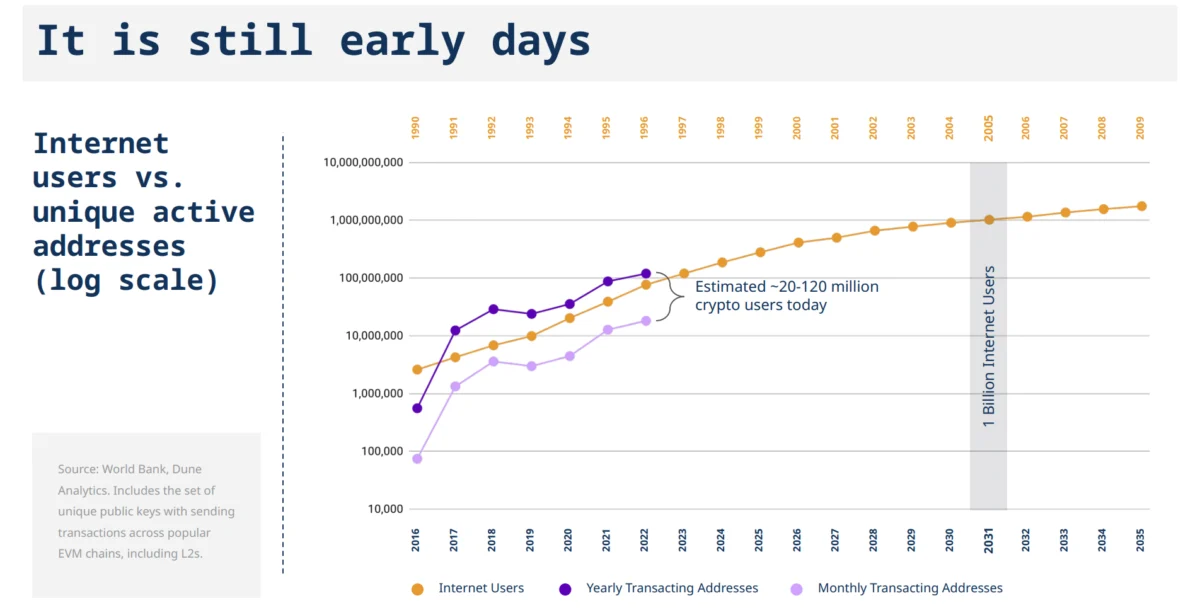
Despite these impressive milestones, a16z emphasizes that the broader digital asset industry remains in its absolute infancy. The venture capital giant explicitly compares the current developmental stage of cryptocurrency to the dawn of the commercial internet in the 1990s—a period characterized by slow dial-up connections, skepticism, structural limitations, and profound, world-altering potential.
Chronology: Tracing the Evolution of Digital Assets and Gaming Convergence
To understand how Web3 gaming reached its current prominence, it is essential to trace the historical timeline of both the internet and the blockchain industry, a parallel frequently drawn by a16z.
1. The 1990s: The Internet’s Infancy
In the mid-1990s, the internet was widely viewed by mainstream media and legacy institutions as a passing fad or a playground exclusively for computer scientists and nerds. By 1996, the global internet user base had just crossed the 100 million milestone. Connections were painfully slow, user interfaces were clunky, and the infrastructure required to build modern web applications simply did not exist. Yet, beneath the surface, foundational protocols like HTTP and TCP/IP were laying the groundwork for a multi-trillion-dollar digital economy.
2. 2008–2016: The Genesis of Blockchain and Bitcoin
Following the 2008 financial crisis, Bitcoin (BTC) introduced the world to peer-to-peer electronic cash and decentralized consensus mechanisms. For the next several years, cryptocurrency remained heavily tied to cypherpunk philosophy and underground digital marketplaces. By 2016, the modern crypto landscape began to take shape with the proliferation of Ethereum (ETH), smart contracts, and the birth of initial coin offerings (ICOs).

3. 2017–2021: The Speculative Expansion and Play-to-Earn Boom
The years leading into the 2020–2021 bull market witnessed unprecedented financial speculation. The concept of "GameFi" and Play-to-Earn (P2E) exploded into global consciousness around 2021, popularized by titles like Axie Infinity. While these early iterations proved that users were eager to earn financial yields through gameplay, many of these pioneer projects suffered from unsustainable economic models, prioritizing speculative tokenomics over genuine gaming fun.
4. 2022–Present: The Shift Toward Sustainable Web3 Gaming
Learning hard lessons from the unsustainable booms of early GameFi, developers over the past two years have pivoted toward "play-and-earn" rather than "play-to-earn." The focus has shifted from hyper-financialization to genuine player ownership, robust in-game economies, interoperable assets, and AAA-quality production values. This maturation has set the stage for institutional backing from firms like Andreessen Horowitz.
Supporting Data: By the Numbers
A16z crypto’s report relies heavily on macroeconomic metrics and data visualization to paint an accurate picture of where crypto adoption stands today versus historical technological revolutions.
User Adoption Parallels
When comparing the adoption curves of the early internet to cryptocurrency, a16z utilizes user activity metrics to measure growth.
- Internet Users (1996): Approximately 100 million yearly active participants globally.
- Crypto Users (2022): The ecosystem registered an estimated 20 million monthly transacting addresses, alongside a broader baseline of 120 million yearly transacting addresses.
This data reveals that crypto’s current user base mirrors the scale of the internet mid-to-late 1990s, suggesting that the industry is rapidly approaching its own "dot-com" acceleration phase, where infrastructure improvements will trigger exponential network effects.
Transaction Volume Breakdown
The disparity in on-chain activity between Web3 gaming and DeFi underscores a fundamental shift in user behavior. While DeFi protocols (such as decentralized exchanges, lending markets, and yield aggregators) command massive amounts of Total Value Locked (TVL), they are primarily utilized by sophisticated financial actors, traders, and whales.
In contrast, Web3 games orchestrating micro-transactions for virtual skins, weapons, land plots, and character upgrades create high-frequency, low-friction interactions. By driving 23 times more on-chain transactions than DeFi, gaming is actively stress-testing blockchain scaling solutions, layer-2 networks, and wallet user experiences at a scale that traditional financial applications have yet to achieve.
Official Responses and Industry Perspectives
The release of the a16z "State of Crypto" report has sent ripples across both the venture capital and gaming industries, drawing commentary from prominent technologists, studio executives, and economic analysts.
Industry observers note that traditional gaming behemoths—such as Electronic Arts, Ubisoft, and Epic Games—have approached blockchain technology with a mixture of immense curiosity and public relations caution. While legacy gamers have frequently pushed back against Non-Fungible Tokens (NFTs) and digital monetization models due to fears of predatory monetization, forward-thinking studios recognize that true digital ownership represents the next logical evolution in player-developer relations.
"Gamers are already accustomed to spending billions of dollars on digital assets that they do not truly own, as centralized game publishers can shut down servers or ban accounts at a moment’s notice," notes a prominent blockchain gaming developer. "Web3 technology does not change the fun factor of a game; it simply shifts the legal and technical paradigm so that players actually own the items they grind for."
Venture capitalists echo this sentiment, arguing that the friction points holding back crypto—such as complex wallet setups and seed phrases—are actively being solved by game developers who understand that user experience (UX) must be invisible to succeed in the consumer entertainment market. Account abstraction, social logins, and gasless transactions are rapidly becoming standard features in modern Web3 gaming infrastructure.
Implications: What Web3 Gaming Means for the Future of Crypto
The ramifications of a16z’s findings stretch far beyond the entertainment sector, carrying profound implications for the trajectory of the broader digital asset economy.
1. Overcoming the Adoption Plateau
For years, the crypto industry has struggled to cross the chasm from early adopters to the mainstream public. Volatility, complex security requirements, and regulatory ambiguity have scared off casual consumers. By embedding blockchain infrastructure invisibly inside compelling video games, developers can onboard millions of users who are interacting with smart contracts and tokenized assets without ever needing to understand the underlying code.
2. Stress-Testing Blockchain Infrastructure
The sheer transaction volume generated by millions of gamers interacting simultaneously requires robust, lightning-fast, and cost-effective blockchain architecture. The success of Web3 gaming will continue to force layer-1 and layer-2 networks (such as Polygon, Arbitrum, Immutable X, Solana, and Avalanche) to optimize performance, lower transaction fees, and improve scalability—benefits that will ultimately spill over into DeFi, enterprise supply chains, and decentralized identity systems.
3. Redefining Digital Property Rights
Beyond finance and gaming, the normalization of digital asset ownership via Web3 gaming lays the psychological and legal groundwork for a broader tokenized economy. When a generation of consumers grows up fully owning their in-game assets, virtual real estate, and digital identities, they will naturally demand the same rights and interoperability across social media, e-commerce, and professional software suites.
Conclusion
Andreessen Horowitz’s latest findings underscore a pivotal truth: the maturation of the cryptocurrency industry will not be driven by complex financial derivatives alone, but by consumer-facing applications that offer tangible utility, entertainment, and ownership. As Web3 gaming continues to evolve past its speculative infancy, it stands ready to serve as the gateway that introduces the next hundred million users to the decentralized digital frontier.