
Institutional Capital Floods Crypto Markets: A $1.9 Billion Surge Signals a New Era of Strategic Adoption
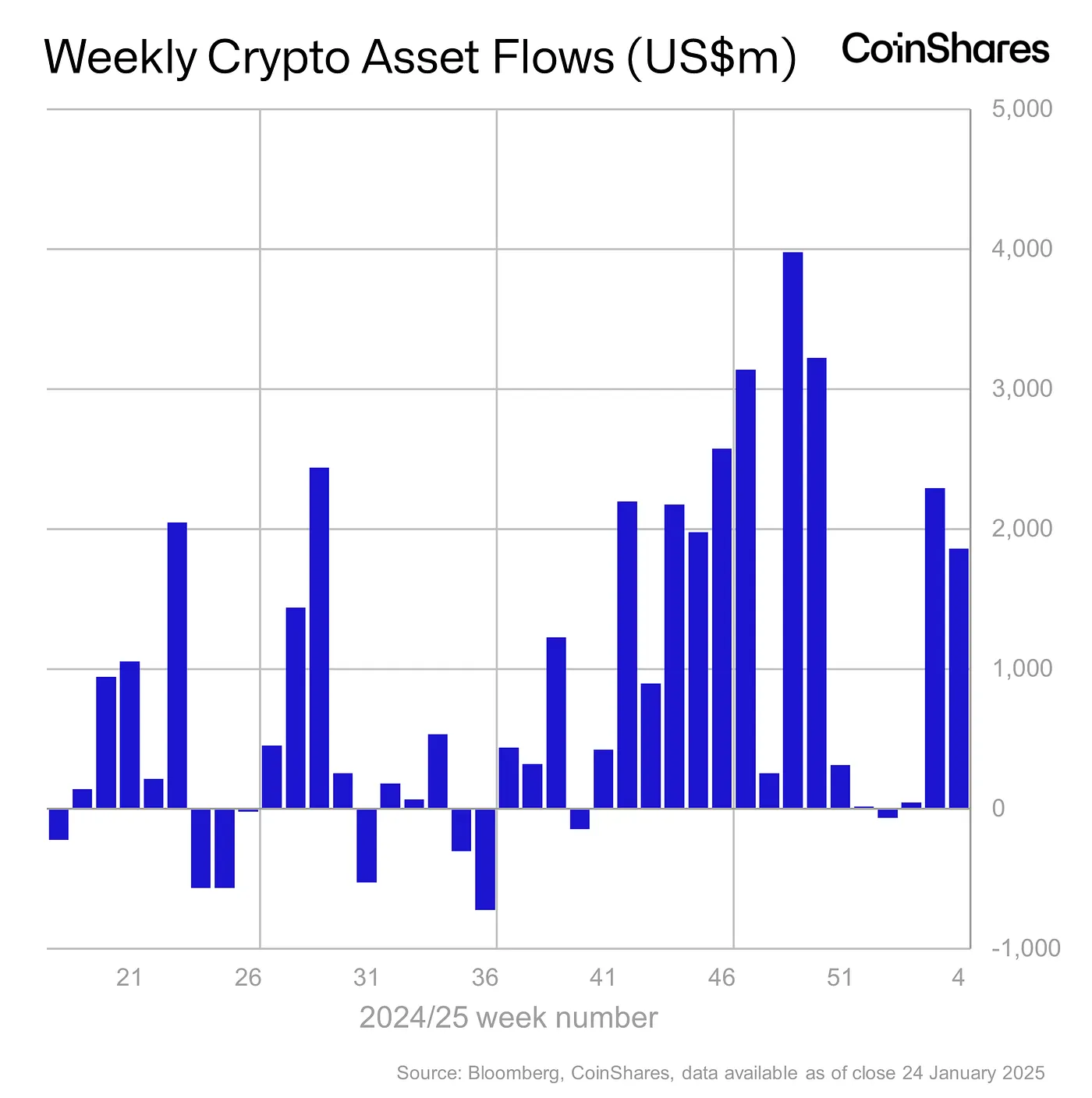
In a remarkable display of market confidence, institutional investors have accelerated their commitment to the digital asset sector, pouring nearly $2 billion into crypto-investment vehicles over the past week. According to the latest "Digital Asset Fund Flows" report from leading asset manager CoinShares, this massive inflow represents a pivotal moment for the industry, largely catalyzed by shifting political winds in the United States and the growing perception of Bitcoin as a strategic national reserve asset.
As market participants recalibrate their portfolios in light of recent executive directives, the data reveals a clear trend: institutional capital is no longer testing the waters—it is diving in.
Main Facts: The Numbers Behind the Surge
The CoinShares report confirms that digital asset investment products captured a staggering $1.9 billion in inflows last week alone. This influx brings the year-to-date (YTD) total to $4.8 billion, a figure that highlights the aggressive pace of capital deployment seen in the early weeks of the current fiscal cycle.
Despite a period of relative price stagnation across the broader crypto market, the underlying trading activity tells a different story. Trading volumes hit a robust $25 billion for the week, accounting for 37% of all activity on trusted crypto exchanges. This high-volume environment suggests that the inflows are not merely passive bets but are driven by active institutional rebalancing and strategic accumulation.
The geographical breakdown is equally telling. The United States remains the undisputed epicenter of this institutional demand, accounting for $1.7 billion of the total $1.9 billion global inflow. While international markets contributed to the momentum—with Switzerland, Canada, and Germany contributing $35 million, $31 million, and $23 million respectively—the American financial sector is clearly the primary engine driving current market sentiment.
Chronology of the Rally: The Trump Effect
The timing of this capital infusion is inextricably linked to recent political developments in the United States. Following the inauguration and the subsequent issuance of executive orders by the Trump administration, the market narrative shifted from speculation to strategic implementation.
The Trigger: Executive Orders and the Strategic Reserve
The catalyst for this surge appears to be a series of presidential executive orders that have signaled a fundamental change in how the U.S. government views cryptocurrency. Most notably, the administration has proposed the initiation of a "strategic reserve asset" in Bitcoin. This policy shift has acted as a lightning rod for institutional investors who had previously been sidelined by regulatory uncertainty.
Pre-Inauguration Momentum
Prior to the executive actions, Bitcoin had already been testing new all-time highs. The market anticipation of a more favorable regulatory landscape—coupled with the promise of federal recognition of Bitcoin as a reserve asset—created a "fear of missing out" (FOMO) effect among institutional players. The inflows tracked by CoinShares last week represent the realization of that anticipation, as firms moved to solidify their positions ahead of what many analysts now view as a long-term bull cycle.
Supporting Data: Bitcoin Dominance and Altcoin Resilience
While the broader digital asset market has seen positive movement, the concentration of capital remains heavily skewed toward the market leader.
Bitcoin’s Lion’s Share
Bitcoin remains the undisputed king of institutional portfolios. According to CoinShares, BTC saw inflows totaling $1.6 billion last week, accounting for a massive 92% of all inflows into the digital asset sector. This brings Bitcoin’s YTD inflows to $4.4 billion.
Interestingly, the report notes that despite the bullish sentiment, some investors are still hedging their bets. "Short-Bitcoin" ETFs—investment vehicles designed to profit from a decline in Bitcoin’s price—saw an inflow of $5.1 million. This suggests that while the prevailing mood is optimistic, institutional risk-management protocols remain strictly enforced, with some desks maintaining tactical shorts to hedge against potential short-term volatility.
The Altcoin Landscape
Ethereum (ETH) continues to hold its position as the secondary choice for institutional capital, recording $205 million in inflows. This is a significant recovery, bringing ETH’s YTD flows to $177 million. The appetite for Ethereum suggests that investors are looking beyond simple store-of-value assets and are increasingly interested in the underlying infrastructure of the decentralized web.
With the exception of Cardano (ADA), which saw minor outflows, the rest of the altcoin sector remained remarkably resilient. The lack of significant outflows across the board indicates that institutional investors are currently in a "buy and hold" mindset, with very little evidence of profit-taking or sector-wide liquidation.

Official Responses and Market Perspectives
Industry analysts and market observers have been quick to interpret the CoinShares data as a structural shift rather than a transient event.
The Institutional Sentiment
Many analysts point out that the entry of major asset managers into the crypto space has bridged the gap between traditional finance (TradFi) and decentralized finance (DeFi). The executive orders have essentially provided a "green light" for conservative pension funds and insurance companies that were previously restricted by the lack of clear federal guidance.
"The institutionalization of crypto is no longer a goal; it is a reality," says one analyst familiar with the report. "When you have the U.S. government openly discussing a Bitcoin reserve, the risk-adjusted return profile of crypto changes entirely for a CIO [Chief Investment Officer]."
Regulatory Clarification
While the executive orders are not yet codified into law, the signal they send to the regulatory community—including the SEC and the CFTC—is clear. The industry expects a transition from a "regulation by enforcement" model to one of collaborative oversight. This shift is arguably the single most important factor in the current $1.9 billion inflow, as it mitigates the "career risk" previously associated with recommending crypto assets to institutional clients.
Implications: A New Financial Paradigm
The implications of these findings are profound, affecting not just the crypto market but the global financial system at large.
1. The Legitimation of Bitcoin as a Sovereign Asset
If the United States successfully implements a Bitcoin strategic reserve, it will force other G7 nations to evaluate their own positions. The current institutional rush is essentially an early-mover advantage play. If Bitcoin becomes a component of national reserves, its status as a "digital gold" is effectively cemented, leading to potential supply shocks as institutional demand outstrips available liquidity.
2. Market Maturity and Volatility
The rise in trading volume—specifically reaching 37% of total trusted exchange volume—suggests that the market is becoming more professionalized. Increased institutional participation typically leads to deeper liquidity, which can, over time, temper the extreme volatility historically associated with crypto assets. However, in the short term, the concentration of capital into a few major players means that institutional movements will dictate the price action more than ever before.
3. The Future of Diversified Portfolios
The fact that Ethereum and other altcoins are seeing consistent inflows alongside Bitcoin suggests that institutions are building "digital asset baskets." This indicates a sophisticated understanding of the sector, where investors are differentiating between pure store-of-value assets (Bitcoin) and utility-based smart contract platforms (Ethereum).
4. A Shift in Global Financial Power
The data showing $1.7 billion entering via U.S.-based vehicles highlights a potential shift in the center of gravity for digital finance. If the U.S. remains the primary jurisdiction for crypto-capital, it will likely see a massive influx of tech talent and financial innovation, potentially mirroring the early days of the Silicon Valley boom.
Conclusion: The Path Forward
The latest data from CoinShares confirms that we are entering a new phase of the cryptocurrency cycle. The combination of massive institutional capital inflows and a supportive political environment in the United States has created a foundation for sustainable growth.
However, investors should remain cautious. While the trend is undeniably bullish, the market remains subject to regulatory changes, geopolitical tensions, and the inherent volatility of digital assets. As the industry matures, the focus will likely shift from pure price speculation to the integration of these assets into standard financial infrastructure.
For now, the message from the markets is loud and clear: the institutional dam has broken, and the flow of capital into the digital asset ecosystem is accelerating at an unprecedented rate. Whether this leads to a new era of financial stability or a period of rapid, volatile expansion remains to be seen, but one thing is certain—the global financial landscape has been permanently altered.
Disclaimer: This article is provided for informational purposes only and does not constitute financial, investment, or legal advice. Cryptocurrency investments involve a high degree of risk, including the total loss of principal. Investors should conduct their own thorough due diligence and consult with a certified financial advisor before making any investment decisions. The Daily Hodl does not endorse any specific assets or strategies mentioned herein.