Korea Blockchain Week 2026 (KBW2026) Unveils Star-Studded Partner Lineup, Bridging Institutional Finance, AI, and Web3 in Seoul
SEOUL — Korea Blockchain Week 2026 with Upbit (KBW2026), widely recognized as Asia’s premier digital asset and blockchain conference, has officially unveiled its powerhouse partner and sponsor lineup. Scheduled to take place in the heart of South Korea’s capital from September 29 to October 1, 2026, this year’s summit is poised to serve as a pivotal convergence point for industry leaders, global financial institutions, and pioneering technologists.
Organized by Web3 ecosystem builder FACTBLOCK, KBW2026 brings together an elite roster of organizations spanning major cryptocurrency exchanges, decentralized artificial intelligence (AI) infrastructure, institutional custody, stablecoin architecture, and next-generation financial networks. Beyond brand partnerships, the event’s blueprint emphasizes thought leadership: chief executive officers and founders from these prominent entities will take center stage to deliver keynote addresses and dissect the major structural shifts steering the global digital asset economy.
Main Facts: The Anatomy of KBW2026’s Strategic Partnership
The unveiled sponsorship roster highlights a deliberate evolution in the blockchain sector, shifting focus from pure retail speculation toward institutional integration, decentralized AI, and utility-driven infrastructure.
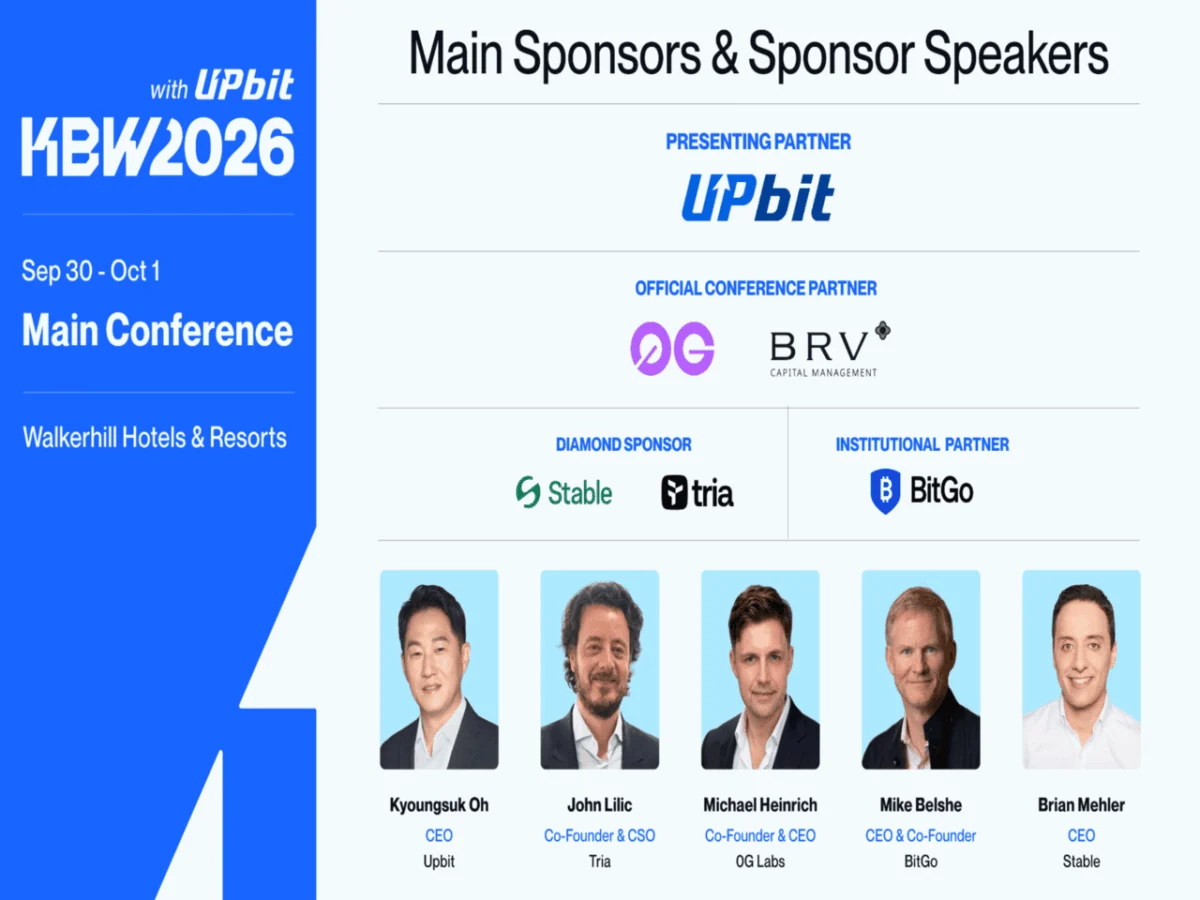
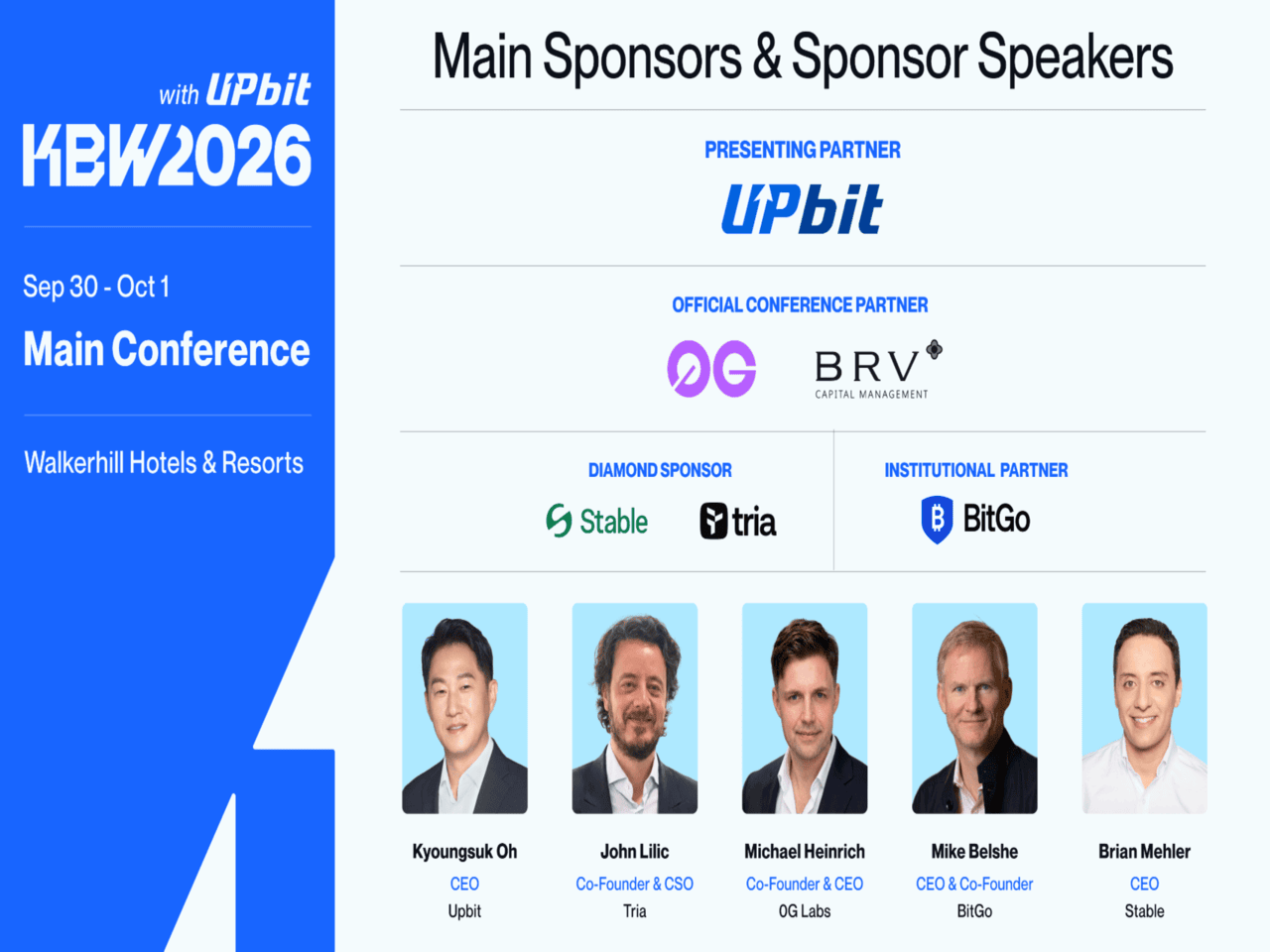
- Presenting Partner: Upbit, South Korea’s leading digital asset exchange, returns as the core presenting partner. Upbit CEO Kyoungsuk Oh will deliver a keynote address evaluating global market trends and South Korea’s evolving strategic positioning within the ecosystem.
- Official Conference Partners: Decentralized AI infrastructure pioneer 0G and prominent global venture capital firm BRV take the co-headline conference slots. 0G Co-Founder and CEO Michael Heinrich will lead discussions on the burgeoning "agent economy" and decentralized compute layers.
- Official Institutional Sponsor: BitGo, a global leader in digital asset financial infrastructure, steps into the institutional spotlight. BitGo Korea—backed by strategic shareholders including Hana Financial Group and SK Telecom—recently achieved a major regulatory milestone by securing Virtual Asset Service Provider (VASP) registration acceptance from South Korea’s Financial Intelligence Unit (KoFIU). BitGo Co-Founder and CEO Mike Belshe will address attendees on institutional adoption.
- Diamond Sponsors: Stable and Tria represent the cutting edge of payment rails and cross-chain financial infrastructure. Stable CEO Brian Mehler and Tria Co-Founder and Chief Strategy Officer John Lilic will present insights into high-performance stablecoin ecosystems and multi-chain neobanking solutions.
The three-day event is structurally split to cater to both elite institutional players and the broader developer and enthusiast community. The invite-only Upbit Institutional Summit (UIS) will kick off proceedings on September 29, targeting traditional financial institutions, regulators, and enterprise leaders. This will seamlessly transition into the expansive KBW2026 Main Conference, running from September 30 to October 1.
Chronology: The Road to Seoul’s Premier Web3 Showcase
The lead-up to Korea Blockchain Week 2026 has been characterized by strategic announcements, regulatory breakthroughs within the South Korean market, and a concerted push toward enterprise-grade blockchain integration.
- August 31, 2026 (Official Announcement): FACTBLOCK officially releases the comprehensive partner and speaker lineup for KBW2026. The announcement highlights a diverse ecosystem coalition involving Upbit, 0G, BRV, BitGo, Stable, and Tria, signaling a maturation of the conference’s scope.
- Mid-2026 (Regulatory Milestones): Vital groundwork is laid in the South Korean market as international infrastructure players like BitGo successfully navigate local compliance frameworks. BitGo Korea’s receipt of VASP registration acceptance from the KoFIU—bolstered by partnerships with legacy financial giants like Hana Financial Group and SK Telecom—sets a precedent for compliant foreign entry into the tightly regulated Korean digital asset economy.
- September 29, 2026 (The Upbit Institutional Summit): The exclusive, invite-only opening day dedicated to institutional finance, macroeconomic outlooks, and corporate treasury strategies.
- September 30 – October 1, 2026 (KBW2026 Main Conference): The primary multi-track conference opens in Seoul, featuring deep dives into decentralized AI, blockchain scalability, institutional custody solutions, and cross-border stablecoin utility.
Supporting Data & Ecosystem Analysis: Why KBW2026 Matters
To understand the weight of the KBW2026 partner lineup, one must examine the macro-trends currently driving venture capital allocation and technological development within the digital asset sphere.
1. The Convergence of AI and Decentralized Infrastructure
The inclusion of 0G as an Official Conference Partner reflects an undeniable market reality: artificial intelligence and blockchain are merging. As artificial intelligence models scale, centralized compute bottlenecks and data privacy concerns have opened the door for decentralized solutions.
- The Technology: 0G functions as a trust layer for AI by integrating verifiable compute, private inference, decentralized storage, and an AI-native blockchain.
- Market Impact: According to recent industry metrics, investments into decentralized AI infrastructure have surged, driven by the need to support autonomous AI agents capable of executing micro-transactions and secure data processing without human intermediaries.
2. Institutional Compliance in South Korea
South Korea remains one of the most active and retail-dense cryptocurrency trading markets globally. However, the regulatory landscape enforced by the Financial Intelligence Unit (KoFIU) is among the strictest in the world.
- The Data: BitGo’s successful navigation of South Korea’s VASP requirements—backed by domestic heavyweights Hana Financial Group and SK Telecom—illustrates that institutionalization in Asia is no longer theoretical; it is operational.
- Significance: By integrating traditional telecommunications and banking muscle with institutional-grade digital asset custody, the Korean market is establishing a secure bridge for traditional capital to enter Web3.
3. Stablecoins and Cross-Chain Financial Rails
The presence of Diamond Sponsors Stable and Tria highlights the hyper-focus on global payments and liquidity fragmentation.
- Stable: Focuses on engineering blockchain infrastructure specifically optimized for high-volume stablecoin payments and cross-border transfers.
- Tria: Powers a fast-growing stablecoin neobank and develops financial architecture that allows businesses and autonomous AI agents to seamlessly transact across disparate blockchain networks.
Official Responses and Executive Perspectives
Industry leaders driving the vision behind KBW2026 have shared their optimism regarding the trajectory of the digital asset landscape and South Korea’s strategic positioning.
Andrew Park, CEO of FACTBLOCK, emphasized the shifting paradigms of the conference:
"This year, KBW is bringing together key partners that are shaping the next stage of the industry, spanning exchanges, institutional digital asset infrastructure, AI, stablecoins, and next-generation financial services. With senior executives from these companies also taking the stage as speakers, KBW2026 will provide a valuable opportunity to see where the most important changes in the global digital asset market are emerging."
Kyoungsuk Oh, CEO of Upbit, highlighted the growing maturation of the domestic market:
"Through our partnership with Upbit, KBW2026 will broaden the conversation around Korea’s digital asset market beyond retail investors to include institutional participation and global financial markets. We look forward to sharing our perspective on how the global landscape is transforming and the vital role South Korea will play."
Michael Heinrich, Co-Founder and CEO of 0G Labs, discussed the intersection of decentralized infrastructure and autonomous systems:
"The rise of the agent economy requires a brand-new computational and trust foundation. By bringing verifiable compute, decentralized storage, and AI-native architecture together, we are building the substrate upon which the next generation of intelligent applications will thrive."
Implications: What KBW2026 Signals for the Future of Web3
The comprehensive roster and agenda of Korea Blockchain Week 2026 carry several profound implications for the global digital asset industry:
1. Shift from Speculation to Utility
The heavy representation of infrastructure providers, stablecoin creators, and AI-blockchain hybrids proves that the industry has moved past simple token speculation. The conversations in Seoul will revolve around utility—how blockchains can settle global trade, secure artificial intelligence models, and provide friction-free payment rails for enterprises.
2. South Korea as an Institutional Gateway
By successfully integrating institutional players like BitGo, alongside traditional financial giants such as Hana Financial Group, South Korea is positioning itself as a compliant, highly regulated gateway for global liquidity. This sets a regulatory blueprint that other Asian jurisdictions may look to replicate.
3. The Rise of Autonomous Financial Agents
With leaders from decentralized AI infrastructure and cross-chain financial networks taking center stage, KBW2026 will likely accelerate discussions on how AI agents will operate within decentralized finance (DeFi). The ability for AI agents to hold digital assets, execute smart contracts, and utilize stablecoin neobanks represents the next frontier of digital commerce.
Conclusion
As the countdown to September 29 ticks down, anticipation surrounding KBW2026 continues to mount. By curating a balanced ecosystem of market-leading exchanges, institutional powerhouses, and frontier technology developers, Korea Blockchain Week 2026 is set to deliver not just a conference, but a comprehensive roadmap for the next era of the global digital asset economy.