Institutional Capital Floods Crypto Markets Following Federal Reserve Pivot
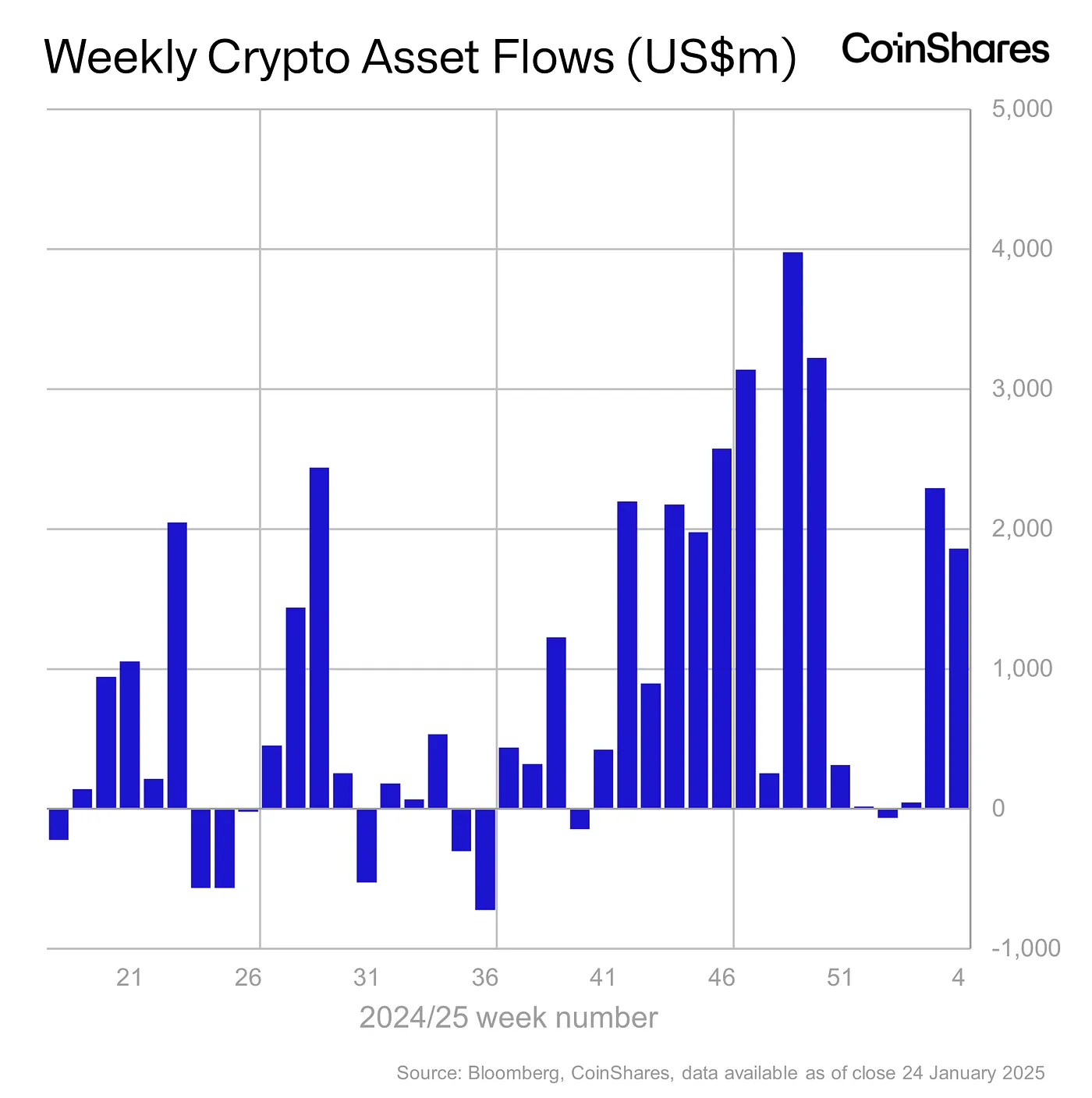
The global cryptocurrency market has experienced a profound shift in institutional sentiment, punctuated by a massive surge in capital inflows that coincided with the U.S. Federal Reserve’s long-awaited interest rate decision. According to the latest Digital Asset Fund Flows Weekly Report from industry-leading asset management firm CoinShares, institutional investors poured a staggering $1.9 billion into digital asset investment products over the past week, marking the second consecutive week of substantial growth.
This influx of capital highlights a growing confidence among institutional players, who appear to be positioning their portfolios to capitalize on a new macroeconomic environment defined by lower borrowing costs and shifting monetary policy.
Main Facts: The Macro-Crypto Connection
The primary driver of the recent market activity was the U.S. Federal Reserve’s decision to initiate a rate-cutting cycle. While market analysts had spent months speculating on the timing and magnitude of this shift, the central bank’s decision to implement a “hawkish cut”—a move characterized by aggressive monetary loosening paired with cautious forward guidance—initially created a period of volatility and hesitation.
Institutional investors, typically risk-averse, reacted to the initial announcement with a degree of trepidation. However, as the implications of a lower-interest-rate environment began to settle, sentiment shifted rapidly. By the latter half of the week, capital markets saw a distinct pivot, with $746 million flowing into crypto-linked exchange-traded products (ETPs) during Thursday and Friday alone. This late-week surge confirmed that institutional sentiment had transitioned from defensive to proactive, as investors sought to mitigate the erosion of fiat currency value through digital asset exposure.
Chronology of Market Sentiment
To understand the recent surge, one must look at the timeline of the Federal Reserve’s announcement and the subsequent market response.
Early Week: The "Hawkish Cut" Jitters
The week began under a cloud of uncertainty. As the Federal Reserve announced its interest rate reduction, the market reaction was muted. Investors grappled with the central bank’s rhetoric, which suggested that while rates were coming down, the economic outlook remained complex. This led to a “wait-and-see” approach, with institutional desks pausing capital deployment to assess how traditional assets like equities and bonds would react to the policy shift.
Mid-Week: The Digesting Phase
By the middle of the week, the initial shock of the “hawkish” terminology subsided. Analysts began to articulate the benefits of lower rates for non-yielding assets. In the digital asset space, the argument that lower interest rates increase the attractiveness of Bitcoin and other crypto-assets—which are often viewed as a hedge against inflation—gained significant traction.
Late Week: The Inflow Surge
The final 48 hours of the trading week proved to be the most critical. As the market digested the data, a wave of buy-side pressure emerged. The $746 million in net inflows on Thursday and Friday represent one of the most concentrated bursts of institutional buying seen in recent months. This momentum solidified the weekly total at $1.9 billion, effectively erasing the cautious sentiment that characterized the market’s opening days.
Supporting Data: Regional and Asset-Specific Breakdown
The global nature of this capital movement reveals a clear leader in institutional crypto adoption: the United States.
Regional Dominance
The United States commanded the lion’s share of investment activity, recording $1.8 billion in net inflows. This dominance is largely attributed to the maturity of the U.S. spot Bitcoin and Ethereum ETF markets, which provide institutional-grade infrastructure for capital allocation. Other nations followed, though at a significantly smaller scale:
- Germany: Added $51.6 million.
- Switzerland: Recorded $47.3 million in inflows.
- Brazil: Saw $9.3 million in new investments.
Conversely, Hong Kong experienced a slight contraction, with $3.1 million in outflows, indicating a potential divergence in regional market sentiment or profit-taking behavior among Asian institutional holders.
Asset Performance
Bitcoin remains the cornerstone of institutional portfolios, attracting $977 million of the total $1.9 billion. This strong performance reflects a continued "flight to quality" within the crypto asset class. Interestingly, short-Bitcoin products—which allow investors to profit from a decline in the asset’s price—suffered, posting $3.5 million in outflows. This has pushed the total Assets under Management (AuM) for short-Bitcoin ETPs to a multi-year low of just $83 million, a clear signal that the institutional "short" trade is losing its appeal.

Beyond Bitcoin, the "Altcoin" sector saw remarkable strength:
- Ethereum (ETH): Enjoyed $772 million in inflows, suggesting a resurgence of interest in smart-contract platforms.
- Solana (SOL): Attracted $127.3 million, cementing its status as a preferred layer-1 alternative among institutional investors.
- XRP: Captured $69.4 million, reflecting renewed optimism regarding its regulatory standing and institutional utility.
Official Responses and Expert Commentary
While CoinShares’ report provides the empirical data, market analysts and industry stakeholders have been quick to interpret the results.
"The recent inflows demonstrate that institutional investors view the Federal Reserve’s rate cut as a green light," noted one market analyst. "By cutting rates, the Fed has effectively lowered the opportunity cost of holding digital assets. Investors are no longer content with the yields offered by traditional cash equivalents when inflation-hedging assets show this much structural strength."
Furthermore, the data from platforms like Rekt Capital suggests that we are moving into a phase of "price discovery" for major assets. The technical indicators, coupled with the fundamental shift in monetary policy, have created a "perfect storm" for institutional re-entry.
Implications for the Future of Digital Assets
The implications of these findings are far-reaching. If the current trajectory of interest rate cuts continues, the structural demand for digital asset ETPs is likely to accelerate.
1. Increased Liquidity and Market Maturity
The sheer volume of capital flowing into crypto ETPs signifies that the market is maturing. It is no longer a speculative playground for retail traders; it is an established asset class integrated into the global financial system. The ability for the market to absorb $1.9 billion in a single week without experiencing extreme volatility suggests a deeper pool of liquidity than previously estimated.
2. A Shift in Portfolio Allocation
The decline of short-Bitcoin positions and the concentration of inflows into top-tier assets like BTC, ETH, and SOL suggest that institutional allocators are shifting from speculative trading to long-term holding strategies. This “HODL” mentality among institutions could reduce the volatility that has historically plagued the sector, potentially paving the way for wider adoption by pension funds and sovereign wealth funds.
3. Regulatory and Economic Sensitivity
The sensitivity of these flows to Federal Reserve policy underscores that the crypto market is now intrinsically linked to global macroeconomic health. As the Federal Reserve navigates the "soft landing" of the U.S. economy, the correlation between digital assets and traditional macro indicators will likely remain high. Investors must remain vigilant regarding future FOMC (Federal Open Market Committee) meetings, as each policy shift will likely trigger immediate and substantial capital flows into or out of the digital asset space.
Conclusion
The latest data from CoinShares confirms that the institutional "wait-and-see" period has ended. The crypto markets, having weathered the initial confusion of a hawkish interest rate pivot, have emerged with renewed vigor. With nearly $2 billion in new capital inflows and a clear preference for foundational assets, the message from the institutional world is unequivocal: digital assets are now a permanent and pivotal component of the modern financial landscape.
As we look toward the final quarter of the year, all eyes remain on the Federal Reserve and the broader economic climate. However, the current momentum suggests that the institutional appetite for crypto exposure is far from satiated, setting the stage for potentially significant growth in the coming months.
Disclaimer: The information provided in this article is for educational and informational purposes only and does not constitute financial, investment, or legal advice. The Daily Hodl is not an investment advisor, and the mention of specific assets or market trends should not be interpreted as an endorsement or a recommendation to buy or sell. Cryptocurrency investments are high-risk; always conduct your own due diligence and consult with a professional financial advisor before making any investment decisions.