Institutional Capital Floods Crypto Markets: A New Era of Strategic Adoption
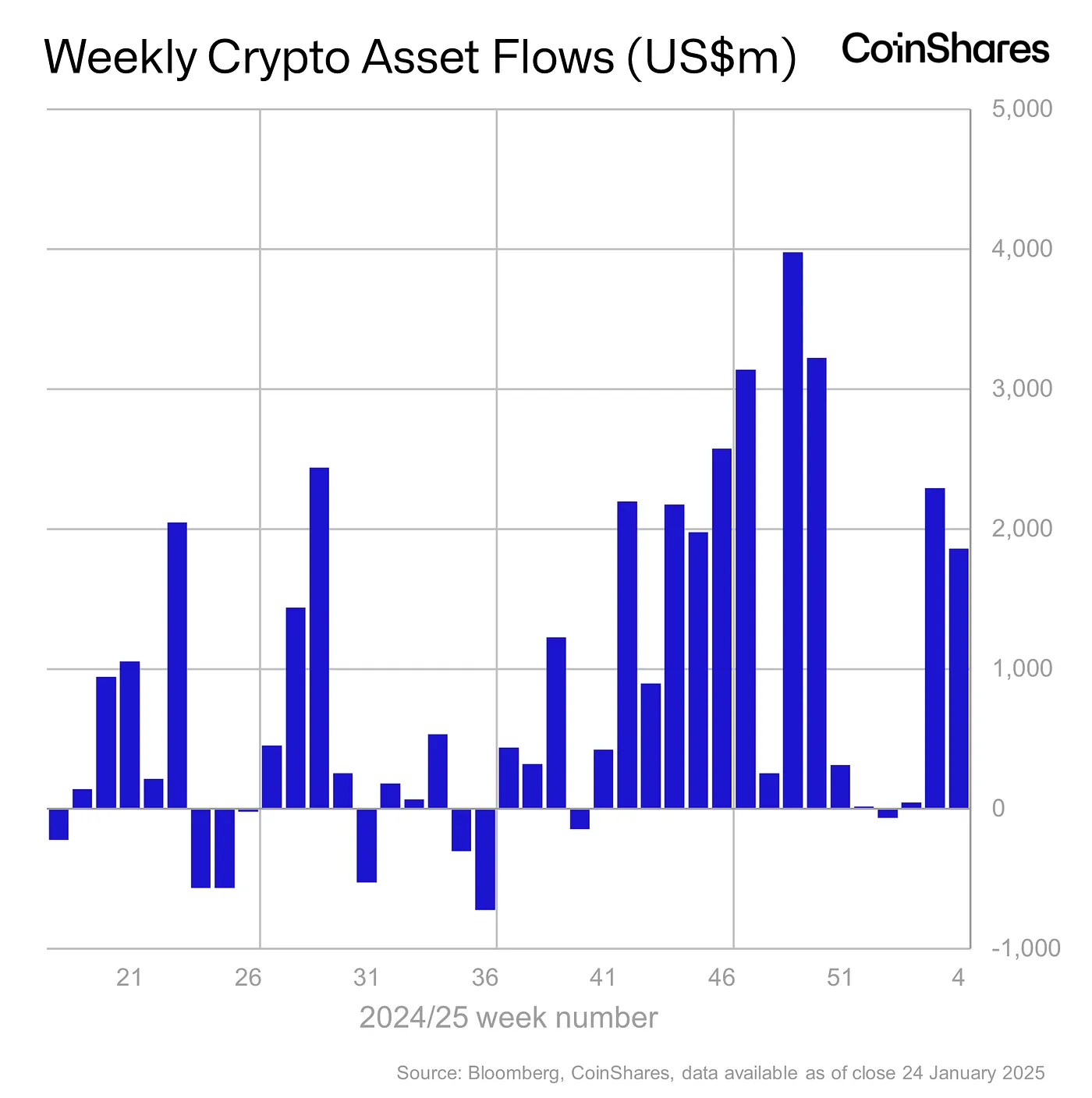
In a staggering display of market confidence, institutional investors have accelerated their commitment to the digital asset sector, pouring nearly $2 billion into investment vehicles in a single week. According to the latest "Digital Asset Fund Flows" report from leading crypto asset manager CoinShares, this surge in capital reflects a profound shift in sentiment, largely catalyzed by evolving political discourse in the United States regarding the future of Bitcoin and decentralized finance.
The Catalyst: A Shifting Political Landscape
The primary driver behind this monumental influx appears to be the recent executive actions spearheaded by President Donald Trump. Specifically, the proposal to initiate a strategic national reserve of Bitcoin has transformed the asset from a speculative retail favorite into a matter of high-level national economic policy.
For years, institutional players—pension funds, family offices, and hedge funds—have navigated the crypto space with a degree of trepidation, hampered by regulatory ambiguity. However, the prospect of the United States government formalizing Bitcoin as a strategic reserve asset has signaled a "green light" to the traditional financial establishment. This policy shift effectively removes the "existential risk" narrative that previously kept institutional capital on the sidelines, providing a framework for long-term strategic allocation.
Chronology of the Surge: A Week of High-Volume Activity
The data provided by CoinShares covers a seven-day window that witnessed extreme market activity. While the broader price action for major assets remained relatively flat throughout the week, the underlying trading volumes told a different story.
- Mid-Week Momentum: As news of the executive orders circulated through institutional circles, trading volumes on trusted crypto exchanges spiked to $25 billion for the week. This figure is particularly significant, as it represents approximately 37% of the total trading volume across the entire industry, highlighting that institutional participants were the primary engine driving market liquidity.
- The Accumulation Phase: Unlike the retail-driven "FOMO" (fear of missing out) cycles of previous years, this institutional surge was characterized by deliberate, systematic accumulation. The steady inflow of $1.9 billion throughout the week indicates that large-scale desks were executing massive buy orders, effectively absorbing supply and stabilizing prices despite the lack of significant upward momentum in spot prices.
- The Close: By the end of the trading week, the total year-to-date (YTD) inflows had climbed to a staggering $4.8 billion, a testament to the compounding interest that institutional mandates have placed on digital assets since the start of the year.
Supporting Data: Regional and Asset-Specific Breakdown
The distribution of these inflows reveals a clear concentration of capital, with the United States acting as the undisputed epicenter of the current crypto renaissance.
Regional Dominance
The United States accounted for the vast majority of the inflows, securing $1.7 billion of the total $1.9 billion invested. This regional dominance is a direct reflection of the U.S. regulatory and political environment, which is currently seen as the most bullish in the world regarding crypto infrastructure. Other regions followed, albeit at a distance:
- Switzerland: $35 million
- Canada: $31 million
- Germany: $23 million
Asset Allocation: Bitcoin Remains King
Bitcoin (BTC) continues to be the primary beneficiary of institutional interest, accounting for 92% of all digital asset inflows last week. The total inflow for Bitcoin reached $1.6 billion, pushing the YTD total to $4.4 billion.
Interestingly, the report noted that "short-Bitcoin" ETFs—investment vehicles designed to profit from a decline in the price of BTC—saw inflows of $5.1 million. This suggests that while the prevailing institutional mood is overwhelmingly bullish, sophisticated market participants are still utilizing hedging strategies to manage risk in anticipation of the volatility that typically follows new all-time highs.
The Altcoin Landscape
While Bitcoin dominates, Ethereum (ETH) saw a notable resurgence. Following a period of sluggish performance, ETH recorded $205 million in inflows, effectively flipping its YTD balance into the positive territory at $177 million. With the exception of Cardano (ADA), which experienced minor outflows, the broader institutional crypto portfolio remained overwhelmingly net-positive, suggesting a diversification strategy that includes blue-chip altcoins.

Implications for the Financial Sector
The significance of this capital flow cannot be overstated. When institutions move at this scale, they do not simply buy and sell; they build infrastructure. The influx of $1.9 billion in one week necessitates deeper custodial arrangements, more robust prime brokerage services, and increased compliance overhead—all of which serve to institutionalize the asset class further.
1. Market Maturity and Price Discovery
The high trading volume relative to price movement indicates that the market is currently in a "price discovery" phase. As institutional buyers continue to absorb available supply, the liquidity profile of Bitcoin and Ethereum is changing. This could lead to lower volatility over the long term, as the "hodling" behavior of institutional entities acts as a ballast against the knee-jerk reactions typical of retail-heavy markets.
2. The Normalization of Crypto as a Treasury Asset
If the U.S. government moves forward with a strategic Bitcoin reserve, the implications for corporate treasuries are profound. Companies like MicroStrategy and Tesla, which have already pioneered corporate Bitcoin adoption, may soon be joined by a wave of public companies looking to diversify their balance sheets away from fiat currency. This move would essentially validate Bitcoin as a legitimate treasury reserve asset, similar to gold or sovereign debt.
3. Regulatory Ripple Effects
The influx of capital suggests that institutional investors have performed their due diligence and are satisfied with the current trajectory of U.S. regulation. By aligning their capital with the government’s proposed executive orders, these institutions are essentially voting for a future where digital assets are integrated into the global financial plumbing. This creates a feedback loop: as more capital flows into the sector, the lobby for clear, supportive regulation becomes more powerful, further de-risking the environment for the next wave of investors.
Official and Industry Perspectives
While CoinShares’ report focuses on the quantitative side of the market, the qualitative shift in industry discourse is palpable. Financial analysts who previously dismissed Bitcoin as a "ponzi scheme" or "digital gold bubble" are increasingly forced to address the reality of institutional adoption.
"The entry of multi-billion dollar institutional mandates is the ultimate validation of the asset class," says a senior market analyst at a leading digital asset firm. "When you see this kind of volume, you are seeing the result of months, if not years, of internal committee reviews, legal approvals, and risk management assessments. This isn’t retail speculation; this is the slow, grinding process of the world’s largest pools of capital reallocating to a new digital paradigm."
Conclusion: What Lies Ahead?
The record-breaking inflows of the past week underscore a fundamental truth: the crypto industry has moved beyond its fringe origins. As the United States pivots toward a more strategic approach to digital assets, the barriers that once separated Wall Street from the blockchain are crumbling.
Investors should remain mindful that while the institutional tide is rising, the crypto market remains inherently volatile. As noted by the experts at CoinShares, the presence of short-interest suggests that even the "smart money" is preparing for turbulence. Nevertheless, the trend line is clear. With $4.8 billion in YTD inflows and a supportive political wind at its back, the digital asset sector is entering its most sophisticated and potentially most rewarding chapter to date.
Disclaimer: The information provided in this report is for educational and informational purposes only and does not constitute financial, investment, or legal advice. Cryptocurrency investments carry a high degree of risk, and investors should conduct thorough due diligence before allocating capital. The market is subject to extreme volatility, and past performance is not indicative of future results.