
Centralized Crypto Exchange Volumes Plummet 43.8% in April, Ending Six-Month Bull Run
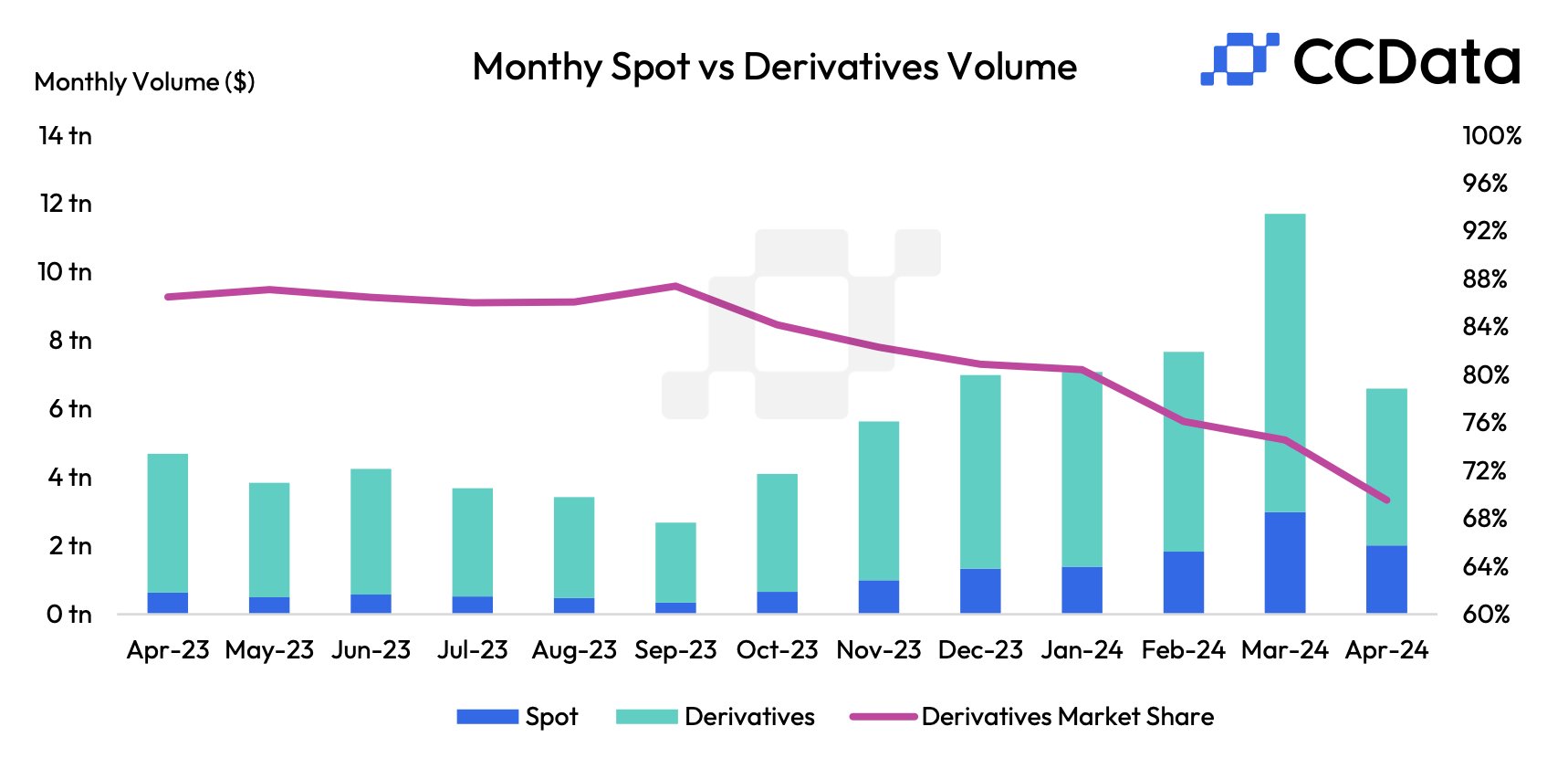
LONDON — After half a year of relentless growth and surging market enthusiasm, the centralized cryptocurrency exchange (CEX) sector hit a sharp speed bump in April. According to comprehensive new data from premier blockchain and digital asset research firm CCData, the combined trading volume for spot markets and derivatives across top-tier and lower-tier centralized platforms nosedived by 43.8% last month, settling at $6.58 trillion.
While the contraction is undeniably steep, market analysts caution against viewing the downturn as a structural bear market. Instead, they frame the correction as a natural cooling-off period following an explosive first quarter fueled by the anticipation and subsequent launch of spot Bitcoin Exchange-Traded Funds (ETFs) in the United States, alongside aggressive retail participation.
Beneath the headline decline in trading activity, sector-specific dynamics reveal a resilient, albeit shifting, crypto economy. While major exchanges absorbed multi-billion-dollar losses in daily throughput, pockets of the decentralized and altcoin ecosystems—most notably metaverse gaming, artificial intelligence (AI), and meme tokens—continued to attract capital and post double-digit month-to-date returns.
Main Facts
The April contraction marks a dramatic reversal of fortune for centralized digital asset platforms, abruptly halting a robust six-month consecutive rally. Key data points defining the current market landscape include:
- The Headline Drop: Combined spot and derivatives trading volumes on CEXs fell by 43.8% in April, dropping from a lofty $11 trillion in March to $6.58 trillion.
- Historical Context: Despite the severe monthly correction, April 2024 volumes remain significantly elevated compared to the entirety of 2023, outperforming every month of the previous year except December.
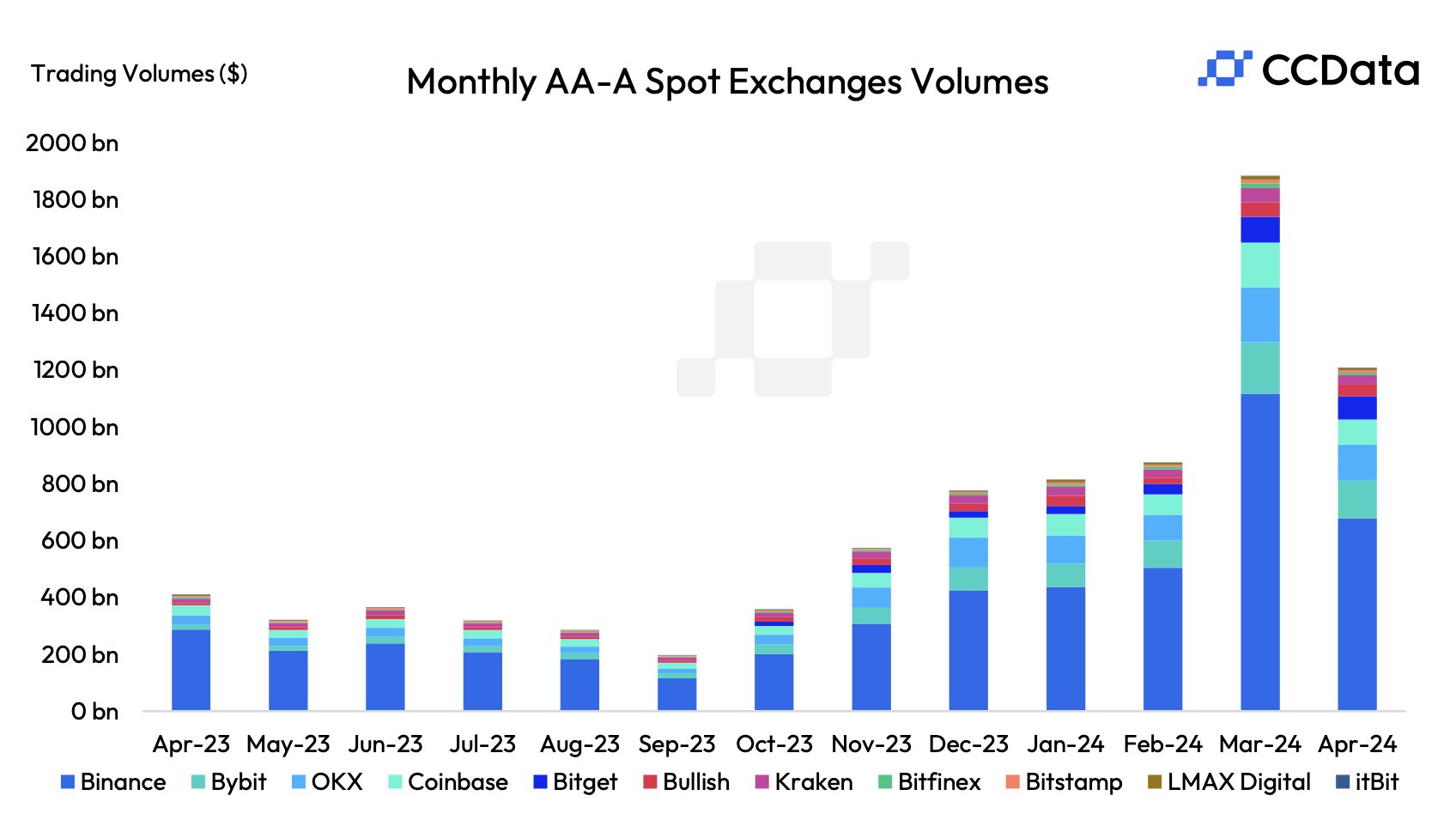
- Heavy Hitters Lead the Decline: Industry heavyweights bore the brunt of the contraction. Binance, the world’s largest cryptocurrency exchange by volume, along with prominent competitors Bybit and OKX, experienced the most substantial dollar-value reductions in trading activity.
- Sector Divergence: While exchange volumes slumped, alternative asset classes showed strength. As of mid-May, metaverse and gaming tokens surged 32.4% month-to-date, outperforming AI tokens (17.4%) and meme coins (16.2%), while Layer-2 scaling solutions languished in negative territory (-4.2%).
Chronology: From Q1 Frenzy to April Cool-Down
To fully understand the gravity of April’s contraction, one must examine the frantic trajectory of the digital asset markets leading up to the end of the first quarter.
Late 2023 to February 2024: The Momentum Builds
The resurgence in centralized exchange volumes began in earnest during the final quarter of 2023, catalyzed by mounting speculation regarding the approval of spot Bitcoin ETFs by the U.S. Securities and Exchange Commission (SEC). As institutional interest spilled over into retail markets, trading volumes climbed steadily month over month.
By February 2024, the momentum had intensified. Combined spot and derivatives volumes on CEXs reached approximately $8 trillion, reflecting renewed risk appetite and surging crypto asset valuations.

March 2024: The Peak of the Rally
March proved to be the apex of the recent bull run. Driven by Bitcoin reaching historic all-time highs ahead of the fourth network halving, combined centralized trading volumes skyrocketed to an estimated $11 trillion. Exchanges experienced unprecedented traffic, straining infrastructure and generating massive fee revenues for platform operators. During this period, leveraged derivatives trading hit fever pitch, driving up open interest across nearly all major platforms.
April 2024: The Correction
As April commenced, the macroeconomic and market dynamics shifted. The initial euphoria surrounding the spot Bitcoin ETF inflows began to normalize, and traders adopted a more cautious stance amid lingering regulatory headwinds and macroeconomic uncertainty regarding global interest rates.
The consequence was an immediate and severe contraction in liquidity. By the end of April, CCData’s tracking revealed that combined volumes had plunged by nearly 44%, wiping trillions of dollars in monthly throughput off the books of the world’s leading exchanges.
Supporting Data: Breakdown of Exchange Performance and Sector Returns
CCData’s granular analysis of individual exchange performance illuminates how the volume contraction distributed across the industry’s elite platforms.
Top-Tier Exchanges Feel the Pinch
While platforms across all grading tiers experienced reduced activity, the highest-volume tier (rated AA to A by CCData) absorbed the most significant reductions in absolute numbers:
- Binance (Grade A): Maintaining its position as the undisputed leader among top-tier spot exchanges, Binance processed $679 billion in April. However, this figure represents a 39.2% decline compared to its March performance.
- Bybit (Grade AA): Bybit demonstrated relative resilience in terms of percentage drop, falling 26.9% to record $133 billion in monthly volume.
- OKX (Grade A): OKX experienced a 34.8% reduction, finishing April with $126 billion in spot trading volume.
Basket Performance Returns: Altcoin Resilience
While centralized exchange operators grappled with drying liquidity, specific crypto asset sectors bucked the broader market trend, posting impressive gains through mid-May. According to CCData’s basket performance metrics as of May 10th, capital rotation shifted away from foundational layers toward high-beta and narrative-driven sectors:
- Metaverse/Gaming: +32.4%
- Artificial Intelligence (AI): +17.4%
- Meme Tokens: +16.2%
- Layer-1 Blockchains: +7.1%
- Decentralized Finance (DeFi): +6.7%
- Staking Assets: +4.0%
- Exchange Tokens: +3.5%
- Infrastructure: +1.6%
- Layer-2 Scaling Solutions: -4.2%
The impressive performance of metaverse gaming and AI tokens indicates that retail and speculative capital has not entirely left the ecosystem; rather, it has migrated toward high-growth thematic narratives while broader spot market trading pauses.
Official Responses and Market Commentary
Cryptocurrency exchange executives and independent market analysts have offered varied perspectives on the sudden contraction in trading volumes.
Industry leaders have generally downplayed the 43.8% drop, attributing it to a healthy cyclical consolidation phase. Representatives from major exchanges noted that March represented an unsustainable anomaly driven by parabolic price action, making an eventual retracement mathematically inevitable.
Furthermore, compliance and legal officers at several top-tier exchanges emphasized that despite the drop in volume, institutional onboarding pipelines remain robust. The continued maturation of custody solutions and regulatory clarity in key international jurisdictions are reportedly keeping long-term institutional interest intact, even if short-term speculative trading has cooled.
Market intelligence analysts tracking the data point out that the resilience of year-over-year metrics offers a more accurate lens for evaluation. Because April 2024 volumes still comfortably outpace almost every month from the prolonged 2022–2023 crypto winter, structural market health remains fundamentally sound.
Implications for the Broader Digital Asset Ecosystem
The sharp contraction in centralized exchange volumes carries several profound implications for investors, platform operators, and regulatory bodies alike.
1. Revenue Pressure on CEX Operators
For centralized exchanges, trading volume is the primary lifeblood. Transaction fees generated from spot and derivatives markets fund operations, expansion, R&D, and security infrastructure. A near-44% drop in a single month forces exchange management teams to tighten operational belts, re-evaluate marketing expenditures, and optimize cost structures until market-wide liquidity recovers.
2. Shift Toward Decentralized Alternatives (DEXs)
Historically, prolonged cooling periods on centralized exchanges often prompt shifts in user behavior. Traders seeking yield, privacy, or exposure to emerging altcoin narratives frequently migrate a portion of their capital to Decentralized Exchanges (DEXs). While CCData’s primary focus is centralized infrastructure, the outperformance of sectors like gaming, AI, and DeFi suggests that on-chain activity may be capturing market share from traditional order-book platforms.
3. Maturation of Market Cycles
The correction serves as a reminder that the crypto market continues to operate in aggressive, liquidity-driven cycles. The explosive growth of Q1 2024 was heavily front-loaded by macro events (namely the Bitcoin ETF approvals). As those catalysts are digested by the market, a period of consolidation is required to establish new support levels before the next leg up.
4. Investor Caution and Risk Management
For retail and institutional investors, the data underscores the necessity of rigorous risk management. The dramatic swings in monthly volume—ranging from $11 billion down to $6.58 billion—highlight how quickly market sentiment can pivot. Analysts advise market participants to look beyond headline volatility and focus on fundamental developments within resilient sectors such as AI, infrastructure, and gaming.
Conclusion
The 43.8% drop in centralized crypto exchange volumes in April marks the definitive end of an extraordinary six-month expansion phase. While a $6.58 trillion monthly volume still commands immense economic gravity—vastly outperforming 2023 baseline metrics—it signals that the market is taking a well-earned breather.
As exchanges recalibrate and capital rotates into high-performing altcoin sectors like metaverse gaming and AI, the digital asset ecosystem prepares for its next major catalyst. Whether the summer months will bring renewed bullish momentum or prolonged consolidation remains to be seen, but the underlying infrastructure of the crypto economy continues to demonstrate enduring durability.
Disclaimer: Opinions expressed in this report are for informational purposes only and do not constitute financial or investment advice. Digital asset markets carry high risks, and readers should conduct their own thorough due diligence before engaging in cryptocurrency trading or investments.