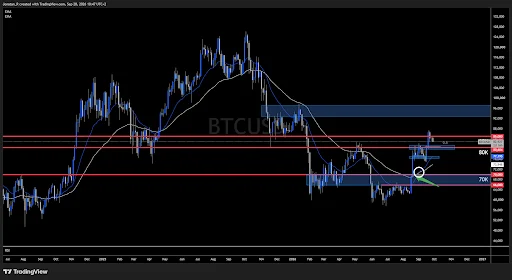
The $110 Million Flash Squeeze: How Leveraged Shorts Fueled a Rapid Crypto Market Surge
By the News Desk | Edited by Samuel Rae
Published by NewsBTC
Main Facts
Cryptocurrency markets delivered yet another stark reminder of the perils of excessive leverage on October 2, when a sudden, violent price surge cascaded through the digital asset ecosystem. Within a tight, ten-minute window, approximately $110 million in leveraged short positions were systematically liquidated across major centralized and decentralized exchanges.
The involuntary liquidations heavily favored one side of the market. Bearish traders—those betting on a decline in asset prices—bore the brunt of the shock as flagship assets Bitcoin (BTC), Ethereum (ETH), and the broader altcoin market moved sharply higher in unison. Rather than signaling a fundamental shift driven by macroeconomic announcements or regulatory announcements, the event exposed a classic derivatives feedback loop: crowded positioning colliding with thin liquidity, triggering a textbook short squeeze.
Key metrics of the October 2 event include:
- Total Liquidations: ~$110 million wiped out globally.
- Duration: Concentrated primarily within a frantic 10-minute burst.
- Primary Victims: Bearish short-position holders forced into automated buybacks.
- Primary Assets Impacted: Bitcoin, Ethereum, and key large-cap altcoins experiencing high perpetual futures open interest.
This flash event highlights an enduring truth of modern crypto market structure: while spot demand establishes baseline valuations, the derivatives market—fueled by perpetual swaps and high-multiplier leverage—frequently dictates the velocity and violence of short-term price discovery.
Chronology of the Event
To understand how a routine price uptick transformed into a $110 million liquidation cascade, it is necessary to examine the sequence of events as they unfolded on order books and derivatives tracking platforms.
Phase 1: The Accumulation of Crowded Positioning
In the days and hours leading up to October 2, perpetual futures markets had grown increasingly lopsided. Amid choppy macroeconomic sentiment and lingering uncertainty across global financial markets, a critical mass of retail and institutional speculators had piled into short positions. Funding rates across major exchanges began to drift negative or flatten, indicating that short sellers were actively paying longs to maintain their bearish bets.
This environment created a powder keg. Because perpetual futures do not expire, traders can hold leveraged short positions indefinitely, provided they maintain sufficient collateral (margin) to cover unrealized losses. However, this structure leaves them acutely vulnerable to upward price spikes.
Phase 2: The Initial Upward Spark
The catalyst for the initial price candle remains difficult to pin to a single headline—a hallmark of pure positioning-driven moves. Whether triggered by an opportunistic spot buy order, a whale clearing an over-leveraged book, or algorithmic trading bots probing liquidity thinness, Bitcoin experienced a sharp, unexpected upward tick.
As the price edged past key psychological and technical resistance levels, it breached the liquidation thresholds of the most vulnerable, highly leveraged short positions resting on exchange order books.
Phase 3: The Ten-Minute Cascade
Once the first wave of stop-losses and automated liquidations was triggered, the mechanical nature of derivatives exchanges took over.
- The Buyback Mechanism: When a short position is liquidated, the exchange forcibly buys back the asset on the open market to close out the trader’s borrowed exposure.
- The Domino Effect: These forced purchases added sudden, aggressive buy-side pressure to an already rising market, pushing prices higher still.
- The Squeeze Loop: The higher price breached the liquidation price of the next layer of short positions, triggering a new round of forced buying.
Within ten minutes, this self-reinforcing feedback loop swept through the order books, erasing $110 million in bearish bets and driving a rapid, vertical expansion in asset valuations. Similar mechanics were observed in August, when a notable Bitcoin short squeeze forced market-wide liquidations, proving that while the scale of these events varies, the underlying structural vulnerability remains constant.
Supporting Data and Market Mechanics
To fully grasp why a $110 million liquidation event can violently jolt multi-trillion-dollar asset classes, one must analyze the interplay between derivatives data, spot market liquidity, and institutional-sized risk positioning.
The Mechanics of a Short Squeeze
A leveraged short position is designed to profit from asset depreciation. A trader borrows an asset (such as Bitcoin) from an exchange or lending pool, sells it immediately at current market prices, and hopes to buy it back later at a lower price, returning the borrowed asset and pocketing the difference.
However, if the asset’s price rises instead, the dollar value of the borrowed asset increases relative to the trader’s collateral. If the market moves against the position past the maintenance margin threshold, the exchange executes an automatic liquidation to protect itself from bad debt.
When positioning is crowded—meaning thousands of traders hold similar short entries at identical price levels—their liquidation prices cluster tightly together. When prices spike, these clusters act as fuel. The liquidations transform bearish speculators into aggressive buyers, supercharging the initial rally far beyond what organic spot demand alone might achieve.
Institutional Risk and Transparent Onchain Venues
Derivatives trading is no longer confined to opaque offshore bucket shops. Modern market infrastructure increasingly utilizes transparent venues and decentralized margin accounts, allowing analysts to track large-scale institutional risk in real-time.
For instance, recent market telemetry highlighted massive individual trades, such as a $67 million Ethereum short position opened on Hyperliquid, demonstrating how professional-grade capital utilizes high-transparency derivatives platforms. When positions of this magnitude are forced to unwind, the ripples affect entire order books, spilling over from decentralized protocols to centralized giants like Binance, Bybit, and OKX.
The Interplay with Spot ETF Flows
Adding another layer of complexity to the October 2 squeeze was the concurrent recovery of US spot Bitcoin Exchange-Traded Funds (ETFs). Following periods of outflows, spot ETFs returned to posting positive daily net inflows.
While spot ETFs operate on a fundamentally different mechanism than perpetual futures—representing direct, regulated ownership of underlying coins rather than leveraged derivatives—both vehicles influence short-term liquidity dynamics. Spot ETF creations generate genuine, structural demand for underlying Bitcoin. When combined with a leveraged short squeeze, the dual pressure of institutional spot accumulation and derivative-driven forced buying creates an environment where headline price candles tell only a fraction of the story.
Furthermore, data from recent ETF trading sessions reveals that even on positive aggregate days, large issuer-level swings (such as dominant inflows into Fidelity or BlackRock products) can create localized supply shocks, further complicating the daily liquidity picture.
Official Responses and Market Commentary
Because the October 2 event was fundamentally structural—driven by mathematical liquidations rather than an external macroeconomic catalyst or corporate announcement—there were no emergency press conferences from central banks, regulatory statements from the SEC, or official PR releases from protocol foundations.
Instead, the "official response" of the market came directly from quantitative analysts, risk managers, and trading desks commenting on the fragility of current perpetual swap markets.
- Risk Management Desks: Several prominent crypto derivatives desks issued internal advisories warning clients against over-leveraging during periods of low realized volatility. Commentators noted that calm spot markets often disguise dangerously crowded positioning in perpetual futures.
- Onchain Analysts: Onchain data providers highlighted the speed of the liquidation cascade, noting that modern automated market makers (AMMs) and high-frequency trading (HFT) algorithms accelerate liquidation execution times from seconds to milliseconds.
- Industry Observers: Commenting on the recurring nature of these events, market analysts reiterated that while $110 million represents a notable flush of bearish leverage, it does not permanently purge risk from the system. Traders immediately began evaluating whether to re-establish short positions at higher levels, setting the stage for potential counter-squeezes should spot demand falter.
Implications for Traders and Market Structure
The events of October 2 carry profound implications for retail participants, institutional allocators, and the broader maturation of the cryptocurrency market.
1. The Illusion of Safety in Crowded Trades
The primary lesson of the flash squeeze is that consensus trades are exceptionally dangerous in crypto derivatives. When a vast majority of market participants lean in one direction—whether aggressively long or heavily short—the market develops an asymmetric vulnerability. Price action ceases to be a pure reflection of fundamental value and instead becomes a function of who can survive the next margin call.
2. Leverage Reset vs. Leverage Elimination
It is crucial to distinguish between a reset of leverage and the elimination of leverage. The eradication of $110 million in short positions successfully cleared out weak, over-leveraged bearish bets. However, it did not cure the market’s underlying appetite for leverage.
- Traders can—and frequently do—reopen leveraged positions almost immediately after being liquidated.
- If spot demand fails to follow through and absorb the newly minted higher prices, a market driven solely by a short squeeze can quickly reverse, plunging back down to trap late-arriving long speculators in a mirror-image long liquidation cascade.
3. The Growing Sophistication of Market Surveillance
As institutional capital increasingly enters the asset class via regulated ETFs, transparent perpetual DEXs, and prime brokerage accounts, the ability to monitor crowded positioning has improved dramatically. Traders and funds that fail to account for open interest concentrations, funding rate skews, and liquidation clusters do so at their own peril.
Conclusion
The October 2 short squeeze will not be remembered as a structural turning point for Bitcoin or Ethereum, but rather as a masterclass in market mechanics. It demonstrated vividly that in the fast-paced ecosystem of digital asset derivatives, positioning is power—and when positioning becomes dangerously overcrowded, the market requires very little external news to spark a multi-million-dollar fire.
This article was written by the News Desk and edited by Samuel Rae.