Andreessen Horowitz Identifies Web3 Gaming as the Catalyst for Mainstream Digital Asset Adoption
SAN FRANCISCO — Prominent Silicon Valley venture capital firm Andreessen Horowitz (a16z) has positioned Web3 gaming as the most viable frontier for onboarding the next generation of digital asset users. According to the firm’s comprehensive annual "State of Crypto" report, released by its dedicated crypto arm, a16zcrypto, the intersection of interactive entertainment and blockchain infrastructure holds the key to moving decentralized technologies out of financial circles and into the daily habits of mainstream consumers.
While decentralized finance (DeFi) and non-fungible tokens (NFTs) initially captured the public imagination during previous market cycles, a16z asserts that the gaming industry possesses the scale, cultural reach, and engagement loops necessary to spark a massive wave of crypto adoption. The report draws parallels between the current developmental phase of digital assets and the nascent internet of the 1990s, suggesting that foundational infrastructure is finally maturing enough to support widespread consumer applications.
Main Facts
The a16zcrypto report outlines several key developments defining the current state and future trajectory of the Web3 ecosystem:
- Web3 Gaming as a Growth Engine: The venture capital firm identifies gaming as the primary catalyst capable of driving large-scale consumer adoption of blockchain technologies.
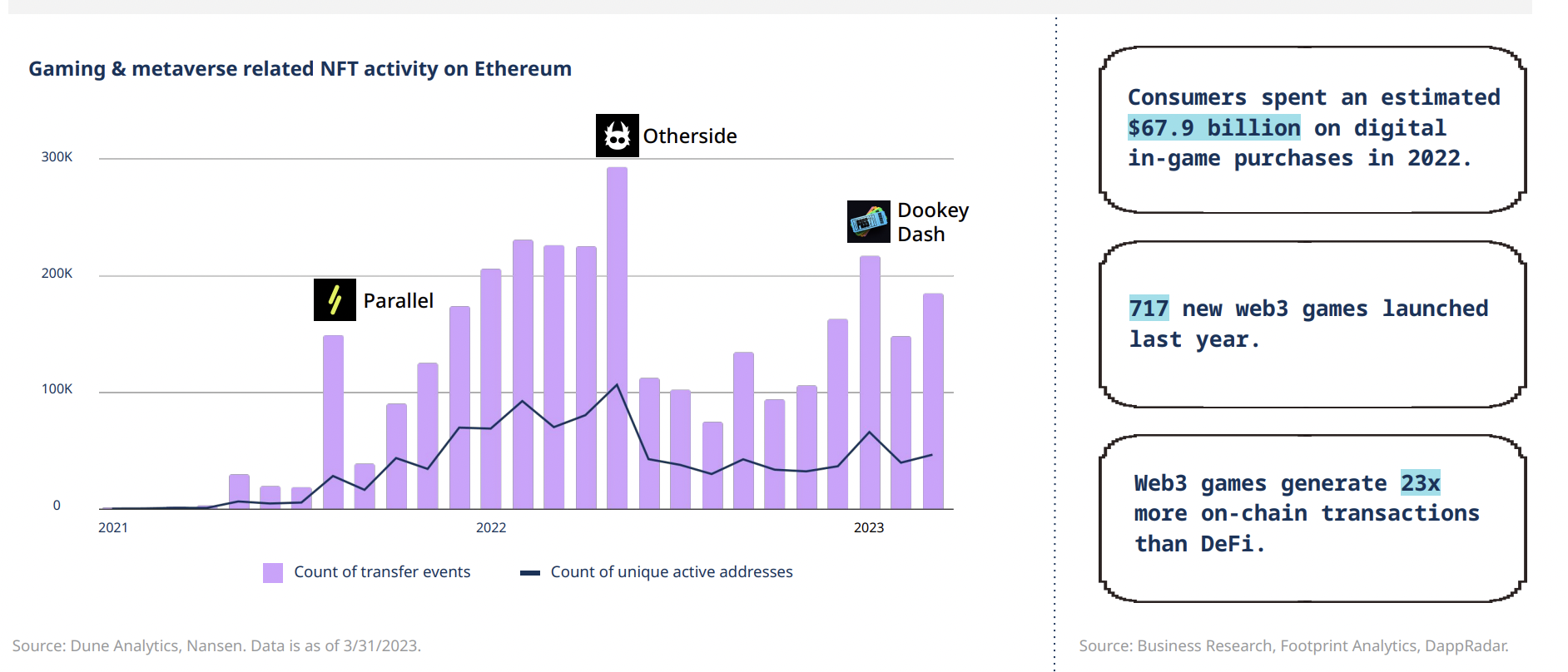
- Massive On-Chain Activity: Web3 games are currently generating 23 times more on-chain transactions than the entire decentralized finance (DeFi) sector, showcasing high levels of user interaction and engagement.
- Vibrant Development Ecosystem: Over the course of the preceding year, 717 new Web3-focused games have successfully launched.
- Lucrative Market Potential: Consumers spent an estimated $67.9 billion on digital in-game purchases in 2022 alone, highlighting a massive pre-existing market ripe for tokenization and player-owned economies.
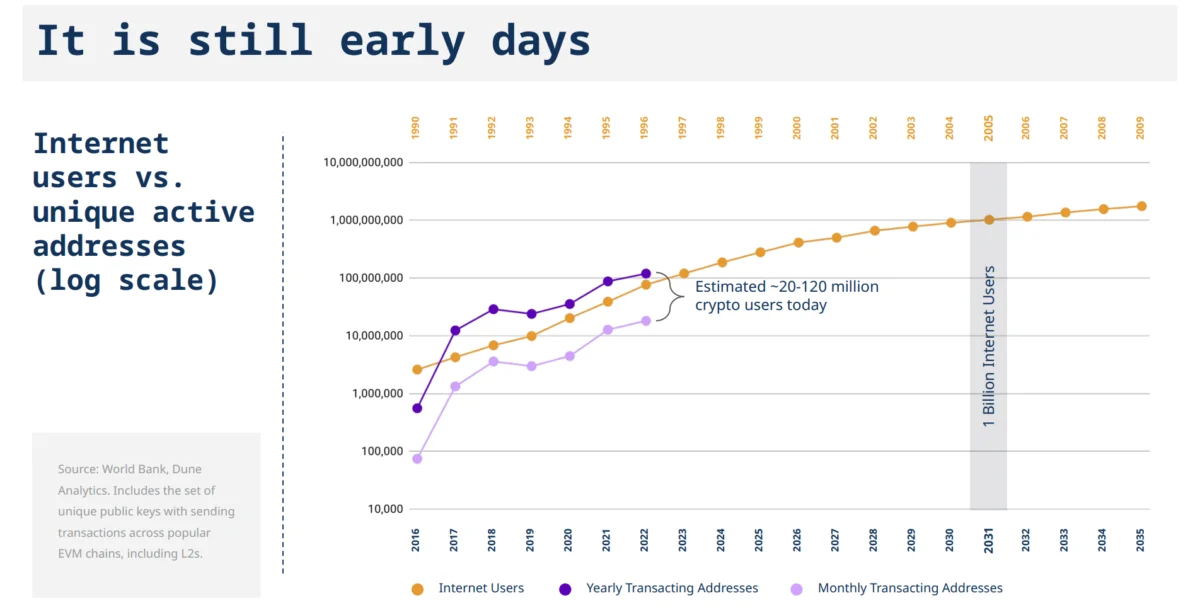
- Adoption Timeline Comparison: The report correlates the current adoption curve of cryptocurrency (starting from 2016) directly with the growth trajectory of the global internet during the 1990s.
Chronology: The Evolution of Crypto Adoption and Gaming
To understand the weight of a16z’s latest projections, it is helpful to examine the historical timeline of both digital assets and the integration of blockchain technology within interactive media.
The 1990s: The Internet Blueprint
In its report, a16z contrasts the modern crypto landscape with the early days of the commercial internet. In 1996, the global internet boasted approximately 100 million users. At the time, infrastructure was clunky, dial-up connections were slow, and the general public viewed the internet as an esoteric tool reserved for academics, hobbyists, and tech enthusiasts. It took decades of infrastructure improvements, user-experience refinements, and killer applications (such as e-commerce and social media) to transition the internet into a ubiquitous global utility.
2016–2020: The Foundation of Modern Crypto
The commercial crypto timeline, as mapped by a16z, begins in earnest around 2016. This era was defined by the rise of smart contract platforms, initial coin offerings (ICOs), and the foundational architecture required to build decentralized applications (dApps). During these years, crypto was overwhelmingly financialized; users interacted with blockchains primarily to buy, sell, trade, or speculate on tokens.
2021–2022: The Boom, DeFi Summer, and Early Web3 Gaming
The years 2021 and 2022 witnessed explosive growth in both capital inflows and user participation. While DeFi protocols and speculative NFT projects dominated headlines, forward-thinking developers began laying the groundwork for true player-owned economies. Play-to-earn models—most notably demonstrated by games like Axie Infinity—proved that users were willing to engage with blockchain backends if there was an economic incentive to do so. However, early iterations often prioritized financial speculation over gameplay mechanics, leading to unsustainable models when token prices dropped.
2022–Present: The Shift Toward Quality and Infrastructure
Moving into the current era, the focus has pivoted drastically. Developers are no longer building "crypto games" where the primary activity is trading tokens; instead, they are building AAA-quality video games that utilize blockchain technology invisibly beneath the hood to secure digital property rights, enable peer-to-peer marketplaces, and allow cross-game asset portability. This evolution marks the maturation phase that a16z highlights in its report.

Supporting Data: By the Numbers
The a16zcrypto report leans heavily on empirical data to support its thesis that Web3 gaming is uniquely positioned to bridge the gap between blockchain technology and everyday consumers.
Transaction Volume and On-Chain Activity
One of the most striking statistics highlighted in the report is that Web3 games generate 23 times more on-chain transactions than decentralized finance (DeFi). While DeFi protocols often command higher total value locked (TVL) due to large capital deposits by whales and institutional investors, gaming platforms boast vastly superior user retention and frequency of interaction. Every time a player crafts an item, trades a skin, wins a match, or moves an asset across a marketplace, an on-chain transaction occurs, driving continuous network activity.
Market Size and Developer Momentum
The global video game market represents one of the largest entertainment sectors on Earth. According to the data cited by a16z, consumers spent $67.9 billion on digital in-game purchases in 2022 alone. Traditional gaming has long conditioned billions of players to spend real fiat currency on purely digital goods that they do not truly own—items that remain locked within proprietary walled gardens.
Web3 gaming proposes a radical shift: true digital ownership via NFTs and decentralized ledgers. Recognizing this massive market potential, independent studios and venture-backed teams launched 717 new Web3 games over the course of a single year.
User Metrics: Crypto vs. The 1990s Internet
To contextualize the current scale of crypto adoption, a16z provides a comparative analysis of user growth:
- In 2022, the report estimated there were approximately 20 million monthly active transacting crypto addresses and 120 million yearly transacting addresses.
- For comparison, in 1996, the commercial internet reached roughly 100 million users.
This metric places the crypto industry right on the cusp of the mainstream explosion that transformed the internet from a niche technology into a foundational pillar of modern civilization.
Official Responses and Industry Perspectives
The findings from a16zcrypto have sparked widespread discussion across the venture capital, blockchain development, and traditional gaming sectors.
Industry analysts point out that while traditional gamers have historically expressed skepticism—and at times outright hostility—toward blockchain integration, the narrative is slowly shifting. Early consumer backlash was largely driven by predatory monetization models, rushed cash-grabs, and the perception that crypto games were nothing more than glorified Ponzi schemes disguised as entertainment.
However, studio executives and venture capitalists argue that the next wave of Web3 games addresses these exact pain points. By prioritizing engaging gameplay, seamless user onboarding (such as abstracting away seed phrases and gas fees), and treating blockchain purely as backend infrastructure rather than a core marketing gimmick, developers are slowly winning over skeptical audiences.
Furthermore, major tech platforms and cloud gaming providers are quietly building out infrastructure to support interoperable digital assets. While legacy gaming giants like Valve have maintained strict bans on blockchain-enabled games on platforms like Steam, competitors such as the Epic Games Store have actively welcomed Web3 titles, providing them with a massive, mainstream distribution channel.
Implications for the Future of Digital Assets
The conclusion drawn by Andreessen Horowitz carries profound implications for developers, investors, and regulatory bodies alike.
1. Shifting the Narrative from Finance to Utility
For over a decade, the public perception of cryptocurrency has been inextricably linked to financial speculation, market volatility, and illicit activity. By championing Web3 gaming, venture firms like a16z are attempting to reframe blockchain technology as a consumer-facing utility. When a user interacts with a blockchain to trade a sword in a fantasy role-playing game without ever realizing they are using crypto, the psychological barrier to adoption crumbles.
2. Redefining Digital Ownership
For decades, gamers have poured billions of dollars into digital cosmetics, characters, and virtual real estate, only to lose access to those assets if a game’s servers were shut down or if their account was banned. Web3 gaming introduces decentralized property rights. If a game developer shuts down a title, players retain ownership of their digital assets, which can potentially be utilized in sequels, traded on open marketplaces, or integrated into entirely separate virtual ecosystems.
3. Regulatory and Infrastructure Challenges
Despite the optimistic outlook presented in the a16z report, significant hurdles remain. Regulatory uncertainty surrounding token economics, securities laws, and digital asset taxation continues to cast a shadow over Web3 development, particularly in Western jurisdictions. Additionally, user experience (UX) friction—such as navigating complex wallet setups, understanding network gas fees, and securing private keys—must be entirely eliminated by developers before mainstream gamers will adopt these systems in large numbers.
Conclusion
Andreessen Horowitz’s assessment paints a clear picture of where the next major wave of digital asset adoption will likely originate. By leveraging the immense cultural and financial power of the global gaming industry, Web3 developers have a unique opportunity to transition blockchain technology from the fringes of high finance into the daily routines of hundreds of millions of consumers worldwide. As infrastructure improves and studio quality catches up to traditional gaming standards, the lines between playing for fun and owning your digital footprint are set to blur permanently.