
Centralized Crypto Exchanges Suffer Steep 43.8% Volume Drop in April, Breaking Six-Month Bullish Streak
Main Facts
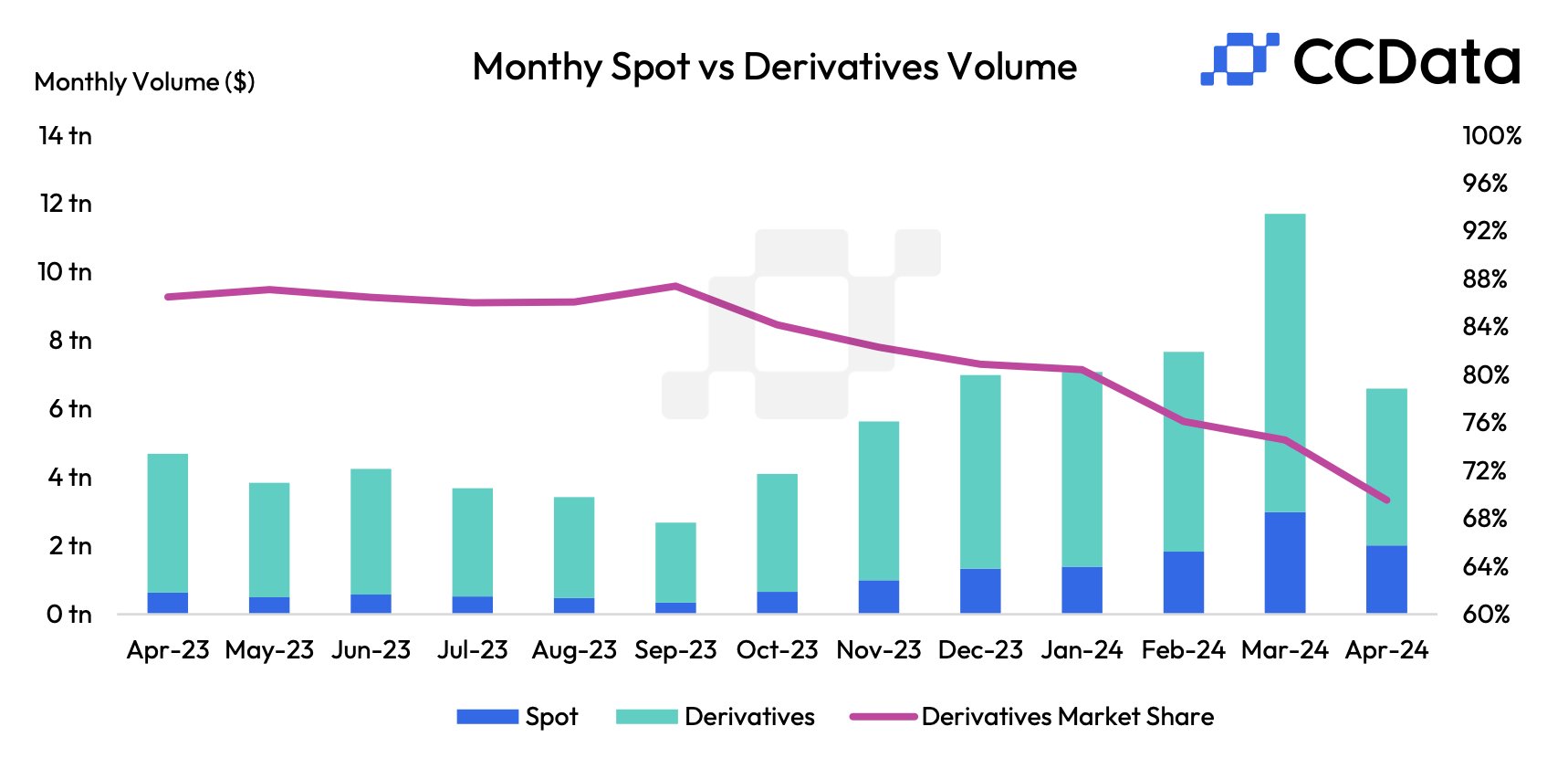
The explosive momentum that characterized the cryptocurrency market through the late winter and early spring of 2024 encountered a severe roadblock in April. New comprehensive blockchain data compiled by market tracker CCData reveals that the total trading volume across centralized cryptocurrency exchanges (CEXs)—encompassing both spot and derivatives markets—suffered a staggering 43.8% contraction during the month.
After sustaining six consecutive months of aggressive upward growth, the combined monthly trading volume plummeted to $6.58 trillion. This dramatic retreat follows a record-shattering March, which saw combined trading volumes peak at approximately $11 trillion, and a robust February, which logged roughly $8 trillion in transactions.
Despite the sharp month-over-month correction, the broader macro perspective remains relatively resilient. Industry analysts point out that April 2024’s total volume still outpaces every individual month recorded throughout the entirety of 2023, save for December.
The downturn hit top-tier platforms particularly hard, with industry giants such as Binance, Bybit, and OKX experiencing the most substantial capital regressions. Simultaneously, sector-specific performance metrics highlight a shifting narrative within the digital asset ecosystem, where speculative niches like metaverse gaming, artificial intelligence (AI), and meme tokens managed to buck the broader market stagnation to deliver notable double-digit month-to-date returns.
Chronology of the Slump
To fully understand the magnitude of April’s contraction, it is essential to trace the trajectory of the crypto market’s activity over the preceding half-year.
Late 2023 to Early 2024: The Six-Month Surge
Beginning in late 2023, centralized exchanges experienced a massive renaissance in user activity and capital inflows. Driven largely by institutional anticipation and the subsequent approval of spot Bitcoin Exchange-Traded Funds (ETFs) in the United States, trading desks witnessed unprecedented volumes. This bullish momentum carried aggressively into the first quarter of 2024.

February 2024: Approaching Peak Activity
By February 2024, the market was operating at a fever pitch. Combined spot and derivatives volumes on centralized exchanges climbed to approximately $8 trillion. Retail and institutional traders alike heavily capitalized on surging token prices, particularly Bitcoin’s march toward new all-time highs.
March 2024: The High-Water Mark
The apex of this cycle arrived in March 2024. Fueled by widespread euphoria, macroeconomic optimism, and relentless altcoin speculation, CEX trading volumes rocketed to an astronomical $11 trillion. Liquidity providers, market makers, and centralized platforms were processing record numbers of daily transactions, creating an illusion of unstoppable expansion.
April 2024: The Sudden Correction
As April unfolded, market sentiment shifted abruptly. Macroeconomic pressures, regulatory tightening, and a natural consolidation phase following explosive quarterly gains caused trading desks to cool down dramatically. By the close of the month, volumes had evaporated by nearly 44%, dragging the aggregate figure down to $6.58 trillion. This sudden cooling officially terminated the six-month consecutive winning streak that had defined the post-crypto-winter recovery.
Supporting Data & Exchange Breakdown
CCData’s comprehensive analytics break down the April slump across individual platforms, highlighting how top-tier exchanges absorbed the blow.
Top-Tier Exchange Performance
The world’s leading centralized exchanges bore the brunt of the volume contraction. According to CCData’s exchange benchmark rankings:
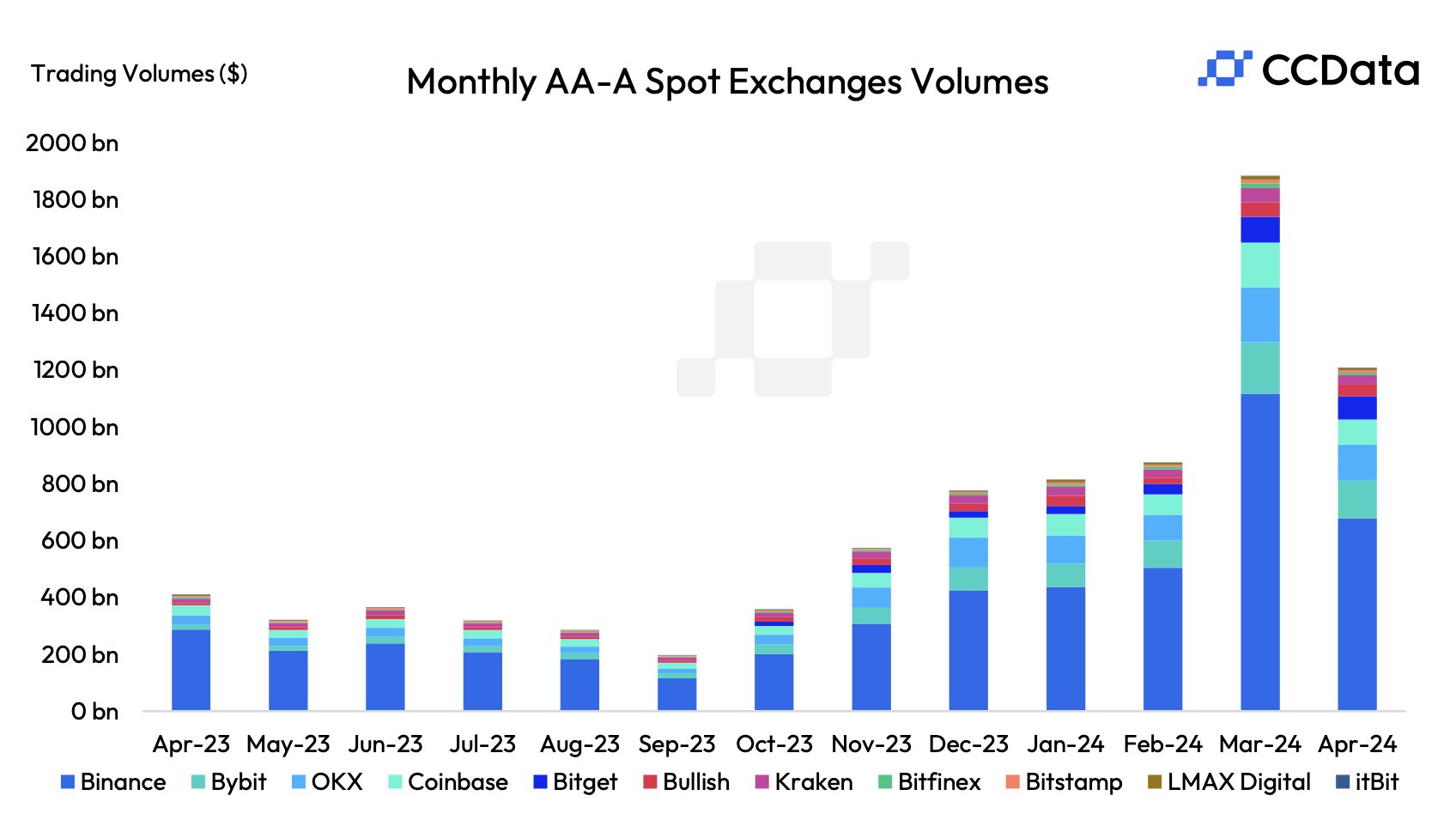
- Binance: As the undisputed global leader in terms of trading volume, Binance (classified as a Grade A exchange) processed $679 billion in spot volume during April. This figure represents a severe 39.2% decline compared to March metrics.
- Bybit: Ranking as a Grade AA exchange, Bybit saw its spot and derivatives operations contract to $133 billion, marking a 26.9% decrease month-over-month.
- OKX: Another dominant player in the derivatives and spot markets, OKX (Grade A) recorded $126 billion in volume, translating to a 34.8% drop.
Sector Basket Performance Returns (As of May 10)
While centralized exchange activity and foundational layer assets contracted, capital rotation within decentralized and niche communities painted a starkly different picture. Data tracking specific crypto narratives through early May revealed striking divergences in performance:
| Sector / Narrative | Month-to-Date Return (As of May 10) |
|---|---|
| Metaverse / Gaming | +32.4% |
| Artificial Intelligence (AI) | +17.4% |
| Meme Tokens | +16.2% |
| Layer-1 Blockchains | +7.1% |
| Decentralized Finance (DeFi) | +6.7% |
| Staking Protocols | +4.0% |
| Exchange Tokens | +3.5% |
| Infrastructure | +1.6% |
| Layer-2 Scaling Solutions | -4.2% |
The data underscores a fascinating market dynamic: even as centralized liquidity dried up and overall exchange volumes plummeted by over 40%, retail and speculative traders aggressively chased high-beta sectors, pushing metaverse and gaming tokens up by an impressive 32.4%. Conversely, Layer-2 scaling networks struggled to find momentum, sliding 4.2% into negative territory.
Official Responses and Industry Commentary
While individual exchanges have largely refrained from issuing panicky press releases regarding the volume contraction, industry executives and market makers have offered measured perspectives on the data.
Representatives from major compliance-focused platforms attribute the April pullback to a necessary market "digestion period." Following the hyper-accelerated price appreciation in the first quarter—largely catalyzed by the historic rollout of spot Bitcoin ETFs—a period of consolidation was widely anticipated by institutional risk desks.
Furthermore, macroeconomic headwinds played a critical role in shaping executive outlooks. Persistent concerns regarding global inflation metrics, shifting central bank interest rate trajectories, and heightened regulatory scrutiny across key international jurisdictions prompted many institutional market participants to pull back on risk exposure.
Market intelligence firms like CCData emphasize that while a 43.8% monthly decline sounds catastrophic in isolation, it must be viewed within the context of structural market maturation. The crypto industry is no longer operating in the speculative vacuum of past cycles; rather, it exhibits cyclical volume expansions and contractions that increasingly mirror traditional equity and derivatives markets.
Implications for the Broader Crypto Ecosystem
The sharp contraction in centralized exchange trading volume carries profound implications for various stakeholders across the digital asset landscape.
1. Revenue Pressures on Centralized Platforms
Centralized exchanges rely heavily on trading fees as their primary revenue engine. A 43.8% drop in monthly volume translates directly to a substantial compression in top-line revenue for giants like Binance, OKX, and Bybit. In response, platforms may look to diversify their service offerings—such as expanding wealth management products, institutional custody solutions, and Web3 wallet integrations—to insulate themselves against future spot market dry spells.
2. Market Liquidity and Volatility Dynamics
Lower trading volumes on CEXs can lead to thinner order books, potentially increasing short-term price volatility during sudden market movements. However, it also signals a transition from frenzied speculative trading to more calculated, long-term accumulation phases by institutional investors.
3. Capital Flight to Decentralized and Niche Sectors
The strong performance of alternative sectors—such as gaming (+32.4%), AI (+17.4%), and meme tokens (+16.2%)—suggests that retail liquidity is far from exiting the ecosystem entirely. Instead, capital is rotating away from stagnant major trading pairs and flowing into high-risk, high-reward narratives. This trend highlights the persistent appetite for speculation among retail market participants, regardless of broader centralized exchange headwinds.
4. Outlook Moving Forward
As the market navigates the remainder of the year, all eyes remain fixed on macro catalysts, regulatory developments, and structural adoption curves. While April’s numbers serve as a sobering reminder of crypto’s inherent volatility, the fact that volumes remain structurally higher than almost any month in 2023 indicates that the foundational floor of the industry continues to rise.