Institutional Capital Floods Crypto Markets: A Mid-Year Analysis of 2025’s Unprecedented Inflow Surge
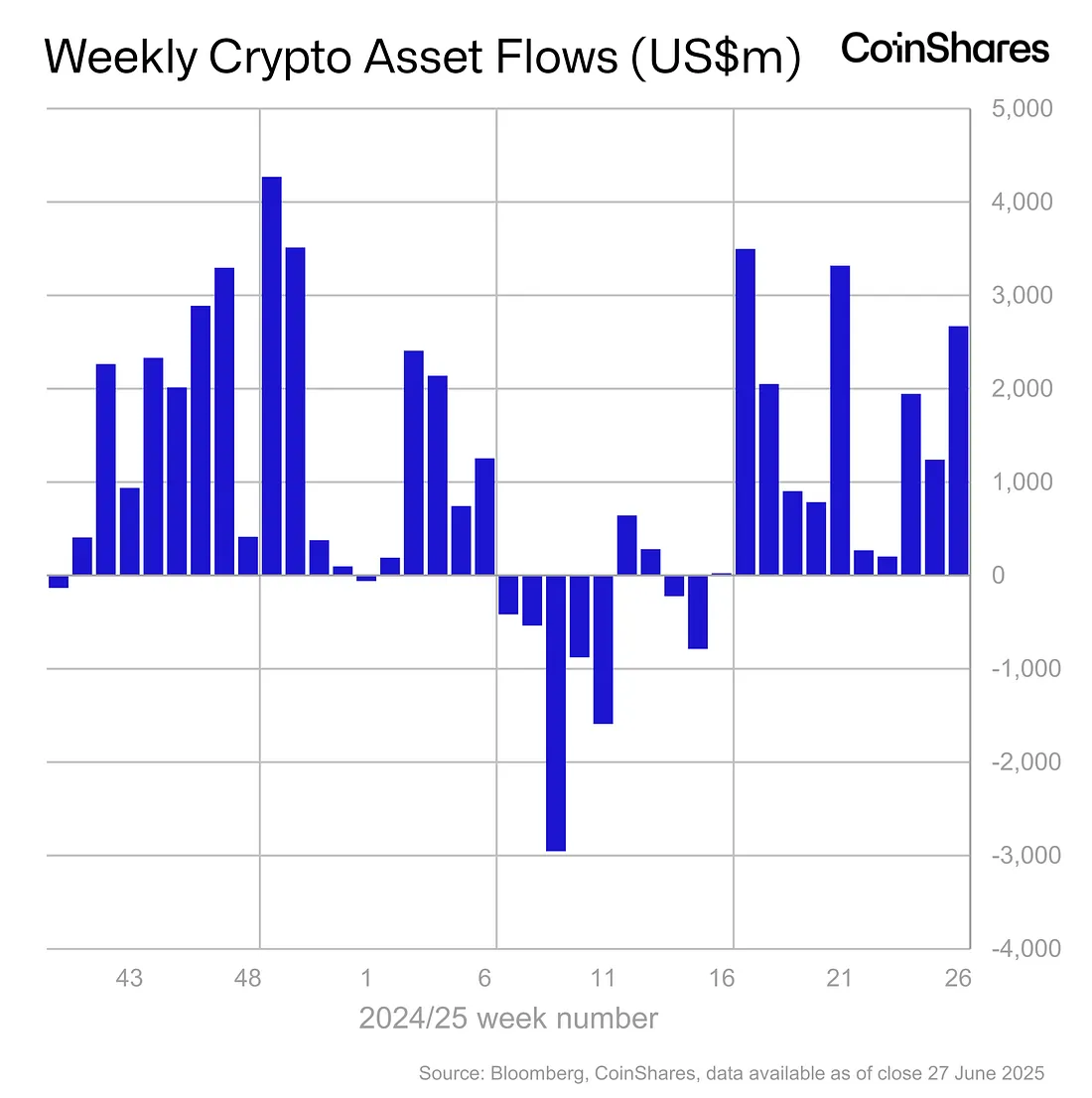
Institutional interest in digital assets has reached a fever pitch as the first half of 2025 draws to a close. According to the latest data from the prominent crypto asset management firm CoinShares, institutional-grade investment vehicles have attracted a staggering $16.9 billion in net inflows over the past eleven weeks alone. This relentless wave of capital underscores a fundamental shift in the global financial landscape, as traditional market participants increasingly integrate cryptocurrencies into their long-term portfolio strategies.
The latest Digital Asset Fund Flows Weekly report highlights that the cumulative inflows for the first six months of 2025 are nearing the record-breaking benchmarks set during the same period in 2024, which saw $18.3 billion in capital allocations. This consistency suggests that despite periodic volatility, the institutional "smart money" remains firmly committed to the digital asset space.
The Core Data: A Mid-Year Tally
The numbers released by CoinShares paint a picture of aggressive accumulation. For the week ending in late June, digital asset investment products recorded a massive $2.7 billion in net inflows. This specific surge serves as the capstone to an eleven-week period of unbroken positive sentiment.
Chronology of the 2025 Inflow Trend
- Q1 2025: Initial institutional momentum was buoyed by regulatory clarity and the anticipation of macroeconomic shifts, leading to a steady climb in Assets Under Management (AUM) across major providers.
- Mid-Q2 2025: Market sentiment saw a brief period of consolidation as investors assessed the Federal Reserve’s interest rate trajectories and global inflationary data.
- Late Q2 2025 (The Current Surge): The most recent eleven-week streak has been characterized by a decoupling of crypto from traditional tech-stock volatility, with investors viewing Bitcoin and Ethereum as "safe-haven" hedges against geopolitical instability.
Comparing the current year to 2024, analysts note that the trajectory is remarkably similar. While 2024 set a high bar, 2025 is proving that the institutional appetite is not merely a transient trend but a structural evolution in how wealth is managed.
Regional Disparities: A Tale of Two Markets
While the appetite for digital assets is global, the geographic distribution of these inflows reveals significant variations in regulatory environments and investor confidence.
The United States: The Engine of Growth
The United States remains the undisputed leader in institutional adoption. In the most recent reporting period, the U.S. market accounted for $2.65 billion of the total $2.7 billion in global inflows. This overwhelming concentration is largely attributed to the maturation of spot-based investment products, which provide institutional investors with a regulated, low-friction pathway to gain exposure to the underlying assets.
European Stability vs. Asian Outflows
In contrast to the American surge, European markets showed mixed results. Switzerland and Germany continued to be hubs of activity, recording inflows of $23 million and $19.8 million, respectively. These nations have long been pioneers in providing institutional-grade custody and exchange-traded products (ETPs), maintaining a loyal investor base that continues to add to their positions.
However, the Asian market—specifically Hong Kong—has faced a more turbulent quarter. Hong Kong saw a total of $132 million in outflows during June alone, contributing to a broader regional trend that saw Canada and Brazil also shedding capital. Analysts suggest that these outflows are likely driven by profit-taking and localized regulatory adjustments rather than a lack of long-term belief in the asset class.
Bitcoin and Ethereum: The Primary Beneficiaries
The institutional focus remains hyper-concentrated on the two industry titans: Bitcoin (BTC) and Ethereum (ETH).
Bitcoin’s Dominance
Bitcoin remains the primary vehicle for institutional capital, accounting for 83% of the total inflows observed in the latest weekly report. This amounts to roughly $2.2 billion dedicated solely to the world’s largest cryptocurrency.
Perhaps more telling than the inflows into long-only products is the performance of short-Bitcoin investment vehicles. These products, designed to profit from a decline in BTC price, saw $2.9 million in outflows, bringing the year-to-date total to $12 million. This is a definitive signal of market sentiment: institutional investors are effectively "betting against the bears," viewing any price dip as a buying opportunity rather than a signal of a market cycle top.

The Ethereum Resurgence
Ethereum, often considered the primary utility layer of the digital asset ecosystem, continues to defy critics. With $429 million in inflows last week, ETH is maintaining a consistent streak of investor interest. This sustained capital infusion suggests that institutional investors are increasingly recognizing Ethereum’s role in decentralized finance (DeFi), smart contract execution, and the broader tokenization of real-world assets.
Macro-Drivers: Why Now?
The question remains: what is driving this massive institutional migration into crypto in mid-2025? CoinShares and independent market analysts point to two primary catalysts:
1. Heightened Geopolitical Volatility
As conflicts persist across multiple theaters and trade tensions between major economic blocs rise, institutional investors are looking for assets that operate independently of central bank control. Bitcoin’s "digital gold" narrative has moved from the fringes of crypto-Twitter into the boardrooms of major hedge funds and asset managers. When traditional fiat currencies face the risk of devaluation or weaponization via sanctions, decentralized digital assets offer an alternative that is borderless and immutable.
2. Monetary Policy Uncertainty
The global economic landscape remains plagued by uncertainty regarding the direction of monetary policy. With central banks struggling to balance the competing pressures of controlling inflation and preventing economic stagnation, investors are wary of traditional bond and equity markets. By allocating a portion of their portfolio to digital assets, institutions are seeking a "non-correlated" asset—one that does not move in lockstep with interest rate announcements or corporate earnings reports.
Implications for the Future
The implications of $16.9 billion in inflows over just three months are profound.
Increased Market Liquidity
As more institutional capital flows into these investment vehicles, the underlying market liquidity increases. This reduces the "slippage" that previously discouraged large-scale trades, making it easier for pension funds, insurance companies, and sovereign wealth funds to enter the space without drastically moving the price of the asset.
The Regulatory Feedback Loop
Increased institutional participation forces regulators to take the asset class more seriously. As these billions of dollars are managed by highly regulated entities, the pressure for comprehensive, pro-innovation regulatory frameworks in the U.S. and abroad intensifies. The institutions are not just participants in the market; they are effectively the lobby that will define the next decade of crypto-law.
The Risk of Concentration
While the inflow numbers are bullish, they do highlight a growing concentration of wealth in specific products. This raises questions about market health and the potential for "flash crashes" if institutional sentiment were to turn in unison. However, the current data suggests that the investor base is becoming more diversified, with a mix of hedge funds, family offices, and retail-oriented institutional platforms all contributing to the current flow.
Conclusion
The mid-year data from 2025 confirms that the "crypto winter" is a distant memory. We are currently in a phase of aggressive institutional integration, where Bitcoin and Ethereum are increasingly viewed as foundational assets for any modern, forward-looking portfolio.
As we look toward the second half of 2025, the key indicators to watch will be the sustainability of these inflows if interest rates begin to stabilize and whether or not the regional disparities—such as the outflows in Hong Kong—reverse course. For now, the message from the institutional world is clear: digital assets have moved from the periphery to the core of the global financial engine.
Disclaimer: The information provided in this report is for educational and informational purposes only and does not constitute financial advice. All investments involve risk, including the loss of principal. Investors are encouraged to conduct their own due diligence and consult with a licensed financial advisor before making any investment decisions in digital assets.