Institutional Capital Floods Crypto Markets: Record Inflows Follow U.S. Policy Shifts
The digital asset market has witnessed a seismic shift in investor sentiment, as institutional capital moves into the sector with unprecedented velocity. According to the latest "Digital Asset Fund Flows" report from leading asset manager CoinShares, institutional investment vehicles attracted nearly $2 billion in a single week. This surge in activity underscores a fundamental pivot in how traditional financial institutions perceive cryptocurrency, a trend largely catalyzed by recent U.S. executive policy proposals.
The Catalyst: A New Era of U.S. Policy
The primary driver behind this monumental capital movement appears to be the recent executive actions taken by the Trump administration. These orders, which emphasize a supportive stance toward the digital asset industry, have specifically proposed the establishment of a strategic national Bitcoin reserve.
For years, institutional investors have operated with a "wait and see" approach, constrained by regulatory uncertainty and a lack of clear legislative frameworks. The prospect of Bitcoin being treated as a strategic reserve asset—a move that would place it in the same institutional category as gold or foreign currencies—has drastically altered the risk-reward calculus for pension funds, hedge funds, and family offices. The executive orders have effectively signaled that the U.S. is not merely "tolerating" the crypto industry, but rather integrating it into the core of its national economic strategy.
Chronology of the Surge
The momentum began building in the weeks leading up to the presidential inauguration, as markets reacted to campaign promises and post-election policy rhetoric.
- Pre-Inauguration Rally: As expectations for a more favorable regulatory environment solidified, Bitcoin broke through previous all-time highs. This price discovery phase served as a catalyst for increased institutional engagement.
- The Executive Order Announcement: Immediately following the official unveiling of the administration’s digital asset agenda, daily flows into crypto-investment products spiked.
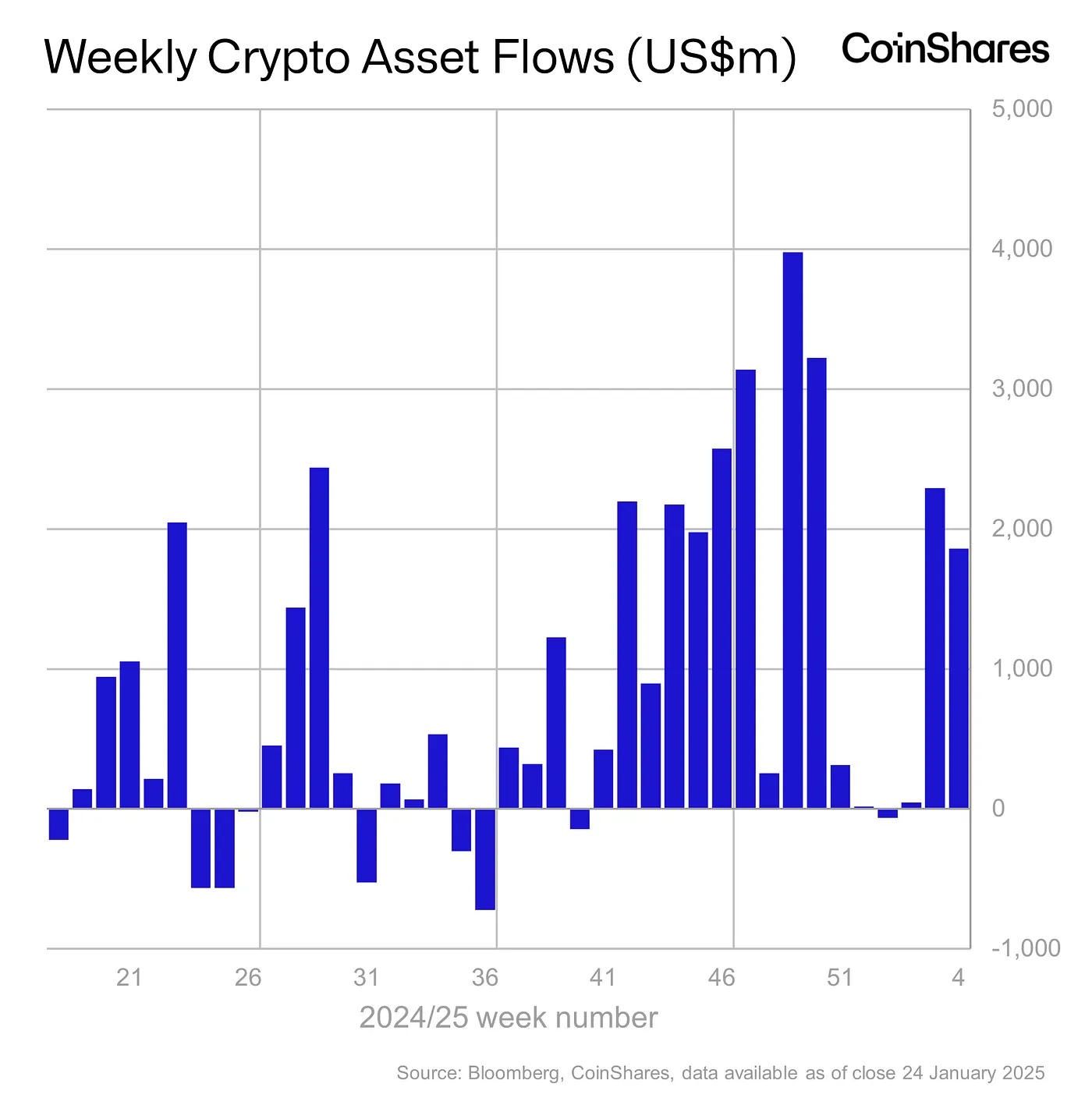
- Weekly Record: Within the seven-day period following the policy announcement, CoinShares recorded $1.9 billion in inflows, bringing the total year-to-date (YTD) inflows to $4.8 billion.
- High-Volume Trading: Despite a relatively stable price action throughout the week, the underlying trading volume on trusted crypto exchanges surged to $25 billion. This high velocity indicates that large-scale institutional players were not just holding assets, but actively rotating capital into the ecosystem.
Supporting Data: A Breakdown of Institutional Flows
The data provided by CoinShares paints a clear picture of geographic and asset-specific preferences. The United States continues to dominate the landscape, cementing its position as the global hub for digital asset institutional investment.
Geographic Distribution
- United States: The U.S. led the charge, capturing $1.7 billion of the total $1.9 billion global inflows. This overwhelming majority highlights the direct correlation between U.S. domestic policy and global liquidity.
- International Contributions: While the U.S. dominated, international markets showed healthy participation. Switzerland, a traditional safe haven for capital, contributed $35 million; Canada added $31 million; and Germany saw $23 million in new inflows.
Asset-Specific Performance
Bitcoin, as the primary asset for institutional exposure, captured the lion’s share of the sentiment.
- Bitcoin (BTC): With $1.6 billion in inflows, Bitcoin accounted for 92% of the total weekly activity. The year-to-date inflows for Bitcoin now stand at $4.4 billion. Interestingly, the market saw a $5.1 million inflow into short-Bitcoin ETFs, suggesting that while the majority of institutional sentiment is bullish, some sophisticated traders are hedging against potential volatility following the rapid rise to all-time highs.
- Ethereum (ETH): The second-largest asset by market capitalization saw $205 million in inflows. This shift is notable, as it marks a departure from previous weeks of stagnation for Ethereum-based products.
- Altcoins: Broadly, the institutional appetite for altcoins remains cautious but positive. With the notable exception of Cardano (ADA), which experienced minor outflows, nearly every institutional product in the sector saw net positive movement.
Official Responses and Industry Outlook
The industry has reacted to these developments with cautious optimism. Financial analysts point to the fact that institutional investment is no longer a fringe activity but a core component of portfolio diversification.
Industry leaders suggest that the influx of $1.9 billion is merely the "tip of the iceberg." As the regulatory framework in the United States becomes clearer—and as other nations potentially follow the U.S. lead in recognizing Bitcoin as a strategic reserve—the barriers to entry for large-scale institutional players are expected to collapse.
However, some analysts remain wary of the volatility associated with "policy-driven" rallies. While the executive orders provide a bullish narrative, the actual implementation of a strategic reserve is a complex legislative and economic process that could face significant bureaucratic hurdles.

Implications for the Future
The current trajectory of institutional investment suggests several long-term implications for the financial ecosystem:
1. The Maturation of Asset Classes
The fact that institutional products (ETFs, ETPs, and trusts) are handling billions of dollars in volume demonstrates that the infrastructure for digital assets has matured. Institutional-grade custody, reporting, and execution platforms are now robust enough to handle high-frequency, high-volume demand from major financial institutions.
2. Geopolitical Competition
The U.S. move toward a Bitcoin reserve creates a new form of geopolitical competition. If the U.S. succeeds in establishing a robust strategic reserve, other nations may feel compelled to diversify their own treasury holdings into digital assets to avoid being left behind. This could trigger a "sovereign race" to acquire BTC, significantly tightening supply and driving long-term price appreciation.
3. Reduced Correlation to Traditional Markets
Historically, cryptocurrencies have moved in lockstep with tech stocks and the Nasdaq. However, as Bitcoin transitions into a "strategic reserve asset" status, its correlation with equities may decrease. Investors may begin to view BTC as a hedge against sovereign fiscal instability, similar to how they have viewed gold for centuries.
4. Regulatory Clarity as a Competitive Advantage
By providing clear, pro-industry guidelines, the U.S. is effectively signaling to global firms that it is the premier jurisdiction for crypto-finance. This will likely lead to a "brain drain" of crypto-talent and capital from restrictive jurisdictions toward the U.S. markets.
Conclusion
The data provided by CoinShares serves as a bellwether for the broader financial market. With $4.8 billion in year-to-date inflows and a massive $1.9 billion weekly surge, the message from institutional investors is clear: they are preparing for a future where digital assets are a cornerstone of the global economy.
While the market remains susceptible to the typical cycles of volatility and regulatory shifts, the institutional "stamp of approval" afforded by the recent U.S. policy focus is a transformative event. As the dust settles from the initial reaction to the executive orders, the industry will be watching closely to see how quickly these capital flows translate into long-term infrastructure investment and, eventually, a new, more integrated financial paradigm.
Disclaimer: The information provided in this report is for educational and informational purposes only and does not constitute financial, investment, or legal advice. Cryptocurrency investments are inherently high-risk, and investors should conduct their own thorough due diligence before committing capital. The Daily Hodl does not endorse or recommend the buying or selling of any specific digital assets. Participation in cryptocurrency markets involves the risk of total loss.