The Rise of the Machine Economy: How Autonomous AI Agents are Revolutionizing Crypto Micro-Payments
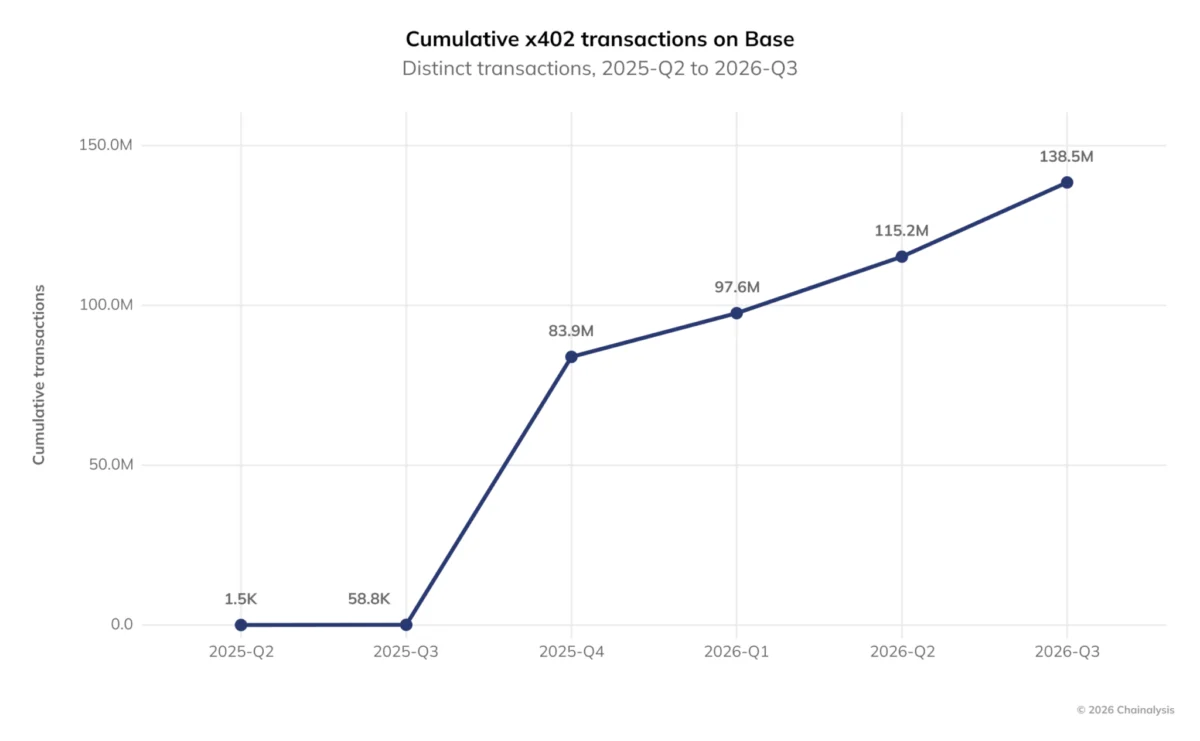
In a quiet, digital revolution that has largely escaped the attention of mainstream retail investors, autonomous AI agents have begun to reshape the architecture of the internet economy. According to a landmark report from blockchain intelligence firm Chainalysis, these software-based entities have successfully executed over 138 million cryptocurrency transactions using the x402 protocol—a Coinbase-incubated framework designed to facilitate machine-to-machine commerce.
This shift marks a departure from traditional human-centric financial models, signaling the dawn of an era where software agents—rather than individuals—are the primary participants in the global economy. By leveraging the speed, transparency, and borderless nature of blockchain technology, these agents are facilitating a new category of "agentic commerce," characterized by high-frequency, low-value micro-transactions that would be economically unfeasible under legacy banking systems.
The Core Facts: Understanding x402 and Agentic Commerce
At the heart of this development is the x402 protocol. Incubated by Coinbase, x402 serves as the infrastructure that allows software agents to pay for online services autonomously. Traditionally, web services are gated by subscriptions or human-verified payment gateways. The x402 protocol removes this friction by enabling AI agents to hold their own digital wallets, make independent payments, and access data-driven services without human oversight.
The data provided by Chainalysis reveals that the vast majority of these transactions are micro-payments. In the 16-month period ending in September 2026, over 87% of all payments processed through the protocol ranged from a fraction of a cent to ten cents. This specific data point is crucial: it confirms that we are seeing the emergence of a machine-readable, machine-payable web where AI agents are paying for granular data, API calls, and computational power in real-time.
Chronology of a Digital Transformation
The rapid adoption of agentic commerce can be tracked through the evolution of wallet behavior and protocol integration.
- Early Adoption (2025): When the x402 protocol first emerged, it was treated as an experimental sandbox. During this phase, there was a significant "latency" between the creation of a wallet and its first transaction. Data shows that in late 2025, the median age of a wallet initiating an x402 payment was 73 days. This suggests that developers were testing the infrastructure, performing manual configurations, and waiting for the right moment to deploy capital.
- The Inflection Point (Early 2026): As the tooling for AI agents matured, the friction began to evaporate. The "on-chain" ecosystem saw a surge in agent-specific frameworks, allowing for easier integration between AI models and crypto payment rails.
- Operational Efficiency (Q3 2026): By the third quarter of 2026, the paradigm had shifted entirely. The time between a wallet’s initial funding and its first transaction collapsed to just 18 minutes. This drastic reduction from 73 days to 18 minutes serves as a clear indicator that these wallets are no longer general-purpose tools but are instead "purpose-built" for agentic commerce. These wallets are effectively being spun up by software agents, funded, and set to work immediately.
Supporting Data: The Anatomy of Machine Spending
The Chainalysis report provides a fascinating breakdown of where these funds are actually going. The narrative that AI agents are merely "testing" the blockchain is countered by the sheer volume of utility-based spending.
Where the Money Flows
The primary destination for these millions of transactions is information-focused services. AI agents are notoriously "hungry" for data, and the x402 protocol has become the primary mechanism for satiating this appetite. Key categories include:
- Technical Services: Code review, data and search API access, and financial intelligence gathering.
- Infrastructure Support: Payments for agent frameworks and specialized "agentic tooling" that allow for more complex autonomous behaviors.
- Model Inference: Perhaps most interestingly, AI agents are increasingly paying other AI agents. A significant portion of x402 activity is dedicated to model inference—where one agent pays another to perform a specific computational task or process data that the first agent cannot handle alone.
- Peripheral Services: Beyond pure data, these agents are actively participating in token issuance, gaming, and gambling services, suggesting that AI agents are beginning to mirror the diverse financial interests of human users.
Implications for the Future of the Web
The rise of agentic commerce via protocols like x402 carries profound implications for the global digital economy. We are moving toward an ecosystem where "micro-monetization" is the standard for software.
1. The Death of the Subscription Model
Current web services rely heavily on monthly subscriptions, which often lead to wasted capital for users who underutilize services. With x402, an AI agent can pay for exactly what it uses—down to the single API query or code snippet. This creates a more efficient "pay-as-you-go" model that benefits both the provider and the consumer.

2. The Autonomy of Capital
The transition from human-directed payments to agent-directed payments represents a shift in the definition of "financial agency." When an AI agent can hold and spend its own capital, it becomes an economic entity in its own right. This could eventually lead to agents that manage their own P&L (Profit and Loss) statements, optimize their own spending to minimize costs, and reinvest profits into their own infrastructure.
3. Impact on Web Infrastructure
This development fundamentally changes the requirements for web infrastructure. If a service provider wants to be "AI-compatible," they must now support autonomous payment rails. This will likely force a wave of upgrades across the tech sector, as companies scramble to integrate blockchain-based payment layers to capture the growing market of autonomous, machine-driven demand.
Navigating the Risks
Despite the optimism surrounding this technological leap, industry experts and developers urge caution. The integration of AI agents with financial protocols introduces new vectors for systemic risk.
For one, the speed at which these agents operate makes traditional risk management—such as human approval or manual fraud detection—obsolete. If an agent is compromised or programmed with a flaw that leads to "runaway spending," it could drain significant amounts of capital in seconds. Furthermore, the anonymity and rapid turnover of these agent-based wallets make it difficult for platforms to enforce standard Know-Your-Customer (KYC) and Anti-Money Laundering (AML) regulations.
As Chainalysis and other industry observers have noted, while the technology is transformative, the regulatory and security landscapes are still playing catch-up. Investors and developers alike are reminded that while the "machine economy" is here, the infrastructure supporting it is still in its nascent stages.
Conclusion: A New Economic Layer
The data from the 2026 report confirms that the "Internet of Value" is no longer just for human-to-human or human-to-business transactions. It has evolved to include machine-to-machine commerce, a layer of the economy that operates at a speed and scale far beyond human capacity.
With 138 million transactions and a clear trend toward purpose-built agent wallets, the x402 protocol has proven that the infrastructure for an autonomous economy is not only possible but already active. As AI agents continue to proliferate and become more specialized, we can expect this volume of micro-transactions to grow exponentially, cementing the role of cryptocurrency as the native currency of the autonomous, machine-led internet.
Disclaimer: The information provided in this article is for educational and informational purposes only and does not constitute financial, investment, or legal advice. The Daily Hodl is not an investment advisor. The cryptocurrency market is highly volatile and involves significant risk. Investors should conduct their own thorough due diligence before participating in any digital asset ecosystem.