Institutional Capital Floods Crypto Markets: A Mid-Year Analysis of 2025’s Unprecedented Inflows
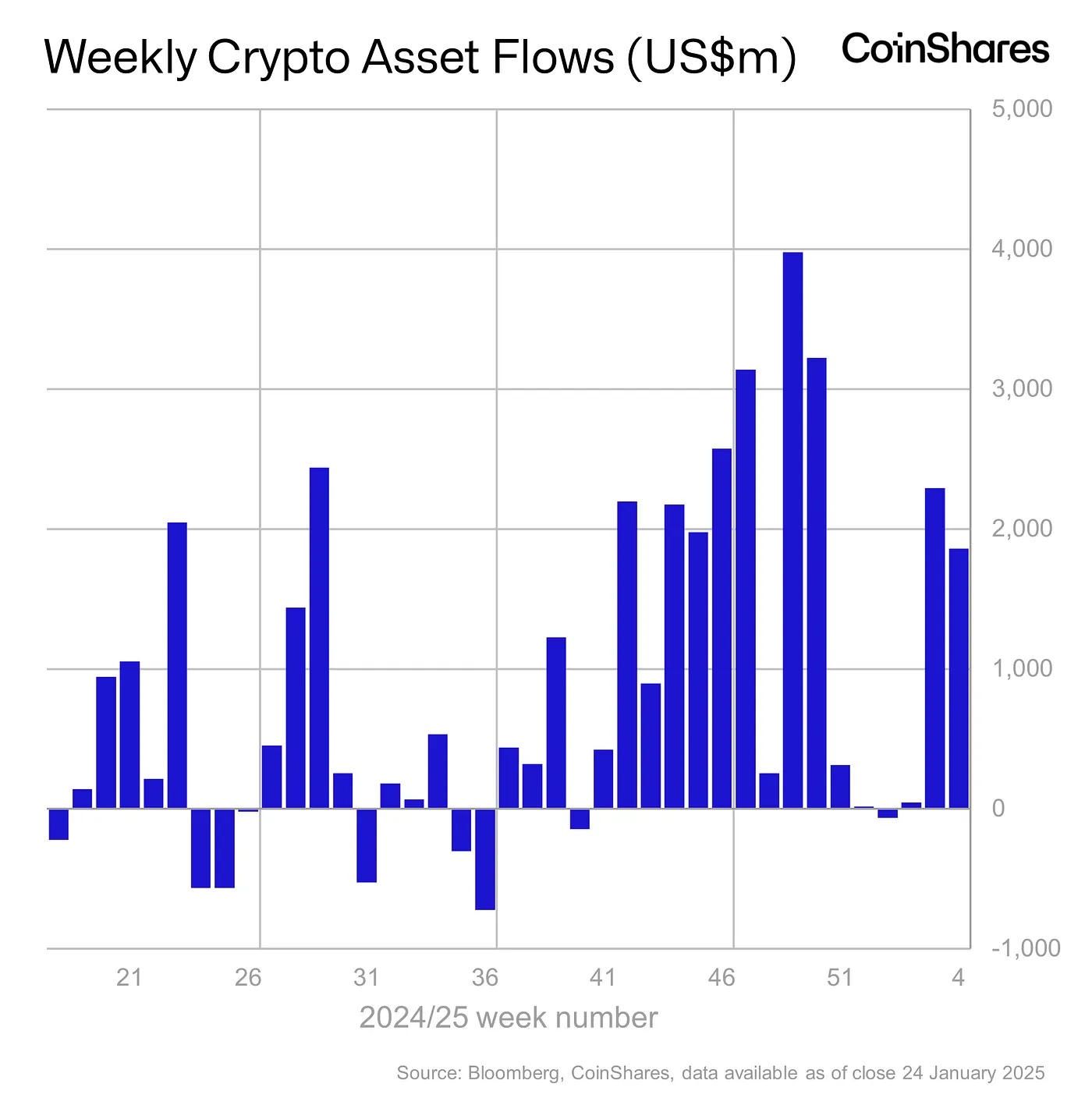
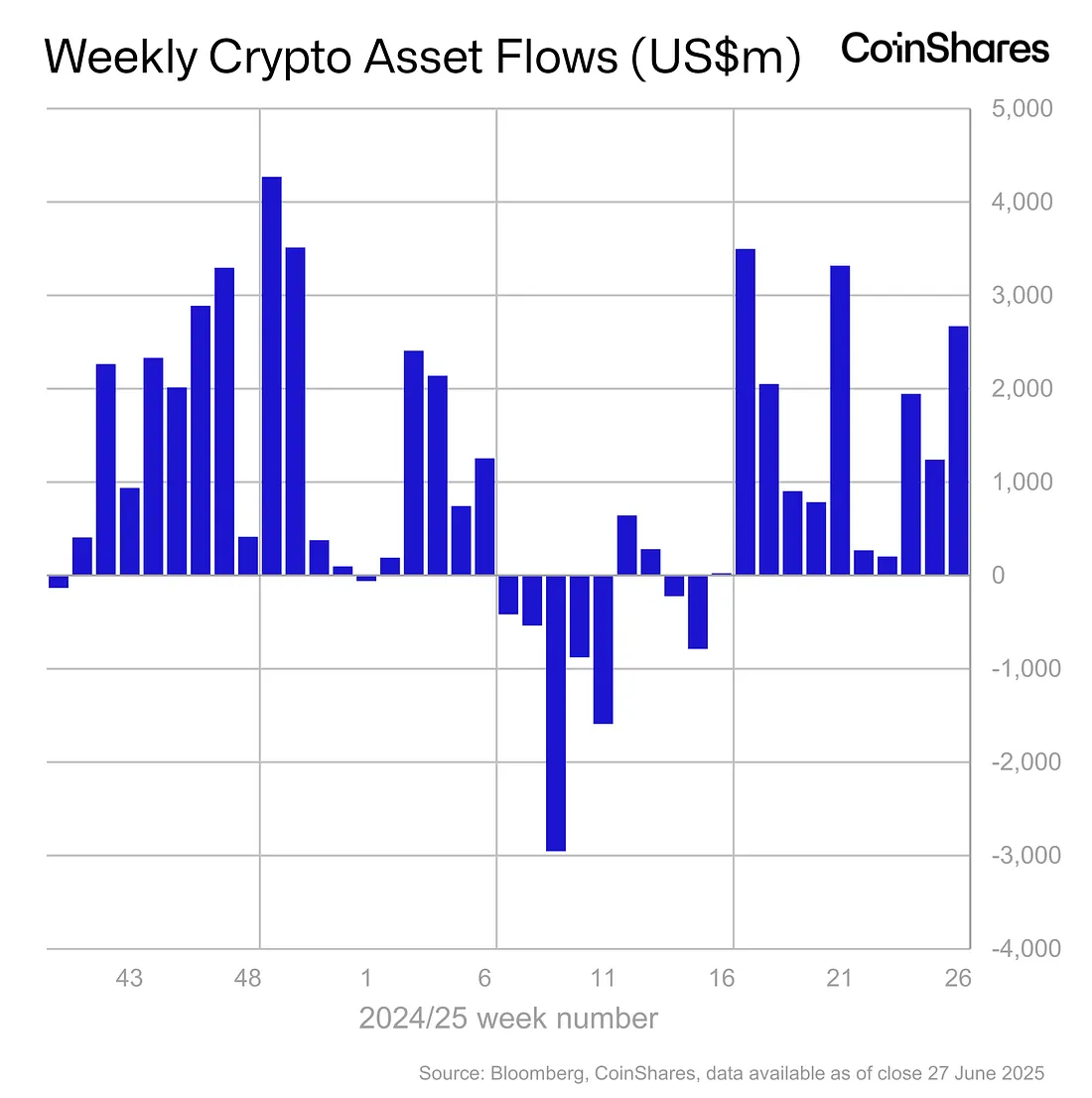
The digital asset sector has reached a significant milestone as it concludes the first half of 2025. According to the latest "Digital Asset Fund Flows Weekly" report from CoinShares, institutional investment vehicles have witnessed a massive resurgence in demand. With over $16.9 billion in capital inflows recorded over the past eleven consecutive weeks, the crypto market is demonstrating a level of resilience that mirrors the bullish momentum seen during the record-breaking months of 2024.
As the global financial landscape grapples with shifting monetary policies and lingering geopolitical instability, institutional investors are increasingly pivoting toward digital assets as a hedge against traditional market volatility.
Main Facts: The State of the Market
The data provided by CoinShares indicates that institutional sentiment is overwhelmingly positive. In the most recent week alone, digital asset investment products absorbed $2.7 billion in new capital. This brings the cumulative total for the current 11-week rally to $16.9 billion.
When evaluating the performance of the first half of 2025 (H1), the data reveals that the current year is pacing almost perfectly alongside the historic performance of 2024. By the end of June 2024, institutional inflows had reached $18.3 billion. While 2025 is slightly trailing that record pace, the momentum suggests that the underlying appetite for crypto-exposure remains robust among traditional finance entities, including asset managers, hedge funds, and pension funds.
The core driver of this influx appears to be a dual-pronged catalyst:
- Geopolitical Uncertainty: With ongoing conflicts and trade tensions globally, investors are treating assets like Bitcoin as "digital gold," seeking store-of-value properties outside the traditional banking system.
- Monetary Policy Ambiguity: Central banks worldwide remain in a period of indecision regarding interest rate adjustments. As investors attempt to anticipate the next move of the Federal Reserve and its global counterparts, they are rebalancing portfolios to include crypto, which historically operates with a different risk-return profile than traditional equities.
Chronological Overview: How the Inflows Unfolded
To understand the current market position, it is necessary to examine the trajectory of these funds over the last quarter.
- Early Q2 2025: The market began the second quarter with cautious optimism. Following a consolidation period in late Q1, institutional desks began slowly increasing their exposure as regulatory clarity in the United States reached a new level of maturity.
- Late May 2025: A notable surge in buying activity occurred as institutional players began front-running the mid-year macroeconomic data releases. This period marked the beginning of the current 11-week winning streak.
- June 2025: This month proved pivotal. While the broader institutional market saw inflows, regional disparities became pronounced. The U.S. market acted as the primary engine of growth, while other regions—most notably Hong Kong—experienced a localized liquidity crunch, with $132 million in outflows reported for the month alone.
- Current Status: As of the end of June, the industry has solidified a "buy-the-dip" mentality, with Bitcoin and Ethereum serving as the primary beneficiaries of the incoming capital.
Supporting Data: Regional and Asset-Specific Breakdowns
The geographic distribution of these inflows highlights a clear trend: capital is centralizing in markets with the most favorable regulatory frameworks and the most liquid exchange-traded products (ETPs).
Regional Performance
- The United States: Dominating the global stage, the U.S. accounted for $2.65 billion of the recent $2.7 billion weekly inflow. The success of U.S.-based spot ETFs remains the primary factor for this concentration of wealth.
- Europe: Switzerland and Germany continue to provide steady support, recording inflows of $23 million and $19.8 million, respectively.
- Outflow Regions: Conversely, Canada, Hong Kong, and Brazil recorded net outflows. The $132 million in outflows from Hong Kong in June reflects a period of profit-taking and a potential cooling off in Asian institutional interest compared to the rapid acceleration seen in the U.S.
Asset-Specific Allocation
Bitcoin remains the king of institutional portfolios, accounting for 83% of total inflows last week ($2.2 billion). Perhaps most telling is the performance of "Short-Bitcoin" products. These vehicles, which allow investors to profit from a decline in Bitcoin’s price, saw $2.9 million in outflows last week. Year-to-date, short-Bitcoin products have seen $12 million in outflows, signaling that the "smart money" is currently betting on sustained growth rather than a correction.
Ethereum, meanwhile, continues to maintain its status as the leading altcoin choice for institutions. It recorded $429 million in inflows last week, signaling a strong institutional belief in the utility and future growth of the Ethereum ecosystem.
Implications for the Future of Finance
The persistent flow of capital into these products has profound implications for both the crypto industry and the global financial system.

1. The Institutionalization of Crypto
We are moving away from the era where retail investors dictate market volatility. As institutional inflows continue to climb into the double-digit billions, the volatility profile of Bitcoin and Ethereum may undergo a transformation. Larger, more stable capital bases often lead to increased liquidity and, over the long term, potentially reduced intraday volatility.
2. Regulatory Pressure
The overwhelming concentration of inflows in the United States places significant pressure on global regulators to harmonize their digital asset policies. When jurisdictions like Hong Kong or Brazil see outflows, it often points to a "flight to quality" where institutional investors prefer the stability of U.S. oversight and the depth of its capital markets. Other nations may be forced to streamline their own regulatory frameworks to prevent further capital flight.
3. The "Digital Gold" Thesis
If the current trend holds, Bitcoin is successfully cementing its status as an essential component of a diversified institutional portfolio. The rejection of "short" products suggests that professional investors no longer view Bitcoin as a speculative toy, but as a long-term asset that belongs in the same category as commodities and precious metals.
Official Perspective and Market Commentary
While CoinShares provides the raw data, the broader financial community is interpreting these numbers as a signal of a "new normal." Financial analysts suggest that the consistency of these inflows—11 straight weeks—is not a fluke but a calculated strategy by hedge funds and family offices.
"The consistency we are seeing in 2025 suggests that the ‘institutionalization’ phase is no longer a forecast—it is a reality," says a senior analyst at a major digital asset firm. "When you see sustained inflows even during periods of macro-economic uncertainty, it confirms that institutions are using these vehicles as a strategic allocation, not just a tactical trade."
However, investors are urged to remain cautious. The volatility inherent in the crypto market has not vanished. As the CoinShares report highlights, while the trend is positive, geopolitical and monetary policy shifts can occur rapidly, potentially altering market sentiment overnight.
Conclusion: What Lies Ahead for H2 2025?
As the market enters the second half of 2025, the central question is whether this momentum can be sustained. With $16.9 billion in the bag for the last quarter, the bar for the remainder of the year is high.
Investors should watch for three key indicators in the coming months:
- Federal Reserve Pivot: Any significant changes in U.S. interest rate policy will likely trigger a massive shift in capital flow.
- Regulatory Milestones: Further clarity on the classification of various altcoins beyond Bitcoin and Ethereum could unlock even more institutional interest.
- Global Adoption: Whether regional outflows in places like Hong Kong are reversed will depend on local policy shifts and the availability of new, competitive investment vehicles.
For now, the message from the institutional sector is clear: the demand for digital assets is not only alive, it is growing. As institutional capital continues to migrate toward crypto-investment vehicles, the boundary between "traditional finance" and "decentralized finance" continues to blur, pointing toward a future where digital assets are a permanent fixture in the global investment landscape.
Disclaimer: The information provided in this article is for educational and informational purposes only and does not constitute financial, investment, or legal advice. Digital assets are high-risk investments. Investors should conduct their own thorough research and consult with a professional advisor before making any financial decisions. The Daily Hodl and the author are not responsible for any financial losses incurred through the use of this information.