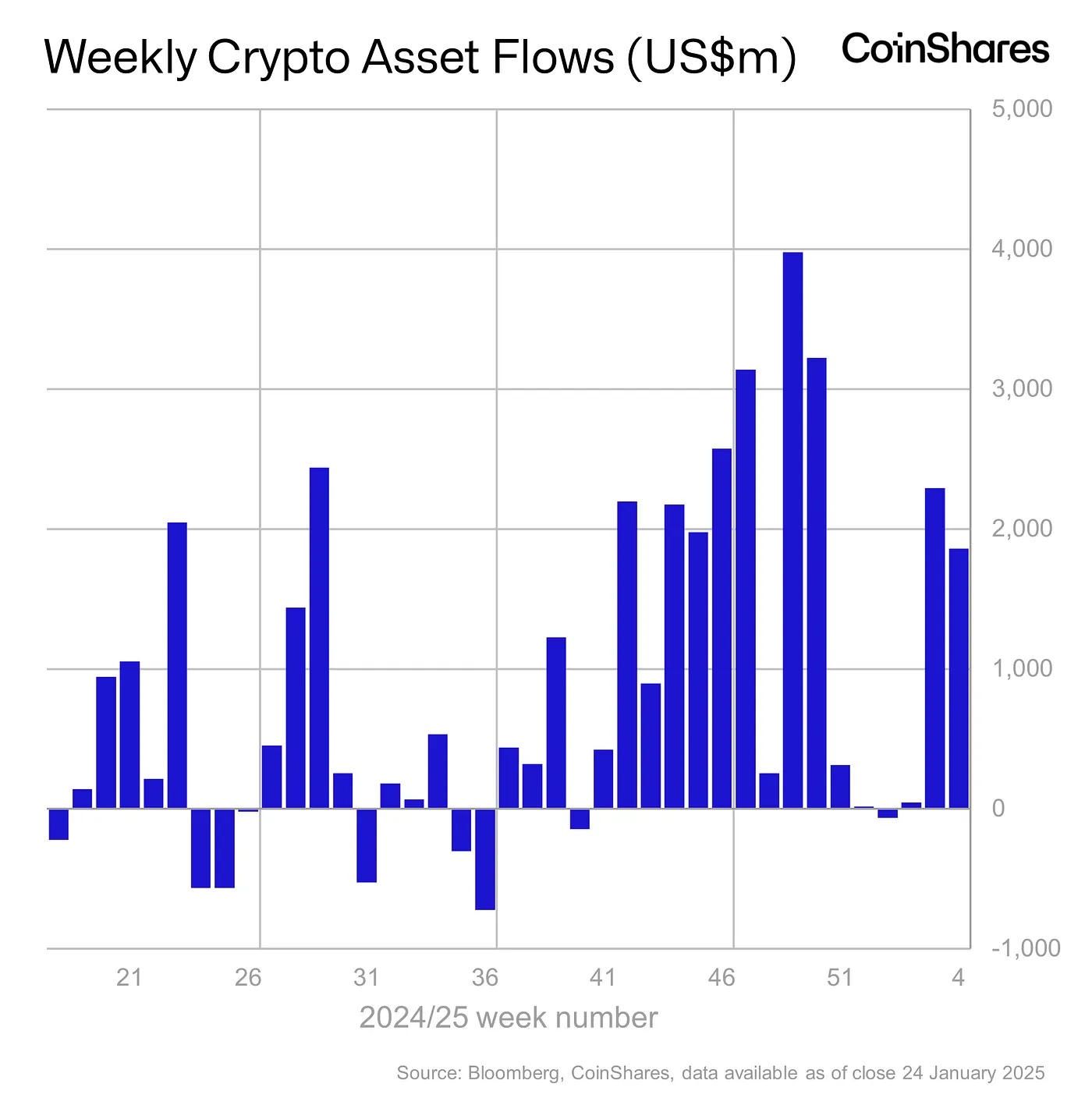
Institutional Exodus: How Geopolitical Tariff Volatility Stalled the Crypto Bull Run
Executive Summary
In a dramatic shift for the digital asset landscape, institutional investors have executed a massive retreat from crypto-focused investment products over the past several weeks. According to the latest "Digital Asset Fund Flows Weekly Report" published by CoinShares, the market has been rattled by the direct economic fallout of President Trump’s recent tariff policies.
What began as a promising start to the year has been effectively neutralized. The latest data reveals that cumulative year-to-date (YTD) inflows have been stripped away by a relentless wave of selling, with outflows totaling $795 million in the most recent week alone. As global markets grapple with the "calamitous" tariff war, the institutional appetite for risk-on assets like Bitcoin and Ethereum has significantly cooled, forcing a re-evaluation of market stability in an era of protectionist economic policies.
The Chronology of the Sell-Off
The recent instability in digital asset investment products is not an isolated event but rather the culmination of a deteriorating macroeconomic environment that gained momentum in early February.
The February Onset
The first signs of institutional cold feet appeared in early February, as rhetoric regarding new international trade tariffs began to circulate. Investors, traditionally sensitive to inflationary pressures and supply chain disruptions, began trimming their positions in crypto-backed exchange-traded products (ETPs) and trusts.
The April Trough
By April 8, the market hit a critical inflection point. As tariff activity intensified, investor sentiment reached a nadir. Total Assets under Management (AuM) across crypto funds plummeted to their lowest levels since early November 2024. The correlation between the administration’s protectionist trade announcements and the rapid liquidation of digital asset portfolios became impossible to ignore, signaling that institutional money—often considered the "smart money"—was prioritizing capital preservation over crypto-speculation.
The Temporary Rebound
A brief glimmer of hope emerged late last week. Following President Trump’s surprise announcement of a temporary reversal of the most severe tariffs, markets reacted with immediate relief. This policy pivot provided a momentary floor for asset prices, helping to lift total AuM back to the $130 billion mark—an 8% recovery from the April 8 lows. However, analysts warn that this recovery is fragile and contingent on the continued stability of trade relations.
Supporting Data: By the Numbers
The scale of the capital flight is staggering, providing a clear window into how institutional desks are managing risk in the face of political volatility.
The "Bleed" by Asset Class
- Bitcoin (BTC): As the primary bellwether for the crypto market, Bitcoin bore the brunt of the selling pressure. The asset recorded $751 million in outflows last week, highlighting that even the most institutionalized crypto-asset is not immune to macro-driven liquidation.
- Ethereum (ETH): The second-largest asset by market cap saw a significant exodus of $37.6 million, reflecting a broader loss of confidence in the Layer-1 smart contract ecosystem under current economic conditions.
- Altcoin Sentiment: Smaller, more speculative altcoins also saw outflows, including Solana (-$5.1 million), AAVE (-$0.78 million), and SUI (-$0.58 million).
The Resilience of Niche Assets
Despite the overarching bearish trend, certain niche assets bucked the trend, recording minor but notable inflows. This suggests that while institutional investors are largely de-risking, some are engaging in strategic rotation toward specific projects.
- XRP: Led the pack with $3.5 million in inflows.
- Emerging Projects: Ondo, Algorand, and Avalanche saw modest positive inflows of $0.46 million, $0.25 million, and $0.25 million, respectively.
These figures indicate that while the "macro trade" is currently bearish, there remains a layer of institutional interest in assets with specific utility or favorable regulatory narratives that transcend the broader tariff-driven panic.
Implications of the Tariff War on Crypto
The impact of the ongoing trade conflict extends far beyond mere price action. It touches on the fundamental thesis of Bitcoin as a "digital hedge" against fiat instability.

The Failure of the Inflation Hedge Thesis
For years, proponents have touted Bitcoin as a "store of value" and an inflation hedge. However, the current data suggests that in the face of aggressive protectionist trade policies—which are inherently inflationary—institutional investors are choosing to exit the market entirely rather than use Bitcoin as a defensive asset. This reveals a disconnect between the "store of value" narrative and the practical reality of how institutional fund managers view crypto liquidity during periods of extreme global volatility.
Impact on Market Liquidity and Volatility
The removal of $7.2 billion in cumulative inflows over the last few months has thinned liquidity in the crypto markets. When institutional players exit in such high volumes, it creates a "feedback loop" of volatility. As prices drop, automated stop-loss orders are triggered, leading to further price degradation. This vicious cycle exacerbates the impact of geopolitical events, making crypto markets appear significantly more volatile than traditional equities or commodities.
The Institutional "Wait-and-See" Strategy
The current environment has forced many institutional players to adopt a "wait-and-see" strategy. The volatility injected by the tariff war makes it difficult for pension funds, family offices, and hedge funds to justify the risk profile of crypto assets to their boards. Unless the trade environment stabilizes, the "institutionalization" of the crypto market—a process many thought was finalized with the approval of various spot ETFs—may experience a prolonged stagnation period.
Expert Commentary and Future Outlook
Market analysts are divided on the long-term implications of these outflows. Some view the current pullback as a "healthy reset" of a market that had become overextended, while others fear that if trade tensions continue to escalate, the crypto sector could face a "lost year" of growth.
The Role of Policy Uncertainty
The core of the issue remains policy uncertainty. Markets despise ambiguity. When a leader announces, reverses, and re-imposes tariffs within a matter of weeks, it makes long-term institutional modeling nearly impossible. "Institutional investors need a predictable regulatory and economic framework to deploy capital," notes one market analyst. "The current tariff flip-flopping is the antithesis of what is required to foster a mature digital asset market."
Looking Toward the Horizon
The recent recovery in Assets under Management (AuM) to $130 billion serves as a reminder that the institutional interest in crypto is not dead; it is merely dormant, waiting for a catalyst to return. If the administration pursues a more consistent trade policy, or if inflation data begins to cool independently of tariff impacts, the inflows could potentially reverse.
However, the "erasure" of $7.2 billion in gains represents a significant hurdle to overcome. Investors are now more cautious, and the threshold for re-entry has been raised. The coming weeks will be critical; investors will be watching trade negotiation headlines with as much intensity as they watch Bitcoin price charts.
Conclusion: A Market at the Crossroads
The data from CoinShares confirms that we are in a high-stakes environment where geopolitical maneuvering directly dictates crypto-market health. The "calamitous" tariff war has served as a wake-up call for the digital asset industry, demonstrating that crypto cannot entirely decouple from the global trade order.
As we look toward the remainder of the year, the central question remains: Will the digital asset market prove its resilience as an independent financial ecosystem, or will it remain a proxy for institutional anxiety regarding the stability of the global economy? For now, the sentiment remains cautious, the outflows remain a warning, and the crypto market remains in a state of suspended animation, awaiting the next move from the halls of power.
Disclaimer: The information provided in this article is for informational purposes only and does not constitute financial, investment, or legal advice. Cryptocurrency investments are subject to high market volatility and risks. Please consult with a qualified financial advisor before making any investment decisions. The Daily Hodl is not responsible for any financial losses incurred based on the content of this article.