Institutional Capital Flood: Bitcoin and Digital Assets Surge Amidst US Policy Shifts
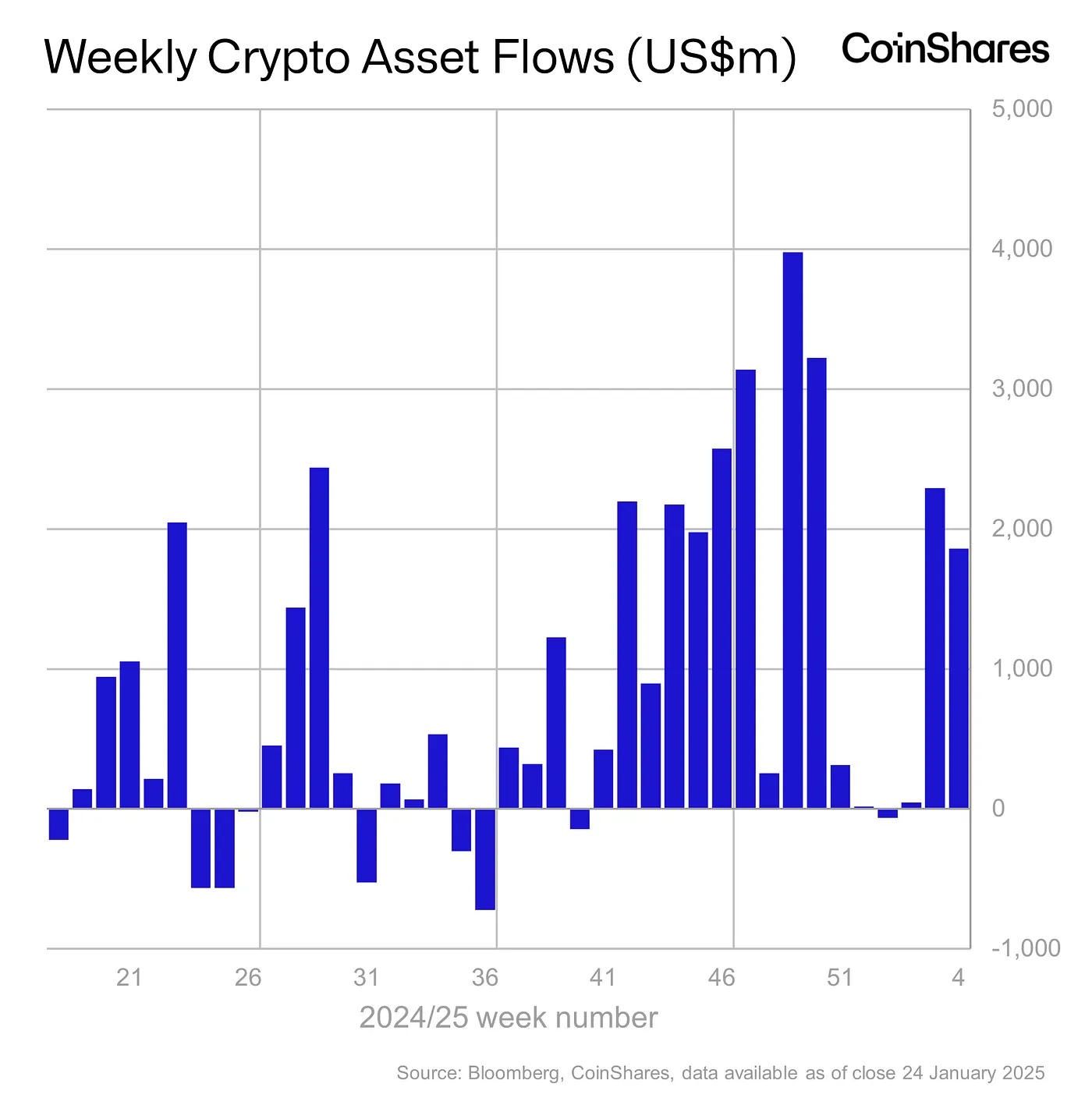
In a dramatic display of market confidence, institutional investors have flooded the digital asset space with nearly $2 billion in new capital over the past week. According to the latest "Digital Asset Fund Flows" report from leading crypto asset manager CoinShares, this massive influx of liquidity is widely interpreted as a direct response to recent executive actions within the United States, signaling a potential paradigm shift in how the world’s largest economy treats Bitcoin and digital assets.
The Core Data: A Multi-Billion Dollar Inflow
The cryptocurrency market has experienced a significant "risk-on" event, with institutional vehicles attracting a staggering $1.9 billion in a single seven-day period. This surge brings the total year-to-date (YTD) inflows to $4.8 billion, a figure that underscores the accelerating institutionalization of the asset class.
While the broader cryptocurrency market experienced relatively flat price action during this period, the underlying trading activity told a different story. Trading volumes on trusted exchanges reached $25 billion for the week, representing 37% of total market activity. This high volume, paired with massive inflows, suggests that institutional players are not merely dipping their toes into the market but are aggressively positioning themselves for long-term exposure.
Chronology: From Executive Orders to Market Momentum
The recent surge in activity can be traced back to a specific sequence of political events in the United States.
Pre-Inauguration Excitement
In the lead-up to the recent presidential inauguration, Bitcoin reached new all-time highs. This rally created a "fear of missing out" (FOMO) atmosphere that permeated institutional trading desks. Investors, anticipating a friendlier regulatory climate, began to front-run potential policy changes.
The Executive Order Catalyst
The primary catalyst identified by CoinShares is the series of presidential executive orders directed at the digital asset industry. Of particular note is the proposal to initiate a strategic reserve asset in Bitcoin. For institutional investors—who have historically been wary of the regulatory "grey zone" in the U.S.—the prospect of the federal government legitimizing Bitcoin as a strategic asset provides the long-sought-after "green light" for capital allocation.
The Weekly Surge
Immediately following these announcements, the capital floodgates opened. By the end of the week, the data confirmed that the United States led the global charge, accounting for $1.7 billion of the $1.9 billion in total inflows. This geographic concentration highlights the degree to which U.S. policy dictates the pulse of the global crypto market.
Supporting Data: The Breakdown of Asset Flows
The influx of capital was not distributed evenly, revealing clear preferences among institutional portfolios.
Bitcoin’s Dominance
Bitcoin remains the undisputed king of institutional interest. The world’s largest cryptocurrency saw inflows totaling $1.6 billion, accounting for approximately 92% of all institutional activity in the sector this week. This brings total YTD inflows for Bitcoin to $4.4 billion.
Interestingly, the market’s nuance is reflected in the behavior of "Short-Bitcoin" ETFs. Despite the bullish sentiment, these instruments saw inflows of $5.1 million, indicating that some institutional investors are still hedging against volatility or potential pullbacks after Bitcoin’s recent record-breaking run.
The Altcoin Landscape
While Bitcoin captured the bulk of the interest, the altcoin market also saw positive momentum. Ethereum (ETH) emerged as the leader among alternatives, securing $205 million in inflows. This significant boost has successfully pushed Ethereum’s YTD inflows into positive territory at $177 million.

Across the board, institutional products remained largely stable. With the notable exception of Cardano (ADA), which experienced minor outflows, no major crypto institutional investment products suffered significant divestment during this period.
Regional Contributions
While the U.S. dominated, international markets also contributed to the global inflow:
- Switzerland: $35 million
- Canada: $31 million
- Germany: $23 million
These figures, while smaller than the U.S. numbers, demonstrate that the positive sentiment regarding digital assets is a global phenomenon, fueled by the anticipation of a more favorable U.S. regulatory environment.
The Regulatory Implications: A New Era?
The executive orders mentioned by CoinShares represent a fundamental shift in the U.S. government’s relationship with digital assets. For years, the narrative in Washington D.C. was characterized by enforcement-first regulation and skepticism from agencies such as the SEC.
Strategic Reserve Considerations
The proposal to establish a strategic Bitcoin reserve is perhaps the most consequential development in the history of the asset. If realized, such a policy would effectively cement Bitcoin’s status as a peer to gold and foreign currency reserves. For institutional investors, this reduces "tail risk"—the fear that the government could suddenly ban or severely restrict the asset class.
Institutional Legitimacy
When institutional investors allocate billions, they are not speculating on a short-term trade; they are making a bet on the long-term viability of the asset class as a store of value. The current influx of capital suggests that the "institutionalization" of crypto has passed the point of no return. With banks, pension funds, and asset managers now having clear mandates to integrate digital assets, the market is moving from a speculative retail-driven phase into a more mature, liquidity-driven phase.
Market Implications: What Comes Next?
As the industry digests these massive inflows, analysts are pointing to several potential outcomes for the coming months:
- Increased Price Volatility: As more institutional capital enters the market, the traditional "boom and bust" cycles of crypto may become dampened by sophisticated hedging strategies, though the sheer scale of recent inflows could trigger rapid short-term price appreciation.
- Product Diversification: With Bitcoin and Ethereum receiving the lion’s share of interest, issuers are likely to scramble to launch more diversified crypto products, including baskets of altcoins or yield-generating instruments, to satisfy institutional demand for variety.
- Regulatory Harmonization: The U.S. pivot toward a strategic reserve will likely force other G20 nations to clarify their own stances. Countries that remain hostile to crypto may find themselves at a competitive disadvantage, potentially triggering a global "race to regulate" that favors institutional adoption.
Final Observations
The data from CoinShares confirms that we are witnessing a significant turning point in the adoption of digital assets. The transition from speculative retail asset to institutional-grade reserve asset is well underway. However, investors are reminded that the crypto market remains inherently volatile.
While the current trend is overwhelmingly positive, the history of the asset class suggests that regulatory hurdles, macroeconomic shifts, and technological challenges remain. Institutional investors are betting on the long-term utility of blockchain technology and the digital scarcity of Bitcoin, but market participants should remain vigilant, conduct their own due diligence, and recognize that even with institutional backing, digital assets carry risks that differ significantly from traditional equities or bonds.
Disclaimer: The information provided in this article is for educational and informational purposes only and does not constitute financial, investment, or legal advice. Cryptocurrency investments involve significant risk. Always consult with a qualified financial advisor before making any investment decisions.