
The Great Capitulation: Why Bitcoin Miners Are Liquidating at Record Rates in 2026
The Bitcoin mining industry, once characterized by aggressive expansion and long-term accumulation, is currently navigating its most perilous period in recent memory. As of early 2026, the sector is experiencing a widespread liquidity crisis, with approximately 20% of mining operations currently running at a net loss. This fiscal instability has forced a dramatic shift in strategy among the world’s largest publicly traded mining firms, which have begun dumping their Bitcoin (BTC) reserves at a rate that has sent shockwaves through the digital asset markets.
Main Facts: A Sector Under Siege
The current crisis is not a sudden anomaly but the culmination of a "perfect storm" of economic pressures. The primary metric for mining health—Hashprice—has been in a steady state of decline since July 2025. Hashprice, which quantifies the daily revenue a miner generates per unit of computing power, currently sits at a precarious $33 per petahash per second (PH/s) per day.
For the vast majority of the industry, the breakeven threshold is estimated at $35 per PH/s. This two-dollar deficit may seem negligible on paper, but when multiplied across thousands of high-performance machines operating 24/7, it renders entire data centers unprofitable. Consequently, the industry is seeing a wave of "miner capitulation," where firms are forced to liquidate their treasury holdings simply to cover operating costs, electricity bills, and debt obligations.
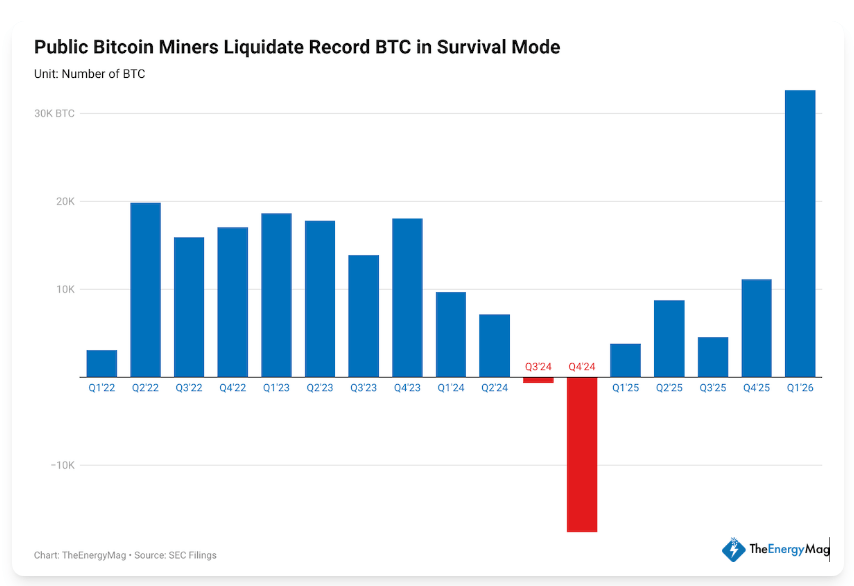
According to data from TheEnergyMag, a coalition of major publicly traded miners—including industry titans such as MARA, CleanSpark, Riot, Cango, Core Scientific, and Bitdeer—collectively offloaded more than 32,000 BTC during the first quarter (Q1) of 2026. This figure is not merely a record; it is a profound deviation from historical norms.
Chronology: From Accumulation to Desperation
To understand the severity of the 2026 sell-off, one must look at the timeline of the industry’s recent evolution.

- 2023: The Era of Reserves: Throughout 2023, miners operated in a "HODL" mode, building substantial BTC treasuries. By the close of that year, collective miner reserves exceeded 1.86 million BTC.
- 2025: The Turning Point: The second half of 2025 marked the beginning of the end for easy profits. A rising network hashrate made mining significantly more competitive, meaning the same amount of effort yielded fewer coins.
- Late 2025 – Early 2026: The most recent halving event significantly reduced block rewards, cutting the "subsidy" miners receive for securing the network. This reduction, coupled with stagnating Bitcoin prices, squeezed profit margins to the bone.
- Q1 2026: The Record Liquidation: The first three months of 2026 saw the largest quarterly sell-off in the history of the industry. The 32,000 BTC sold in these months not only eclipsed the total sales for all four quarters of 2025 but also shattered the previous record of 20,000 BTC set during the catastrophic Terra-Luna collapse of Q2 2022.
Supporting Data: The Shrinking Balance Sheets
The trend of depleting reserves is validated by on-chain analytics provided by firms like CryptoQuant. Since 2023, the total Bitcoin held by miners has been in a slow, steady decline, falling from 1.86 million BTC to approximately 1.8 million BTC.
The Q1 2026 liquidation has significantly accelerated this descent. Analysts at CoinShares, in their Q1 2026 Bitcoin Mining Report, highlight that the industry is effectively paying for its existence through the sale of its own capital assets. The report warns that unless there is a meaningful recovery in the price of Bitcoin or a significant decrease in network difficulty, higher-cost operators—those still using older, less energy-efficient hardware—will likely face insolvency in the coming months.
The data illustrates a brutal reality: the industry is no longer operating on a growth-at-all-costs model. Instead, it has pivoted to a survivalist strategy where treasury management is dictated by the immediate need for fiat liquidity to keep physical operations running.
Official Responses and Industry Outlook
The industry’s reaction to this downturn has been polarized. While smaller, less efficient miners are quietly exiting the space or merging with larger competitors to survive, the giants of the industry are vocalizing their concerns through public disclosures and investor updates.
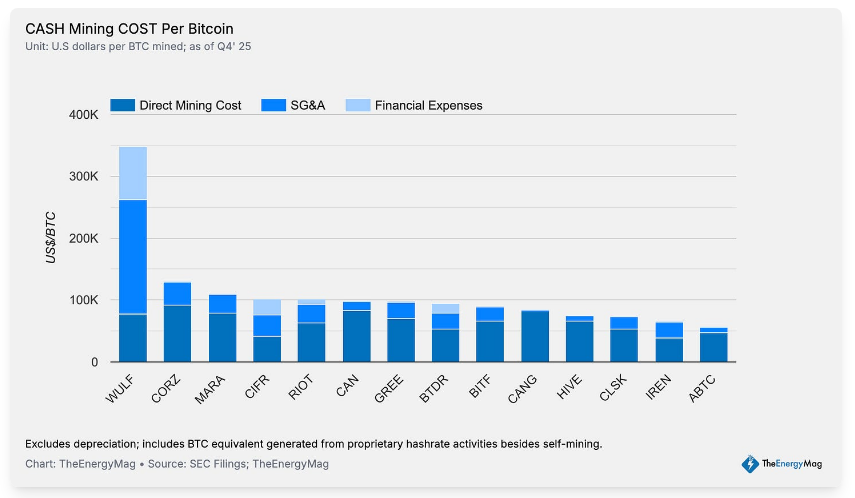
Many CEOs of publicly traded mining firms have begun to pivot their public messaging, emphasizing "operational efficiency" and "energy optimization" over raw hash rate growth. The goal, according to several recent earnings calls, is to reduce the cost per coin to below $30,000 to ensure profitability even during market volatility.
However, the sentiment is not entirely grim. Market observers note that the "cleansing" of the mining sector—where inefficient operators are forced to shut down—is a necessary part of the Bitcoin cycle. As less efficient machines are unplugged, the network’s hashrate difficulty is expected to adjust downward, eventually making it easier for the remaining, more efficient miners to generate profit.
Implications: A Shifting Power Dynamic
The implications of this massive sell-off extend far beyond the mining sector itself.
1. The Treasury "Batons" are Changing Hands
While miners have been net sellers, a distinct counter-trend has emerged among corporate treasuries. As miners offload their assets, large-scale corporate buyers—most notably Strategy—have stepped in to absorb the supply. Michael Saylor, the face of the corporate Bitcoin movement, has continued to signal intent for further acquisitions, effectively acting as the "buyer of last resort" for the market. This creates a fascinating dynamic where the institutional "smart money" is accumulating at the same time that the "infrastructure providers" (miners) are forced to liquidate.
2. Concentration Risk
The current crisis may lead to increased centralization in the mining industry. As smaller firms go under, larger players with deep capital reserves or access to cheap, renewable energy are poised to acquire the distressed assets of their competitors at a discount. This consolidation could, in the long run, lead to a more efficient, albeit more concentrated, mining landscape.
3. Market Volatility
The sustained selling pressure from miners acts as a headwind for Bitcoin’s price. When the mining industry—which typically provides the "floor" for network security—becomes a consistent source of sell-side liquidity, it naturally dampens the potential for parabolic upward movement in the short term. Investors are closely monitoring the miner reserve charts, as a stabilization in these holdings is often considered a prerequisite for a sustained bull run.
4. The Role of Energy Policy
The crisis has also reignited the debate over energy consumption. With miners being forced to prioritize electricity costs, many are relocating to jurisdictions with cheaper, often stranded, energy sources. This shift is turning the Bitcoin mining industry into a significant player in global energy markets, as miners increasingly act as "grid balancers," consuming excess energy during off-peak hours and shutting down when prices spike.
Conclusion
The first quarter of 2026 will likely be remembered as a pivotal moment for the Bitcoin mining industry. It was a period defined by the limits of efficiency and the cold reality of market economics. While the massive liquidation of 32,000 BTC has created short-term pain and downward price pressure, it is also a signal of a maturing industry. The survivors of this "Great Capitulation" will likely be those with the lowest power costs, the most efficient hardware, and the strongest balance sheets. As the dust settles, the industry that emerges will be leaner, more resilient, and perhaps better equipped to handle the challenges of the next cycle. For now, all eyes remain on the hashprice, the treasury balances, and the ongoing tug-of-war between the miners who must sell and the corporate titans who are waiting to buy.