
Bitcoin Mining in the Red: A Q1 2026 Reckoning and the Great Liquidation
The Bitcoin mining industry, once defined by its relentless pursuit of exponential growth and massive infrastructure scaling, is currently navigating its most perilous chapter in recent memory. As of April 2026, roughly 20% of the entire industry is operating at a net loss. This statistic is not merely a figure on a ledger; it is the fundamental catalyst for a seismic shift in market behavior that has seen publicly traded mining giants pivot from "HODLing" to aggressive, survival-driven liquidation.
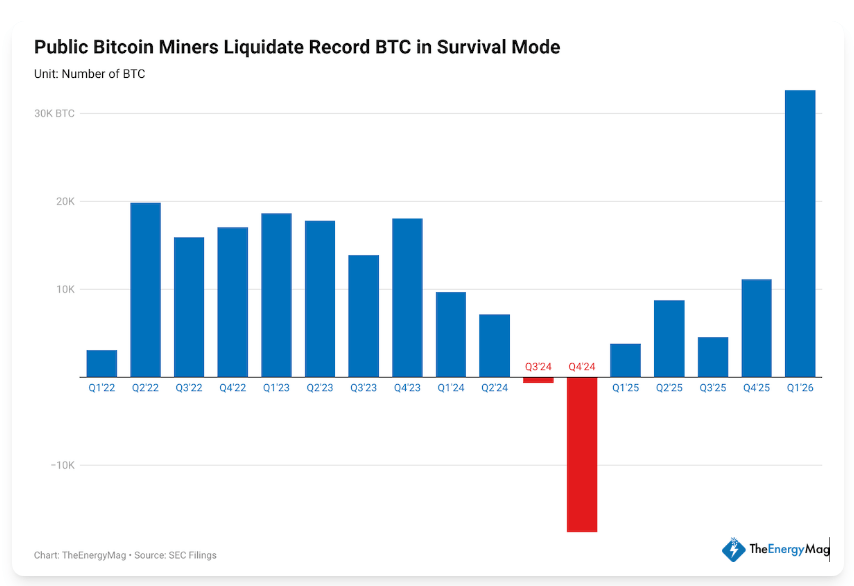
In the first three months of 2026, the sector witnessed a record-shattering divestment event. According to data from TheEnergyMag, major publicly traded miners—including industry titans like MARA, CleanSpark, Riot, Cango, Core Scientific, and Bitdeer—offloaded more than 32,000 BTC. This massive sell-off is not just a quarterly outlier; it is a profound indicator of the systemic pressure facing the backbone of the Bitcoin network.
The Anatomy of a Squeeze: Profits Eroded
The primary metric governing the health of the mining industry is "hashprice"—the daily revenue a miner generates per petahash per second (PH/s) of computing power. Since July 2025, this figure has been in a steady, agonizing decline. Current market data from Hashrate Index places the hashprice at approximately $33 per PH/s per day.
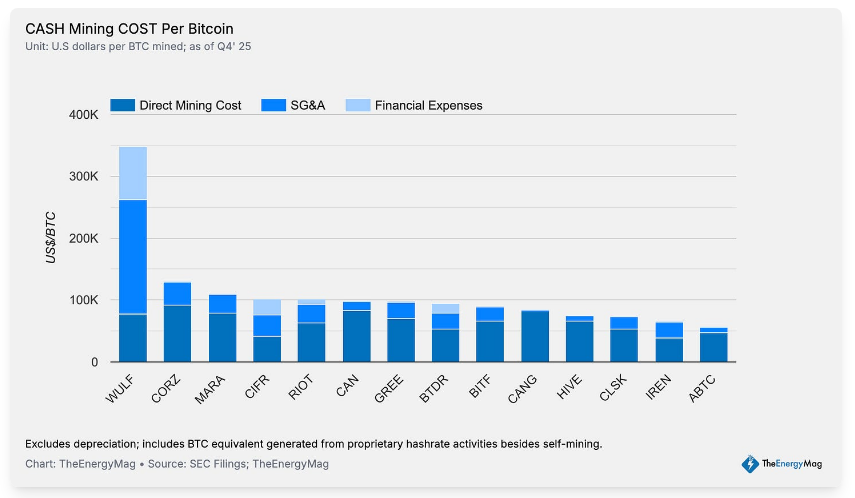
For a significant portion of the industry, particularly those relying on legacy hardware that lacks the energy efficiency of the latest generation of ASICs, the break-even point hovers around $35. When the cost of electricity and operational overhead exceeds the revenue generated by the block reward and transaction fees, the resulting margin compression is fatal.
This $2 gap is the difference between solvency and insolvency. For firms that invested heavily in expansion during the bullish periods of 2024 and early 2025, the current reality is a stark reminder of the cyclical volatility inherent in digital asset mining.

A Chronology of the 2026 Mining Crisis
The current predicament did not manifest overnight. It is the result of a compounding series of events that have systematically tightened the screws on mining margins.
The Q3 2025 Downturn
Starting in the summer of 2025, the hashprice began a persistent slide. As the network hashrate continued to climb, the difficulty of mining blocks increased. This "difficulty adjustment" meant that miners were required to expend more electricity to earn the same amount of Bitcoin, effectively raising the cost of production while market prices remained stagnant or dipped.
The Q1 2026 Liquidation Event
The first quarter of 2026 became the theater for a massive, industry-wide sell-off. The 32,000 BTC liquidated by the aforementioned major firms surpassed the total sales from all four quarters of 2025 combined. Even more alarming is that this volume eclipses the previous quarterly record of 20,000 BTC, which occurred during the chaotic collapse of the Terra-Luna ecosystem in Q2 2022. Unlike 2022, where the sell-off was a panic-driven response to a market crash, the 2026 sell-off is a calculated, desperate attempt to "keep the lights on."
The Present State (April 2026)
As of mid-April, the industry remains in a state of flux. While some miners have successfully offloaded debt through asset sales, the structural issues—high network difficulty and reduced block rewards following the most recent halving—persist.
Data-Driven Perspectives: Reserves and Risks
The long-term health of the mining sector is often measured by the "Miner Reserve" metric—a tally of how much Bitcoin miners are keeping on their balance sheets rather than selling into the open market.
Data from CryptoQuant paints a somber picture. Since the beginning of 2023, the total Bitcoin held by miners has been in a consistent state of depletion. At the close of 2023, the industry collectively held over 1.86 million BTC. Today, that figure has dipped to approximately 1.8 million. While a reduction of 60,000 BTC over several years may seem modest in the context of the total circulating supply, the rate of depletion accelerated sharply in Q1 2026.
This downward trajectory suggests that miners are no longer using their reserves as a strategic hedge against volatility; they are using them as a liquid treasury to cover operational expenditures (OpEx) and debt service.
Expert Analysis and Official Outlooks
The financial community remains cautious, with major analysts warning that the "capitulation phase" may still be in its infancy. In its Q1 2026 Bitcoin Mining Report, asset manager CoinShares explicitly cautioned that higher-cost operators should prepare for continued consolidation or potential bankruptcy if the Bitcoin price does not stage a significant recovery in the second half of the year.
The report highlights a "survival of the fittest" environment, where only those with the most efficient electricity contracts and the most advanced hardware will emerge from the current bear market. "For those running older-generation machines, the math simply doesn’t work anymore," one analyst noted. "Without a massive price appreciation, we expect to see a wave of distressed asset sales, where mining rigs are sold for pennies on the dollar to more efficient competitors."
The Corporate Counter-Balance: Treasury Buyers
While the mining industry faces a period of intense contraction, the broader Bitcoin ecosystem is witnessing a fascinating divergence in behavior. As miners act as net sellers, corporate treasury buyers are stepping in to absorb the supply.
Strategy, the corporate entity widely recognized as the largest Bitcoin holder among public companies, has remained undeterred by the volatility. Following a series of signals from co-founder Michael Saylor, the market expects an imminent, substantial purchase. Saylor’s social media activity, which often serves as a barometer for the company’s treasury strategy, has been interpreted by analysts as a "green light" for continued accumulation.
This dynamic creates a tug-of-war in the market: miners are selling to survive, while corporate entities are buying to hold. This structural shift effectively transfers Bitcoin from the hands of the producers (miners) to the hands of the long-term holders (corporate treasuries).
Implications for the Future of Bitcoin
The implications of this mining crisis are far-reaching:
- Network Decentralization: As inefficient miners go bankrupt, their hardware is often purchased by larger, more efficient firms. This leads to a higher concentration of hashrate in fewer, more professionalized operations, which some critics argue could impact the decentralized nature of the network.
- Energy Efficiency as the New Moat: The industry is moving away from a business model based on "scale at any cost" toward a model based on "efficiency at any cost." Future mining success will be dictated by access to ultra-cheap, renewable energy and proprietary, high-efficiency chipsets.
- Market Price Sensitivity: Because miners are no longer holding their BTC, they have lost some of their ability to act as "market makers" during price dips. When they are forced to sell, it creates downward pressure that requires significant retail or institutional demand to offset.
As we look toward the remainder of 2026, the story of the Bitcoin mining industry will likely be defined by a thinning of the herd. While the current headlines focus on the losses and the liquidations, historical precedents suggest that such periods of intense stress often pave the way for a more robust and efficient mining ecosystem in the years to follow. For now, however, the industry remains at a critical juncture, waiting for the hashprice to stabilize and for the market to signal that the worst of the volatility is behind them.