Winter Storm Disrupts U.S. Bitcoin Mining: A Stress Test for Network Resilience
A powerful winter storm, characterized by record-breaking temperatures and widespread power disruptions, swept across the United States over the past weekend, triggering a massive, albeit temporary, contraction in the Bitcoin network’s total mining capacity. As regional electrical grids struggled to maintain stability under the weight of extreme heating demand, the nation’s Bitcoin mining fleet—a significant component of global infrastructure—was forced to pivot from energy consumption to grid conservation.
The event served as a high-stakes stress test for the Bitcoin network, highlighting both the vulnerability of its geographic concentration and the unique flexibility of mining as a "demand response" utility.
Chronology of the Disruption
The crisis began to materialize late Friday as meteorological fronts intensified across the American South and Midwest, regions that have become the epicenter for the U.S. mining industry.
- Friday: As temperatures plunged, utility providers began signaling potential grid stress. Mining operations, particularly those located in Texas—a state that houses a substantial portion of the U.S. mining capacity—began proactively throttling operations.
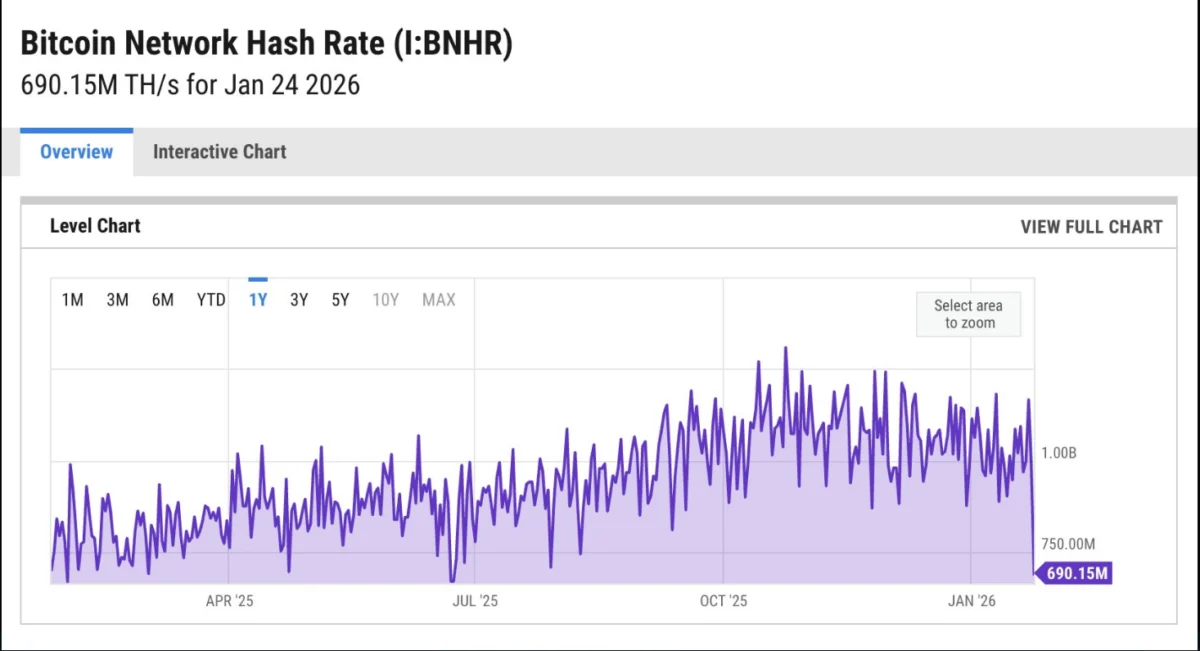
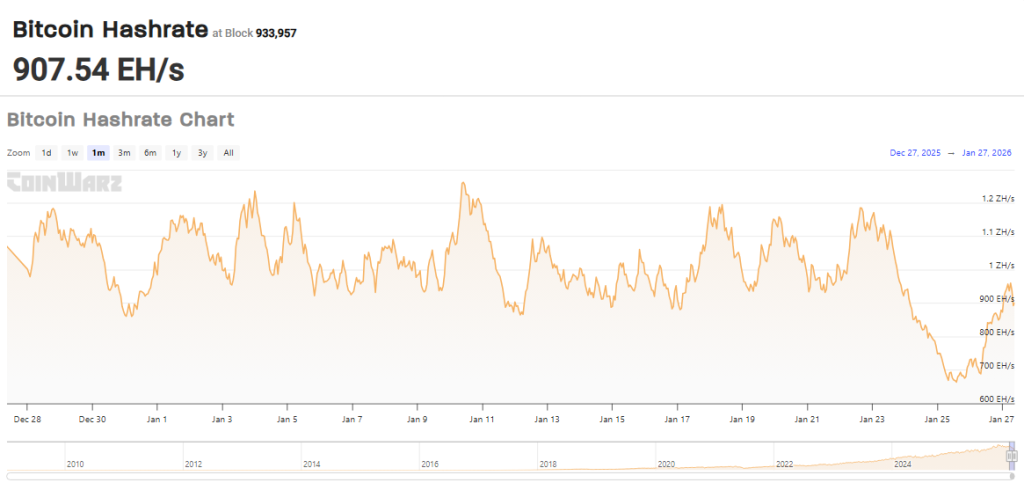
- Saturday: The impact became visible on the blockchain. As data centers across the country powered down, the network’s total hash rate began a precipitous decline. By Sunday, the total computing power securing the network had plummeted to roughly 663 EH/s (exahashes per second), marking a seven-month low and a significant departure from the network’s steady climb in recent months.
- Monday: As the storm front dissipated and weather conditions stabilized, the network entered a rapid recovery phase. By early Monday, as crews worked to restore power and operators brought their rigs back online, the hash rate began an aggressive climb, reaching approximately 854 EH/s, signaling the resilience of the industry’s recovery mechanisms.
The Mechanics of Demand Response
The swift contraction of the mining fleet was not merely a result of infrastructure failure; it was, in many cases, a calculated, voluntary decision. Mining operators, particularly those working in partnership with local utility providers, operate under "demand response" agreements. These agreements allow utility companies to request that miners reduce their power consumption during periods of peak demand to prevent brownouts or total grid failure.
Abundant Mines, an Oregon-based cryptocurrency infrastructure firm, reported that roughly 40% of global mining capacity went offline within a 24-hour window. This capability underscores the unique nature of Bitcoin mining hardware: unlike traditional manufacturing, which may require long lead times for shutdown and startup, mining rigs can be ramped down and back up with minimal latency.

"The ability to act as a flexible electrical load is one of the industry’s most significant contributions to energy grid stability," noted a spokesperson for the industry. By shedding load instantly when demand spikes, miners effectively provide a buffer for residential and commercial heating systems during severe weather events.
Supporting Data and Market Impacts
The scale of the disruption was quantified by several industry analysts who tracked the immediate impact on both network security and daily production metrics.
According to data compiled by CryptoQuant and other market trackers, the production of major mining firms saw a dramatic decline. For instance, Marathon Digital, one of the industry’s largest players, saw its daily Bitcoin production drop from an average of 45 coins per day to just seven during the height of the storm. Similar trends were observed at Riot Platforms and other major mining entities.
The U.S. Energy Information Administration (EIA) has previously identified more than 130 dedicated cryptocurrency mining sites across the United States. Given that the U.S. is estimated to supply nearly 38% of the global mining hash rate, any major atmospheric event hitting the U.S. mainland is guaranteed to cause global fluctuations in mining difficulty and throughput.
While the network’s total hash rate fell below 700 EH/s, the Bitcoin protocol’s difficulty adjustment mechanism ensures that the network remains functional. The drop in hash rate simply meant that the remaining active miners were, for a brief window, more profitable, as they were competing for the same block rewards with less overall competition.
Market Sentiment and Price Action
Bitcoin’s price volatility during the weekend was influenced by a confluence of factors, with the mining disruption acting as a backdrop to ongoing macroeconomic and geopolitical anxieties. Bitcoin traded around the $88,300 level throughout the weekend.
Market analysts noted that while traders were watching the hash rate drop closely, the event did not trigger a panic-driven sell-off. The market’s resilience suggests that institutional investors are increasingly viewing mining disruptions as a temporary operational issue rather than a fundamental flaw in the Bitcoin protocol.
The price had previously seen peaks near $96,000 during periods of geopolitical tension, suggesting that the "storm-related" dip in hash rate was a secondary concern for investors compared to broader macro-financial indicators. The market’s ability to absorb the news of a 40% drop in domestic mining capacity without a corresponding crash in asset value is a testament to the maturing nature of the crypto-asset class.
Official Responses and Strategic Implications
The role of Bitcoin miners in grid stabilization has become a point of contention and interest for federal and state regulators. Following the weekend’s events, questions regarding the sustainability and reliability of these "mining-as-grid-stabilizers" models have intensified.
Industry advocates argue that the events of this past weekend prove that miners are good corporate citizens. By providing immediate load shedding, they prevented the need for grid operators to implement forced load shedding (rolling blackouts) for residential customers.
However, critics, including some environmental groups and state-level policy planners, argue that the concentration of such massive energy-consuming operations in weather-vulnerable regions like Texas remains a systemic risk. The Federal Energy Information Administration is expected to release a more detailed study later this year on the long-term impact of integrating crypto-mining loads into the national energy infrastructure.
The Path Forward: Resilience and Decentralization
The event has reignited discussions regarding the geographical decentralization of mining. While the United States remains a global leader in mining infrastructure, the vulnerability to large-scale weather events has led some analysts to call for a more diverse geographic distribution of mining farms to ensure the network remains robust against localized environmental disruptions.
As the industry moves forward, the focus is likely to shift toward "hardened" infrastructure that can withstand extreme weather without requiring a total shutdown. Simultaneously, software developments in automated demand-response protocols are expected to become more sophisticated, allowing miners to better integrate with smart-grid technologies.
In conclusion, the winter storm of 2026 served as a reminder that while Bitcoin is a digital asset, it remains tethered to the physical world—and specifically, the physical power grid. The network’s ability to lose 40% of its capacity in a single day and recover to 854 EH/s within 48 hours is not a sign of weakness, but a demonstration of an incredibly adaptive, decentralized system that can survive, and even thrive, amidst the unpredictable realities of climate and grid management.
For now, the hash rate has stabilized, the mining machines are back to full capacity, and the Bitcoin blockchain continues to produce blocks with the same deterministic consistency that has defined it since its inception. The weekend was a fleeting disturbance in a long-term trend of rapid expansion, providing valuable data that will undoubtedly shape the future of energy-conscious mining strategies for years to come.