Institutional Capital Floods Crypto Markets Following Federal Reserve’s Strategic Rate Pivot
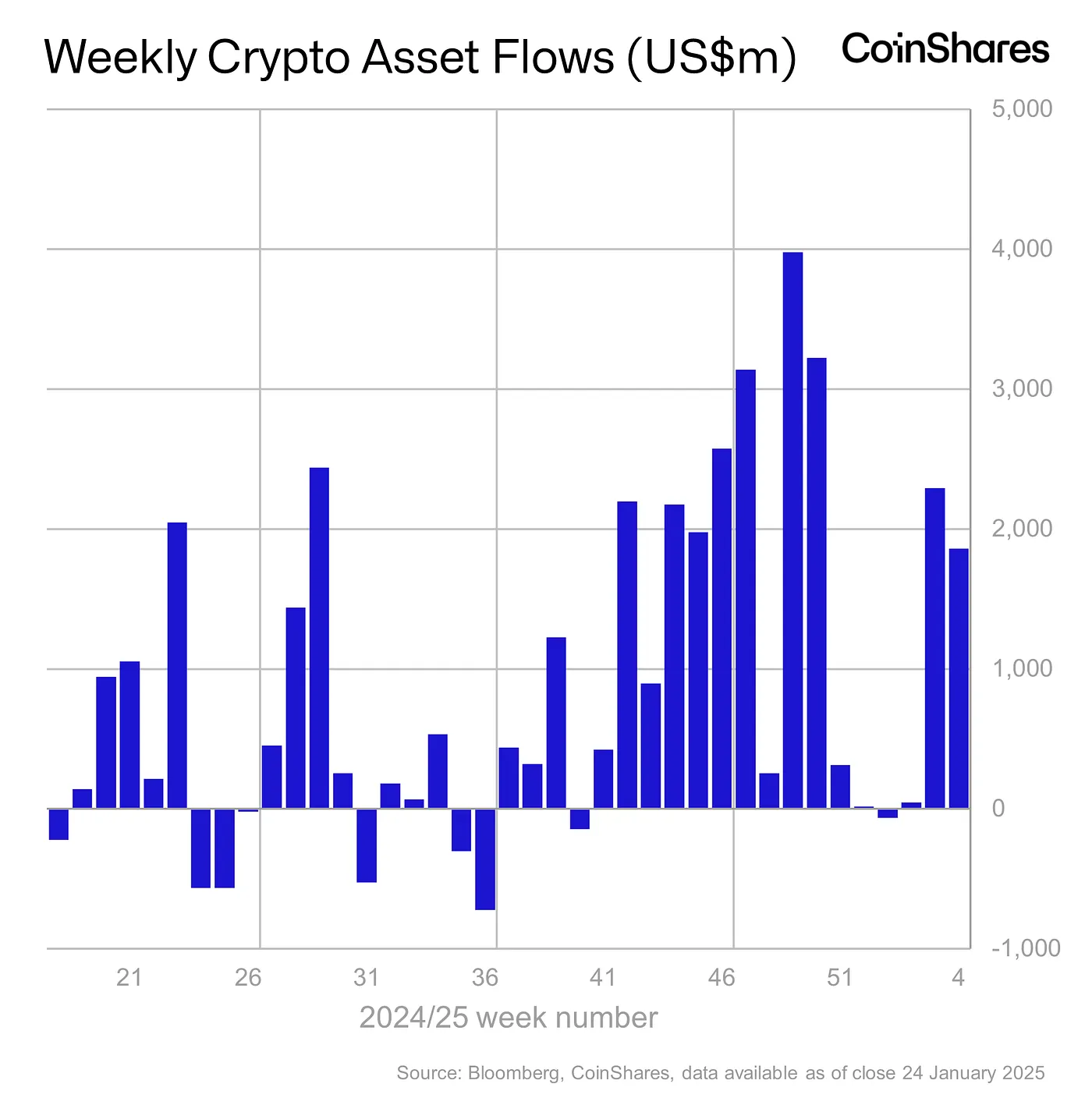
The global cryptocurrency market has experienced a significant surge in institutional interest, signaling a robust shift in investor sentiment following the U.S. Federal Reserve’s decision to initiate a long-awaited interest rate cut. According to the latest Digital Asset Fund Flows Weekly Report from CoinShares, institutional investors have funneled a staggering $1.9 billion into digital asset investment products over the past week, marking the second consecutive week of substantial inflows.
This influx of capital underscores a maturing market that, despite initial volatility, appears to be embracing the new macroeconomic reality of lower interest rates. While the Federal Reserve’s policy shift was initially dubbed a "hawkish cut"—a move that introduced a degree of uncertainty into global markets—the crypto sector ultimately interpreted the change as a catalyst for growth.
The Chronology of Market Reaction
The narrative of the past week was defined by a shift from skepticism to conviction. When the Federal Reserve announced its rate adjustment, market participants initially reacted with caution. The ambiguity surrounding the central bank’s forward guidance and the implications of the "hawkish" nature of the cut led to a brief period of hesitation among institutional ETP (Exchange-Traded Product) holders.
However, as the week progressed, the narrative shifted. By Thursday and Friday, the market had largely processed the Federal Reserve’s policy trajectory, leading to a massive wave of buying activity. Data indicates that $746 million of the total $1.9 billion weekly inflow entered the market during those final two trading days alone. This late-week surge suggests that once the dust settled, institutional investors identified the rate cut as a net positive for risk-on assets, specifically those in the digital asset space.
Supporting Data: A Global Inflow Snapshot
The appetite for digital assets remains geographically concentrated but is showing signs of broadening interest. The United States continues to dominate the global landscape, accounting for $1.8 billion of the total inflows. This dominance is largely attributed to the robust performance of U.S.-based spot Bitcoin and Ethereum ETFs, which have become the primary vehicles for institutional exposure.
Other key regions also reported positive momentum:
- Germany: Added $51.6 million in inflows.
- Switzerland: Contributed $47.3 million.
- Brazil: Recorded $9.3 million.
Conversely, Hong Kong served as the notable outlier, reporting minor outflows of $3.1 million. This regional divergence highlights that while global sentiment remains broadly bullish, localized regulatory or market-specific factors continue to influence capital movement.
Asset-Specific Performance
Bitcoin (BTC) predictably led the charge, securing $977 million in inflows. This confirms that Bitcoin remains the primary "safe haven" asset for institutions looking to hedge against inflationary pressures or leverage the benefits of monetary easing.
In a stark contrast to long-position confidence, "Short-Bitcoin" products continue to suffer. These vehicles saw $3.5 million in outflows last week, pushing their total Assets under Management (AuM) to a multi-year low of $83 million. This trend indicates that the institutional community is largely abandoning bearish bets on the flagship cryptocurrency.
Ethereum (ETH), Solana (SOL), and XRP also saw significant participation:
- Ethereum: $772 million in inflows.
- Solana: $127.3 million in inflows.
- XRP: $69.4 million in inflows.
The strong performance of altcoins suggests that the "interest rate rally" is not limited to Bitcoin; it is effectively lifting the entire ecosystem as risk appetite returns to the broader digital asset market.
The Macroeconomic Context: Why Rate Cuts Matter
The Federal Reserve’s decision to lower interest rates is a pivot point for global liquidity. For years, high interest rates have acted as a gravitational force, pulling capital away from "risk-on" assets like cryptocurrencies and into traditional yield-bearing instruments like Treasury bonds. As rates decline, the opportunity cost of holding non-yielding assets—or assets perceived as high-risk—decreases.

Institutional investors view this shift as a transition into a "liquidity-rich" environment. Lower borrowing costs typically stimulate economic activity and inflate asset prices. When the Fed signals a move toward easing, it historically correlates with a rotation into assets that offer high growth potential, which is where digital assets have historically excelled.
Official Perspectives and Expert Analysis
Market analysts are interpreting these figures as a sign of institutional "buy-the-dip" mentalities maturing into "buy-the-policy" strategies. Rekt Capital, a prominent market analyst whose data was cited in recent reporting, has pointed toward technical indicators suggesting that Bitcoin is exiting a period of consolidation.
While the "hawkish" component of the Fed’s rate cut—which refers to the central bank’s desire to maintain a delicate balance between controlling inflation and supporting employment—initially spooked traders, the subsequent inflow data suggests a realization: the era of tightening is likely coming to an end.
CoinShares’ researchers note that the consistent flow of funds over two weeks suggests this is not merely a momentary reaction, but rather a structural trend. "After months of speculation," the report notes, "inflows resumed later in the week as markets began to digest the implications for digital assets." This suggests that the institutional "wait and see" period has concluded.
Implications for the Future of Digital Assets
The implications of this massive capital influx are multi-fold:
1. Market Legitimacy
The sustained commitment from institutional players to move billions of dollars into crypto ETPs reinforces the legitimacy of the asset class. It suggests that digital assets are no longer speculative fringes but are now recognized as legitimate components of a diversified institutional portfolio.
2. Reduced Volatility in the Long Term
Historically, retail-dominated markets are characterized by high volatility. As institutional ownership increases, the market structure tends to change. Institutional investors often utilize long-term strategies, which can introduce greater price stability. However, the sheer speed at which these billions flowed in during the latter half of the week also suggests that "algorithmic" or rapid-response institutional trading still plays a major role.
3. Regulatory Tailwind
As institutional money flows into regulated ETPs, the pressure on regulators to provide clearer frameworks increases. The success of U.S. ETFs, in particular, demonstrates that there is a massive pent-up demand for exposure to digital assets that can be managed through traditional financial channels. This reality is likely to influence future policy debates regarding the integration of decentralized finance (DeFi) with traditional banking.
4. The "Altcoin" Re-rating
The strong performance of Solana and XRP suggests that investors are looking beyond the "big two" (BTC and ETH). As liquidity expands, investors are increasingly willing to allocate capital to projects that demonstrate utility, technological advancement, and strong community support.
Final Observations
The data provided by CoinShares serves as a bellwether for the broader financial landscape. The $1.9 billion influx is more than just a number; it is a vote of confidence in the resilience of digital assets during a volatile economic transition.
As the world watches the Federal Reserve’s next moves, the cryptocurrency market has positioned itself as an active participant in the global economic recovery. Investors are no longer merely reacting to news; they are anticipating the long-term benefits of a looser monetary policy. For the crypto industry, the challenge now lies in maintaining this momentum as the market enters a period of potentially historic volatility and growth.
Disclaimer: The information provided in this article is for educational and informational purposes only and does not constitute financial, investment, or legal advice. Cryptocurrency investments carry a high level of risk. Investors should conduct their own due diligence and consult with a qualified financial advisor before making any investment decisions. The author and publisher are not responsible for any financial losses incurred based on the information provided herein.