Institutional Appetite Surges: Digital Asset Investment Vehicles Near Yearly Inflow Records
The global cryptocurrency market is currently witnessing a massive wave of institutional momentum, with digital asset investment vehicles surging toward record-breaking annual flows. According to the latest data released by CoinShares, one of the world’s most prominent digital asset management firms, the sector has experienced a sustained period of growth that signals a robust return of capital into the crypto ecosystem.
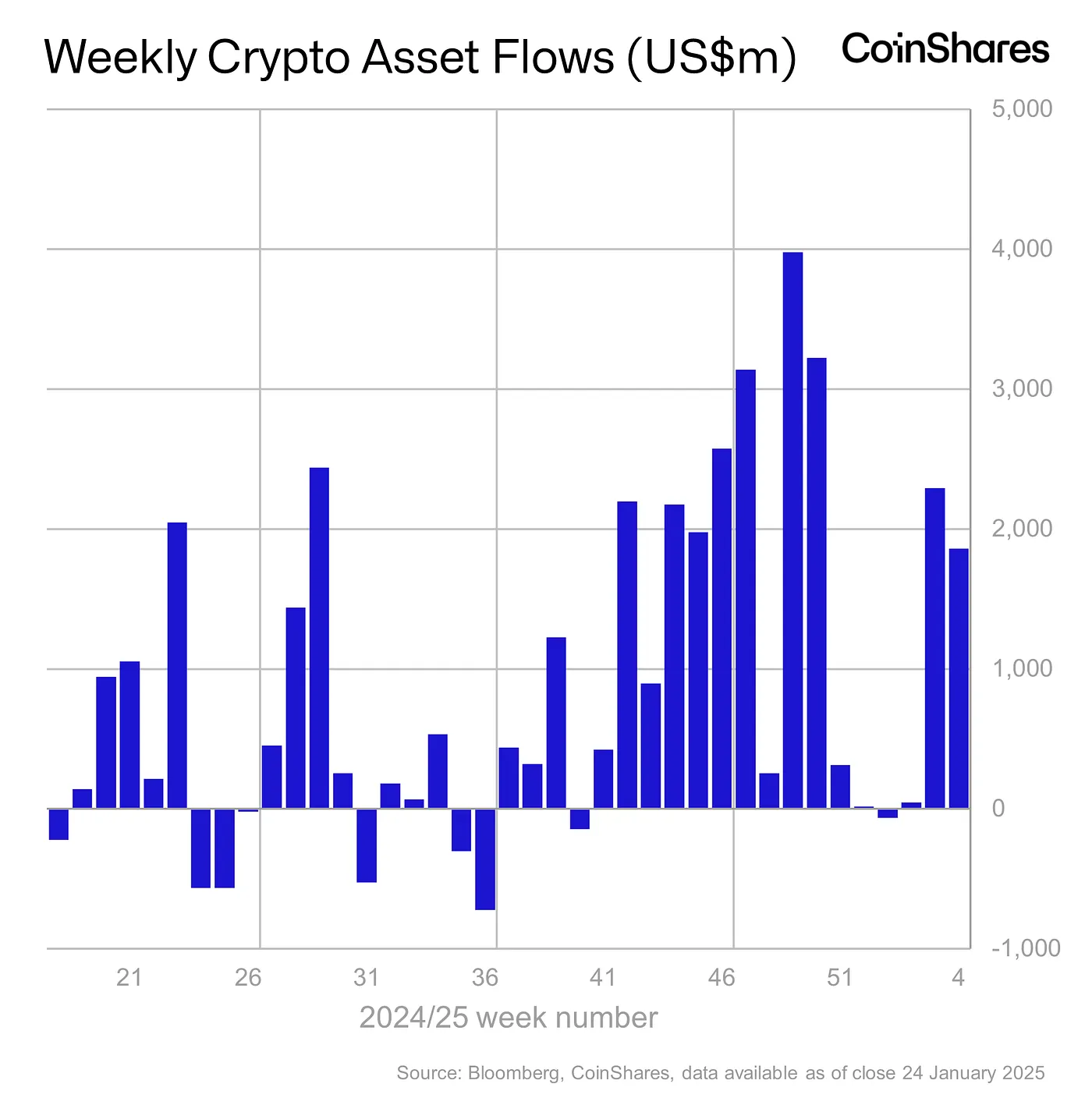
As of the most recent reporting period, crypto exchange-traded products (ETPs) attracted nearly $900 million in inflows in a single week. This trend, which marks four consecutive weeks of positive capital movement, brings total year-to-date (YTD) inflows to an impressive $6.7 billion, rapidly approaching the peak of $7.3 billion recorded earlier this year.
The Macro-Economic Catalyst: Why Capital is Returning
The resurgence in digital asset inflows is not merely a result of speculative fervor; rather, market analysts point to a confluence of shifting macroeconomic realities. CoinShares’ latest "Digital Asset Fund Flows Weekly" report highlights three primary drivers behind this sharp increase in both pricing and investment volume:
- Global M2 Money Supply Expansion: As central banks globally navigate the complexities of inflation and economic stimulation, the expansion of the M2 money supply is driving investors toward "hard" assets. With traditional fiat currencies facing long-term devaluation pressures, Bitcoin is increasingly viewed as a hedge against monetary debasement.
- Stagflationary Risks in the United States: The persistent threat of stagflation—a combination of stagnant economic growth and high inflation—has left traditional portfolio managers looking for non-correlated assets. Bitcoin’s performance in this high-uncertainty environment has cemented its status as a critical component of institutional risk management.
- The Rise of Strategic Bitcoin Reserves: Perhaps the most significant development is the shift in political and economic strategy at the state level in the U.S. Several states have begun exploring or formally proposing the inclusion of Bitcoin as a strategic reserve asset, a move that provides a "legitimacy stamp" for massive institutional capital that was previously sidelined by regulatory ambiguity.
Chronology of the Recent Surge
The current trajectory of institutional inflows did not happen in a vacuum. To understand the gravity of the recent $882 million weekly inflow, one must look at the recent timeline of the digital asset market:
- Early February 2024: The market reached a previous high-water mark for the year, with cumulative net inflows into US-listed ETFs hitting $61.6 billion. At the time, this was considered a historic ceiling for institutional adoption.
- Mid-2024 (Consolidation Phase): Following the initial launch euphoria of the US-listed Bitcoin ETFs, the market entered a period of consolidation. While trading volumes remained steady, net inflows slowed as investors awaited further macro-economic clarity regarding interest rate cuts.
- Late 2024 (The Current Breakout): Over the past month, the narrative has shifted aggressively. Driven by the aforementioned economic factors, capital began pouring back into products, resulting in a four-week winning streak that has successfully propelled the YTD figure toward the $7 billion threshold.
- The Milestone Event: Last week served as a critical turning point. By attracting $867 million in global inflows, Bitcoin helped drive the cumulative net inflows of US-listed ETFs to a staggering $62.9 billion since their inception in January 2024, effectively shattering the February record.
Geographic Breakdown: A Global Divergence
While the inflows are a global phenomenon, the distribution of capital reveals a distinct divergence in regional appetite.
The Dominance of the United States
The United States remains the undisputed leader in the digital asset investment space. Last week alone, the U.S. market accounted for $840 million of the total global inflow. This dominance is largely attributed to the maturity of the U.S. ETF market, which provides the liquidity and regulatory framework required by massive pension funds and institutional endowments to enter the space safely.
The International Landscape
Outside of the U.S., the picture is more mixed. Germany and Australia have shown continued interest, recording $44.5 million and $10.2 million in inflows, respectively. However, other major financial hubs have seen outflows. Canada and Hong Kong, often bellwethers for regional sentiment, saw outflows of $8 million and $4.3 million. Market experts suggest these outflows may represent "profit-taking" or a rebalancing of portfolios in favor of the more liquid U.S.-based instruments.
Asset Performance: Bitcoin and the Altcoin Ecosystem
Bitcoin continues to capture the "lion’s share" of institutional attention, confirming its role as the "digital gold" of the 21st century.
Bitcoin’s Unrivaled Status
Bitcoin’s $867 million weekly inflow demonstrates that when institutions decide to enter the crypto market, they primarily do so through the industry’s flagship asset. The growth of the U.S.-listed ETF market has effectively institutionalized Bitcoin, turning it from a speculative retail trade into a staple of modern portfolio construction.
The Altcoin Landscape
While Bitcoin dominates, there are subtle signs of diversification within the altcoin space. SUI, a high-performance layer-one blockchain, attracted $11.7 million in inflows, suggesting that investors are beginning to hunt for utility-driven ecosystems. Conversely, Ethereum (ETH) saw a relatively modest $1.5 million in inflows. This discrepancy highlights a growing "selectivity" among institutional investors who are moving away from broad-based crypto exposure toward assets with clear, demonstrable technological differentiation.
Implications for the Future
The implications of this institutional influx are profound, touching on everything from market structure to long-term financial policy.
1. Market Maturity and Volatility
As institutional ownership increases, the nature of crypto volatility is expected to change. While the market will remain inherently more volatile than equities, the presence of long-term "HODLers" (institutional funds, corporate treasuries, and sovereign wealth vehicles) tends to dampen the impact of retail-driven panic selling.
2. The Normalization of Digital Assets
The move by U.S. states to consider Bitcoin as a strategic reserve asset is a watershed moment. It signals that digital assets are moving from the "fringe" of finance into the "core" of sovereign strategy. This normalization will likely trigger a second wave of adoption among insurance companies and family offices that require high levels of regulatory certainty before deploying capital.
3. The Future of ETF Innovation
With Bitcoin ETFs now firmly established, the focus is shifting toward what comes next. The market is already speculating on the approval of more complex derivative products and, potentially, basket-based funds that combine multiple layer-one protocols. The success of the current inflow cycle provides the necessary empirical data to convince regulators that these products are not only viable but essential for a modern financial system.
Conclusion: A New Era of Financial Integration
The data provided by CoinShares confirms that the institutional "wait-and-see" approach is rapidly evaporating. We are witnessing the integration of digital assets into the global financial architecture. With nearly $63 billion in cumulative net inflows into U.S. ETFs, the message from the institutional world is clear: digital assets have moved beyond the experimental phase and are now a permanent, and increasingly central, fixture of the global investment landscape.
Investors, however, should remain cognizant of the inherent risks. While the institutional tailwinds are strong, the market remains susceptible to rapid shifts in monetary policy and regulatory posture. As the gap between traditional finance and the decentralized ecosystem continues to narrow, the necessity for robust due diligence has never been greater. The current record-breaking flow of capital is a testament to the resilience of the asset class, but as always, in the world of high-stakes finance, past performance is never a guarantee of future results.
Disclaimer: The information provided in this article is for educational and informational purposes only and does not constitute financial, investment, or legal advice. Digital assets are subject to high volatility and risk. Investors should conduct their own thorough research and consult with a qualified financial advisor before making any investment decisions. The Daily Hodl does not endorse the purchase or sale of any specific cryptocurrency or digital asset.