
Bitcoin’s Mining Paradox: Record Difficulty Meets Market Volatility as Miners Face a Squeeze
The Bitcoin ecosystem is currently navigating a complex confluence of macroeconomic pressure and technical recalibration. In a week characterized by significant market turbulence, the Bitcoin network reached a new zenith in mining difficulty—an all-time high of 127.6 trillion. This milestone, which underscores the sheer scale of global competition for block rewards, arrives alongside a softening in Bitcoin’s market price, creating a precarious environment for mining operations worldwide.
As the network adjusts to this intensified competitive landscape, industry participants are bracing for the inevitable ripple effects. With Bitcoin retreating by approximately 3% to touch an intraday low of $113,005 before a modest recovery to $113,250, the dual challenge of declining revenue and rising operational costs has moved to the forefront of the cryptocurrency discourse.
Main Facts: The Record-Breaking Metric
Mining difficulty is the fundamental mechanism that governs the Bitcoin protocol. It serves as a self-regulating gauge that ensures blocks are produced at a steady cadence, regardless of the total amount of computational power (hashrate) dedicated to the network. When more miners connect their hardware to the blockchain, the protocol automatically increases the difficulty to maintain the target interval of ten minutes per block.
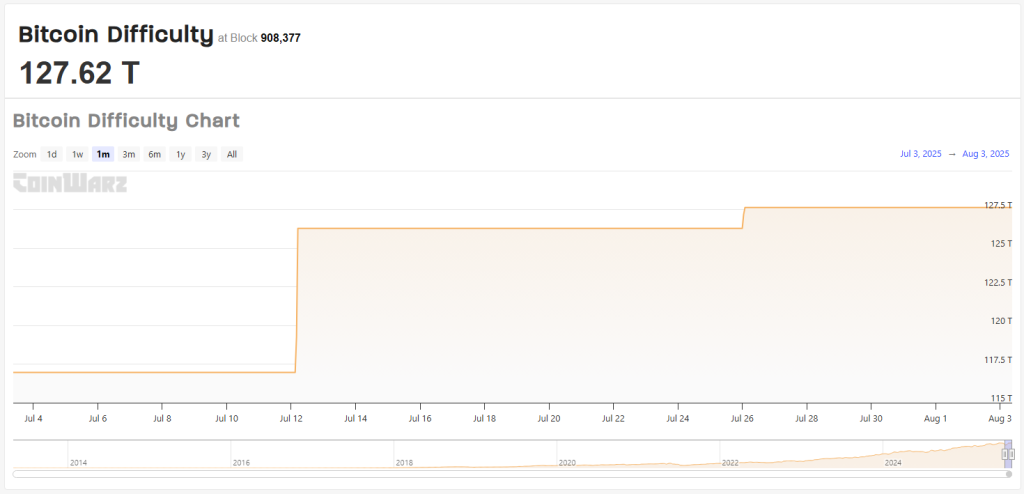
The latest data from CoinWarz confirms that the network has hit a record-setting difficulty of 127.6 trillion. This figure represents the mathematical complexity required to solve the cryptographic puzzles necessary to secure the network and mint new Bitcoin. When this number climbs, it signifies a "thicker" network, one that is highly secure but significantly more expensive to maintain for individual operators.
This surge in difficulty is not an isolated event but a reflection of the cumulative investment in specialized hardware (ASICs) by large-scale mining enterprises. However, as of this week, that technical strength is being tested by a softening market, leading to a "double-squeeze" scenario where miners are simultaneously forced to work harder for fewer rewards while the fiat value of their product fluctuates downward.
A Chronological Perspective on Network Health
To understand the current state of the network, one must look at the recent trajectory of mining activity.
- June 2025: The network experienced a temporary cooling period, with difficulty sliding to a low of 117 trillion. During this time, lower electricity costs and a momentary lull in hardware expansion provided a brief reprieve for smaller mining operations.
- Late July 2025: A rapid infusion of hashrate triggered a sharp reversal. As large-scale firms upgraded their facilities and deployed next-generation mining rigs, the difficulty curve began a steep climb.
- August 2025 (The Current Week): The network hit the 127.6 trillion threshold, marking a peak in competitive mining intensity.
- The August 9 Outlook: Projections suggest a slight reprieve. Analysts anticipate a 3% adjustment downward, bringing the difficulty to approximately 124 trillion. This shift is part of the routine 2,016-block cycle—a mechanism designed to recalibrate the network every two weeks to account for fluctuations in the total global hashrate.
Currently, the average block time has drifted to approximately 10 minutes and 20 seconds. This slight deviation from the 10-minute ideal is exactly why the upcoming adjustment is scheduled. By lowering the barrier slightly, the protocol effectively acknowledges that the current pace of production is lagging behind the idealized blockchain timeline.

Supporting Data: Understanding Hashrate and Network Dynamics
The relationship between price, hashrate, and difficulty is the "trinity" of Bitcoin mining economics. Hashrate represents the total processing power, while difficulty represents the effort required to utilize that power effectively.
According to CoinWarz and other analytics providers, the correlation between market price and mining investment remains strong but asymmetrical. When Bitcoin prices rise, miners are incentivized to invest in more hardware, which inevitably leads to a difficulty spike. Conversely, when prices drop, miners who operate on thin margins are often forced to power down their equipment, which eventually causes the hashrate to drop and the difficulty to adjust downward in subsequent cycles.
The current 3% dip in price to $113,005 has served as a stress test for the industry. While the price recovered to $113,250 by 7:30 pm ET, the volatility serves as a reminder that the mining sector is highly sensitive to price-driven operational liquidity. For firms that rely on daily cash flow to cover electricity bills and hardware amortization, a 3% drop in price is not merely a market headline—it is a direct hit to their "break-even" threshold.
Implications for the Mining Industry
The consequences of this record-high difficulty are profound for both institutional miners and retail enthusiasts. The "squeeze" is felt most acutely in the following areas:
1. The Survival of the Most Efficient
The current environment favors large-scale industrial miners with access to low-cost, sustainable energy and the most modern, energy-efficient ASIC hardware. Older, less efficient models (such as older generation S19 or similar units) are quickly becoming liabilities rather than assets. As electricity costs continue to represent the largest portion of a miner’s overhead, operations that cannot maintain a competitive cost-per-kilowatt-hour are increasingly forced to shutter their facilities.
2. Operational Consolidation
We are witnessing a period of consolidation. Larger, well-capitalized firms are absorbing the market share left behind by smaller players who can no longer compete. This leads to a more centralized mining landscape, which has sparked ongoing debates regarding the decentralization of the Bitcoin network. While the network remains secure, the barrier to entry for independent miners is now higher than it has ever been in the history of the protocol.
3. The Feedback Loop
The relationship between price and mining is cyclical. When mining becomes too difficult, miners turn off their machines. This causes the hashrate to drop, which then causes the difficulty to decrease in the next cycle. This decrease makes mining easier and more profitable for those who remained online, which eventually draws miners back into the market. We are currently in the phase of the cycle where the "weeding out" process is occurring.
Official and Industry Perspectives
While no single entity governs the Bitcoin network, industry analysts at platforms like CoinWarz and TradingView emphasize that this is a "healthy" mechanism of the protocol. The difficulty adjustment ensures that Bitcoin does not suffer from "runaway production" during periods of high interest.
However, the tone among mining firm executives has become increasingly cautious. Reports from various mining pools indicate that capital expenditure (CAPEX) for new hardware is being scrutinized more heavily. Firms are no longer aggressively expanding; instead, they are optimizing existing infrastructure. The sentiment is clear: until the next major price catalyst occurs, the industry will prioritize efficiency over pure growth.
Looking Forward: The Path to Stability
As the network approaches the August 9 difficulty adjustment, the market remains in a state of watchful waiting. The projected 3% decrease in difficulty will provide a temporary margin of safety for marginal miners, potentially allowing those on the brink of profitability to remain operational for a few more weeks.
However, the long-term health of the mining sector will depend heavily on the broader Bitcoin price action. If the price continues to face downward pressure, the network may see a more significant decline in hashrate as miners collectively decide to preserve capital. If the price rallies, the difficulty will likely climb once more, continuing the perpetual race for computational supremacy.
In summary, the record difficulty of 127.6 trillion is a testament to the robustness of the Bitcoin network. It is a system that demands efficiency, punishes waste, and remains entirely indifferent to the short-term anxieties of the market. For the miners at the heart of this engine, the current "squeeze" is merely the latest chapter in the ongoing evolution of the digital asset space—a high-stakes game where only the most efficient and well-capitalized players can consistently emerge on top.