Institutional Capital Floods Crypto Markets: Record-Breaking Inflows Follow Landmark US Executive Orders
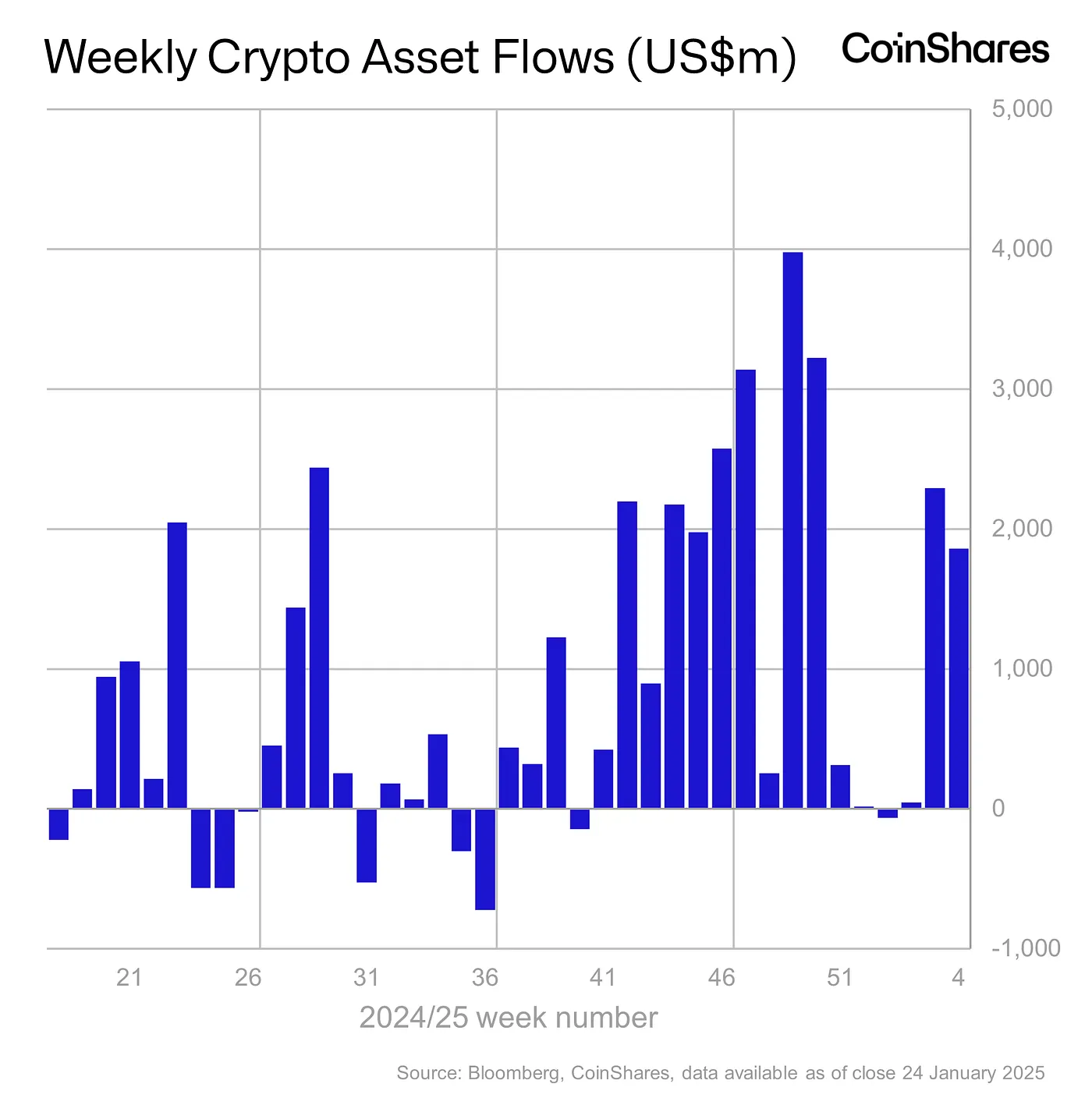
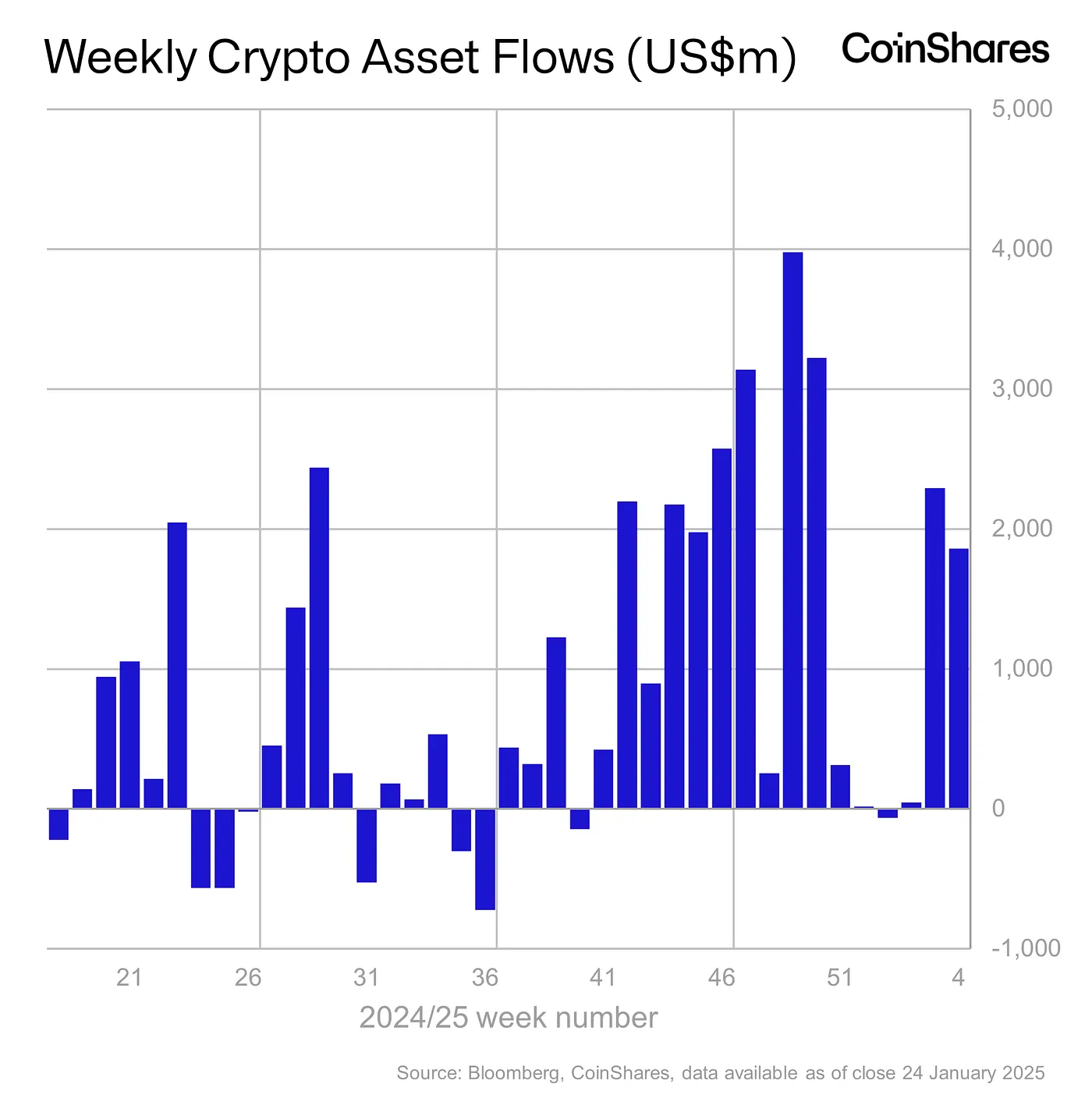
In a definitive display of renewed institutional confidence, the digital asset sector has witnessed a historic surge in capital allocation. According to the latest Digital Asset Fund Flows report from premier crypto asset manager CoinShares, institutional investors funneled nearly $2 billion into digital asset investment vehicles over the past week alone. This massive inflow, which brings year-to-date (YTD) totals to a staggering $4.8 billion, is widely attributed to the ripple effects of recent U.S. presidential executive orders aimed at integrating digital assets into the national economic framework.
Main Facts: A Resurgence of Institutional Appetite
The data underscores a pivotal shift in market sentiment. While price action for major cryptocurrencies remained relatively stagnant throughout the reporting period, the volume of capital entering the market tells a different story. Institutional players—ranging from hedge funds to pension funds—are increasingly viewing Bitcoin and its counterparts as essential components of a modern portfolio, particularly in light of evolving U.S. regulatory and policy stances.
The $1.9 billion weekly inflow is not merely a statistical anomaly; it represents a strategic pivot. Even as the broader market consolidated, trading volumes remained robust, hitting $25 billion for the week. This figure is particularly telling, as it accounted for 37% of all trading volume on trusted cryptocurrency exchanges, signaling that the "smart money" is actively participating in the market despite a lack of significant short-term price appreciation.
Chronology: The Road to the $2 Billion Inflow
The surge in interest did not occur in a vacuum. The timeline of events leading to these record inflows is closely tied to the shifting political landscape in Washington:
- Pre-Inauguration Momentum: Bitcoin achieved new all-time highs in the lead-up to the presidential inauguration, a move that set the stage for institutional curiosity.
- The Executive Order Catalyst: Following the inauguration, official executive orders were issued. These directives, which proposed the initiation of a strategic reserve asset in Bitcoin, acted as a primary catalyst for the institutional influx.
- The Reporting Period: During the week following these announcements, CoinShares tracked the massive $1.9 billion movement.
- Market Response: As the market digested the potential for a U.S. strategic reserve, institutional desks mobilized, moving capital into regulated investment products to gain exposure before any potential formal policy implementation.
Supporting Data: Regional and Asset-Specific Breakdown
The geographic distribution of these inflows reveals the dominance of the United States as the primary hub for crypto-capital. Of the $1.9 billion recorded, $1.7 billion originated from U.S.-based entities. Other global markets also showed positive, albeit smaller, trends:
- Switzerland: $35 million in inflows.
- Canada: $31 million in inflows.
- Germany: $23 million in inflows.
Asset Performance Analysis
Bitcoin remains the undisputed king of institutional portfolios. With $1.6 billion in inflows, BTC accounted for 92% of the total movement into the sector. This has brought the year-to-date inflow total for Bitcoin to $4.4 billion.
Interestingly, the rise of Bitcoin’s price has invited a two-sided market. CoinShares noted that short-Bitcoin ETFs, which allow investors to profit from price declines, saw a modest inflow of $5.1 million. This suggests that while institutional sentiment is overwhelmingly bullish, professional risk-management desks are hedging against potential volatility.
Ethereum, the second-largest cryptocurrency by market capitalization, served as the primary beneficiary among altcoins. It recorded $205 million in inflows, effectively reversing previous trends and bringing its YTD inflow tally to $177 million. With the exception of Cardano (ADA), which faced minor outflows, the broader institutional crypto market enjoyed a week of near-universal growth.
Official Responses and Strategic Implications
The pivot toward treating Bitcoin as a "strategic reserve asset" represents a paradigm shift. Historically, cryptocurrencies were viewed by institutional investors as speculative, high-risk "toys." The current narrative, influenced by the executive orders, suggests a transition toward "digital gold" or a geopolitical reserve asset.

Financial analysts suggest that this shift is not just about price speculation; it is about infrastructure. When the U.S. government discusses the inclusion of Bitcoin in a strategic reserve, it legitimizes the asset class for risk-averse institutional managers who previously could not justify the exposure due to regulatory uncertainty.
The Role of Regulation
For years, the "UK regulator" and various U.S. agencies (such as the SEC) served as a barrier to entry, often shutting down or stifling crypto-related financial products. However, the current trend suggests that the regulatory pendulum is swinging toward clarity. By proposing specific frameworks for a strategic reserve, the U.S. is signaling that it intends to lead the global digital asset economy rather than suppress it.
The Broader Implications for Global Finance
The massive inflows reported by CoinShares carry several long-term implications for the financial ecosystem:
1. Market Maturity and Depth
With billions of dollars flowing into regulated investment vehicles, the market depth of Bitcoin and Ethereum is increasing. This maturity makes the market more resilient to "flash crashes" and less prone to the erratic swings of retail-only trading.
2. The Institutionalization of Altcoins
While Bitcoin remains the primary focus, the significant inflow into Ethereum highlights a growing understanding of "smart contract" platforms. Institutional investors are beginning to differentiate between "store of value" assets and "utility" assets, a level of sophistication that indicates the market is moving past the "crypto-gambling" phase.
3. Geopolitical Competition
The focus on a "strategic reserve" suggests that Bitcoin is being viewed through the lens of national security and monetary sovereignty. If the U.S. proceeds with such a reserve, it will likely trigger a "race to the top" among other sovereign nations to secure their own digital asset supplies, further cementing the status of crypto as a permanent fixture in global finance.
Conclusion: A New Chapter for Digital Assets
The data provided by CoinShares is a clear indicator that the institutional barrier has been breached. The combination of high trading volumes, massive capital inflows, and favorable government rhetoric has created a "perfect storm" for the maturation of the digital asset industry.
While volatility remains an inherent characteristic of the crypto market, the influx of $1.9 billion in a single week suggests that institutional players are no longer sitting on the sidelines. They are positioning themselves for a future where digital assets are integrated into the bedrock of global financial architecture. As we look toward the remainder of the year, all eyes will be on Washington to see how the proposed executive orders are translated into concrete legislative action. For now, the numbers speak for themselves: the institutional embrace of digital assets is not just a trend—it is a fundamental restructuring of modern investment.
Disclaimer: The information provided in this article is for educational and informational purposes only and does not constitute financial, investment, or legal advice. Cryptocurrency investments carry significant risks, including the potential loss of principal. Investors should conduct their own due diligence and consult with a certified financial advisor before making any investment decisions. The Daily Hodl does not recommend the buying or selling of any specific assets, and any trades made are at the sole discretion and risk of the investor.