Institutional Exodus: How Geopolitical Tariff Volatility Stalled the Crypto Bull Run
Executive Summary: The Macroeconomic Impact on Digital Assets
The burgeoning momentum of the cryptocurrency market has hit a significant roadblock, as institutional investors scramble to recalibrate their portfolios in the face of heightened geopolitical uncertainty. According to the latest Digital Asset Fund Flows Weekly Report from CoinShares, the global crypto asset management sector has witnessed a dramatic reversal of fortune.
Over the past three weeks, institutional sentiment—often considered the "smart money" indicator—has shifted from aggressive accumulation to risk-off behavior. This cooling effect is directly linked to the recent tariff policies introduced by President Donald Trump. As markets grapple with the inflationary pressures and supply chain disruptions inherent in these "calamitous" trade measures, the digital asset class has seen its year-to-date (YTD) gains almost entirely eroded, leaving investors and analysts questioning the resilience of crypto in a protectionist global economy.
The Chronology of the Capital Flight
The current climate of volatility did not emerge in a vacuum. To understand the current state of digital asset funds, one must look at the timeline of the recent market turbulence:
- Early February: Initial market optimism began to wane as geopolitical tensions mounted. The first wave of negative sentiment emerged, marking the start of a trend that would eventually pull billions of dollars out of institutional investment products.
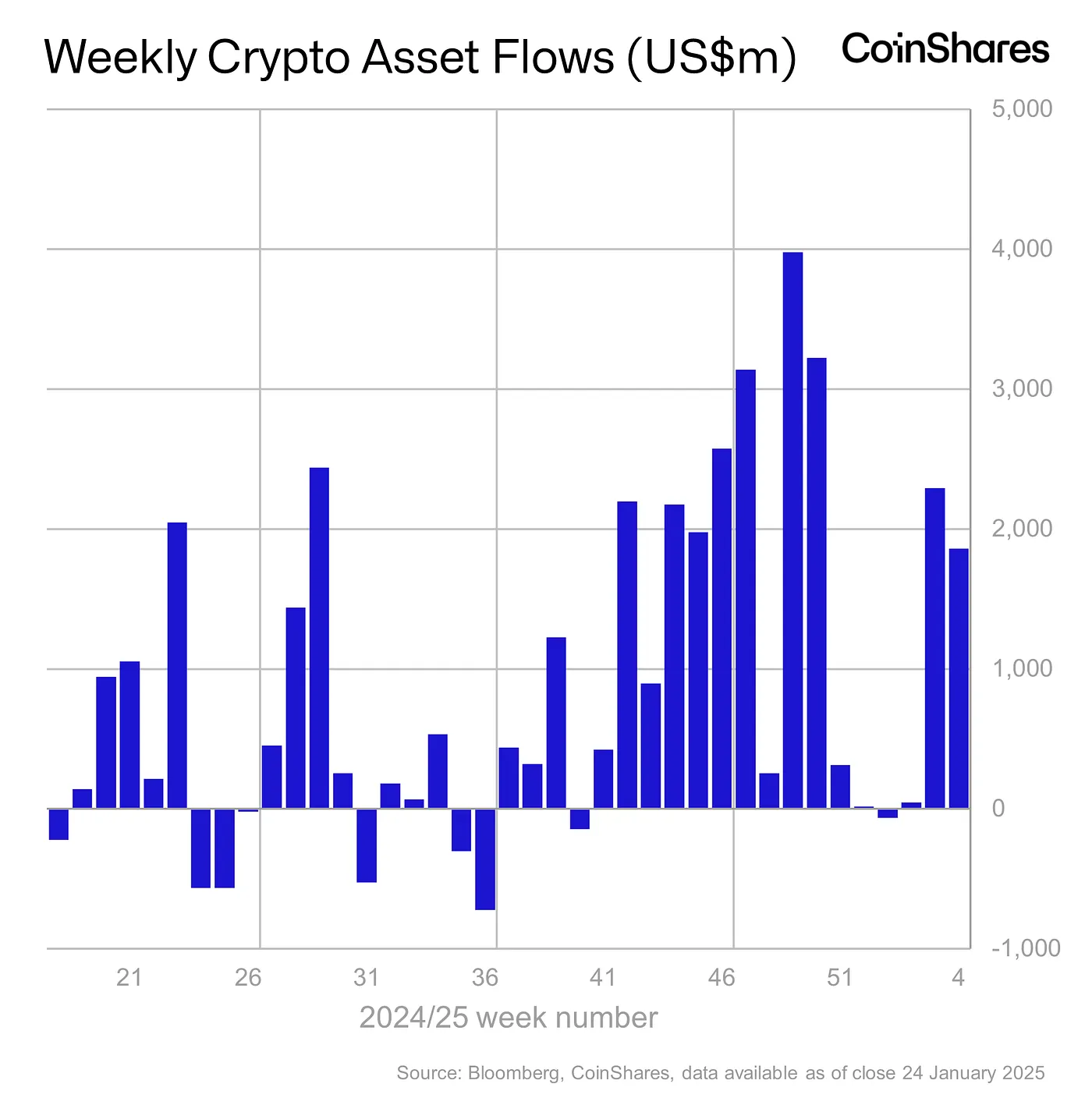
- The Mid-Spring Slump: By April, the cumulative effect of the policy shifts had become undeniable. Outflows began to snowball, reaching a staggering total of $7.2 billion. This figure essentially wiped out the inflows that had been accumulated throughout the early months of 2024.
- April 8 – The Market Floor: Total Assets under Management (AuM) hit their lowest point since early November 2024, signaling a period of extreme capitulation among institutional holders.
- The Post-Reversal Recovery: Following President Trump’s temporary reversal of the most severe tariff measures, a late-week price rebound occurred. This brief period of relief helped bolster market confidence, resulting in an 8% increase in total AuM to approximately $130 billion.
Supporting Data: Dissecting the Outflows
The data provided by CoinShares offers a granular look at where capital is fleeing and where it is finding refuge. The exodus was not uniform across the board, though the "Blue Chip" assets bore the brunt of the selling pressure.
The Heavy Hitters: Bitcoin and Ethereum
Bitcoin (BTC), the undisputed leader in market capitalization, was the primary target for institutional liquidation. Last week alone, Bitcoin-based investment products saw $751 million in outflows. This trend suggests that institutional investors view Bitcoin as a high-beta asset that is overly sensitive to macroeconomic shifts, rather than the "digital gold" hedge that many proponents claim it to be in the short term.
Ethereum (ETH), despite its robust ecosystem and recent upgrades, was not spared. The world’s second-largest cryptocurrency saw $37.6 million in outflows. Other prominent altcoins, including Solana (SOL), AAVE, and SUI, also saw capital departures of $5.1 million, $0.78 million, and $0.58 million, respectively.
The Bright Spots: Niche Altcoin Resilience
While the broader market was defined by outflows, specific segments showed surprising resilience. Smaller, more specialized altcoins bucked the trend, attracting modest inflows. XRP led this group with $3.5 million in new investment, while Ondo, Algorand, and Avalanche saw inflows of $0.46 million, $0.25 million, and $0.25 million, respectively. This movement suggests that, even during periods of macro-driven fear, there remains a persistent appetite for specific blockchain technologies that offer utility beyond mere speculative store-of-value propositions.
Implications of the "Tariff War" on Digital Assets
The direct link drawn by researchers between trade policy and crypto outflows represents a paradigm shift in how we evaluate market drivers.

The Inflation/Interest Rate Nexus
Tariffs are inherently inflationary. When the cost of imported goods rises due to taxes, the consumer price index (CPI) often follows. This places the Federal Reserve in a difficult position: if they raise interest rates to combat tariff-induced inflation, the "risk-on" environment that fuels cryptocurrency growth is severely hampered. Institutional investors, who typically operate on longer time horizons, are moving to cash or defensive positions in anticipation of a prolonged period of high interest rates necessitated by these trade policies.
The End of the "Safe Haven" Narrative
For years, the crypto industry has marketed Bitcoin as a hedge against fiat currency devaluation. However, the recent data suggests that in times of extreme trade-related volatility, institutional investors treat crypto as a speculative technology stock rather than a sovereign hedge. This creates a "correlation trap" where crypto prices mirror the movements of the Nasdaq and other high-growth indices, making them susceptible to the same geopolitical headwinds that affect traditional tech firms.
Analysis: What Does This Mean for the Future?
The volatility of the past quarter has provided a stress test for the institutionalization of crypto. The fact that the market was able to recover from its April 8 lows so rapidly after the tariff reversal suggests that while sentiment is fragile, the underlying liquidity remains robust.
The Institutional Dilemma
Institutional investors are currently caught in a tug-of-war. On one side, they are attracted to the technological potential and long-term scarcity of digital assets. On the other, they are bound by fiduciary duties that require them to mitigate exposure to assets that react poorly to volatile trade environments. As long as trade policy remains the primary lever for the current administration’s economic strategy, the crypto market may remain in a "stop-and-start" cycle.
The Path Forward
For the crypto industry to decouple from these macroeconomic shocks, it must demonstrate consistent utility and resilience independent of policy cycles. While price rebounds following policy reversals are a positive sign of market vitality, true stability will require a broader base of adoption that is less dependent on institutional inflows and more anchored in decentralized finance (DeFi) and real-world asset (RWA) tokenization.
Conclusion
The recent report from CoinShares serves as a sobering reminder that digital assets are not immune to the traditional levers of state power. The "calamitous" tariff war initiated by President Trump has served as a masterclass in how macroeconomic policy can act as a circuit breaker for even the most optimistic market trends.
As we look toward the remainder of the year, investors should expect continued sensitivity to political announcements. The ability of the market to regain its $130 billion AuM valuation following the tariff reversal is a testament to the sector’s strength, but it also highlights the volatility that remains the defining feature of the space. Whether the market can sustain this momentum will depend on the stability of trade policy and the ability of digital assets to prove their long-term value proposition in an increasingly fragmented global economy.
Disclaimer: This report is for informational purposes only and does not constitute financial, investment, or legal advice. Cryptocurrency investments involve a high degree of risk, including the total loss of principal. Investors are encouraged to conduct their own due diligence and consult with a qualified financial advisor before making any investment decisions.