Institutional Capital Floods Crypto Markets: A Mid-Year Analysis of the 2025 Surge
The global financial landscape is witnessing a seismic shift in how institutional investors allocate capital, with digital assets firmly establishing themselves as a core component of diversified portfolios. According to the latest Digital Asset Fund Flows Weekly report from industry-leading asset manager CoinShares, the first half of 2025 has seen an aggressive accumulation of crypto-based investment products, signaling a robust appetite for decentralized assets despite a backdrop of macroeconomic uncertainty.
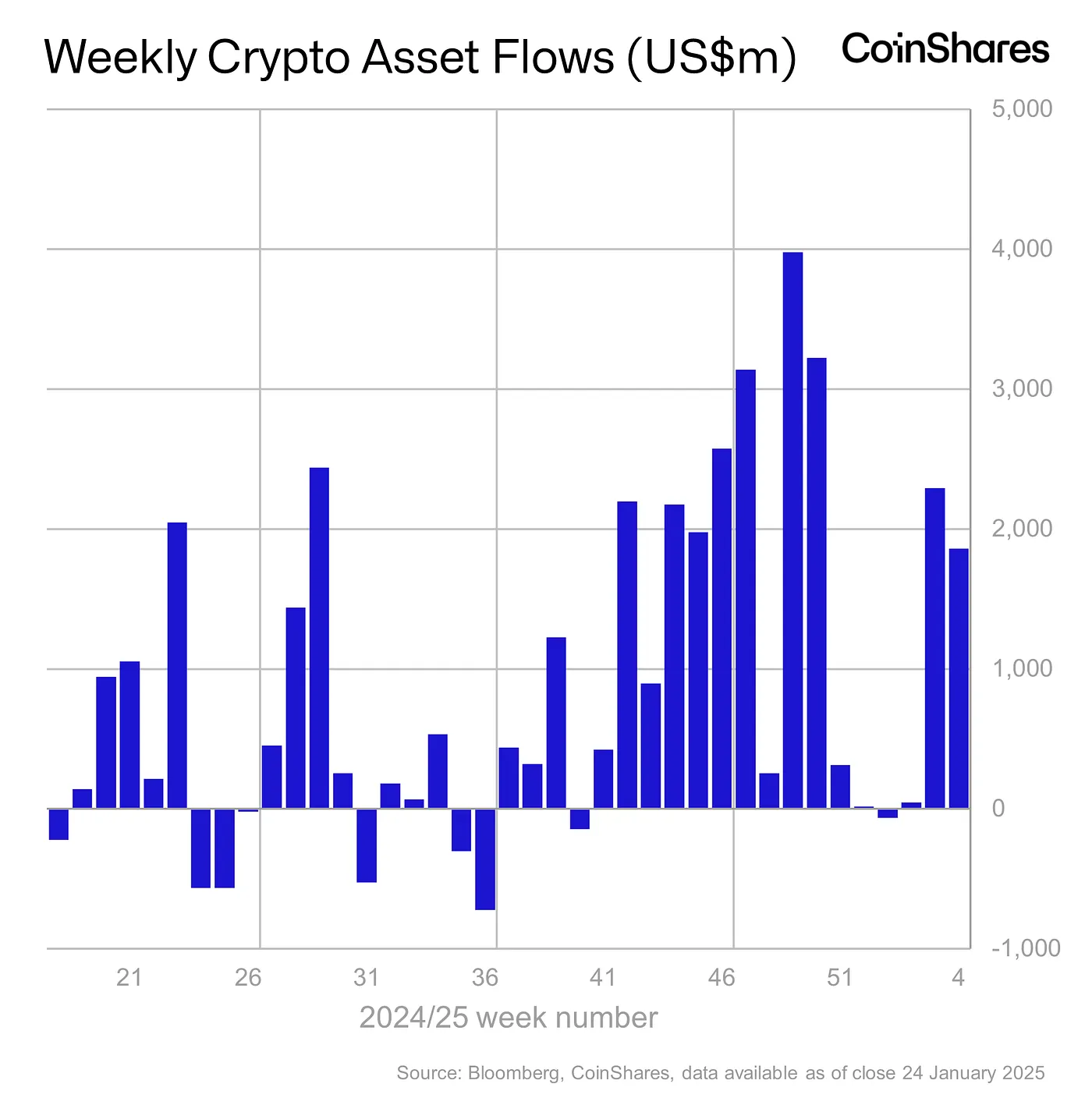
In just the last eleven weeks, institutional investment vehicles have absorbed over $16 billion in inflows. This sustained momentum suggests that the asset class has moved beyond speculative retail interest, evolving into a sophisticated hedge against traditional market volatility.
Main Facts: The $16 Billion Institutional Wave
The data released by CoinShares underscores a remarkable trend: institutional investors are not merely dipping their toes into the digital asset pool—they are diving in headfirst. The cumulative inflows of $16.9 billion over the most recent eleven-week period indicate that the appetite for regulated, exchange-traded, and institutional-grade crypto products remains resilient.
As of the conclusion of June 2025, total inflows for the first half of the year reached $16.9 billion, falling only slightly short of the $18.3 billion recorded during the same period in 2024. This continuity is significant; it suggests that even as the market matures and moves through different phases of the economic cycle, the institutional conviction in Bitcoin and Ethereum remains largely unshaken.
Chronology of the 2025 Inflow Surge
To understand the current momentum, it is essential to view the performance of these investment products through a temporal lens.
Q1 2025: The Foundation of Growth
The year began with a cautious but steady accumulation. Following the regulatory clarity established in late 2024, institutional desks began rebalancing portfolios to include digital assets as a hedge against sovereign debt concerns and currency debasement.
Q2 2025: The Acceleration Phase
The second quarter, specifically the period spanning April through June, saw an intensification of inflows. As geopolitical tensions flared in various parts of the globe and central banks began signaling a pivot in monetary policy—creating uncertainty regarding interest rates and inflation targets—investors turned to crypto.
The most recent data point, a staggering $2.7 billion inflow in the final week of June alone, confirms that this trend is not slowing down. This influx has been instrumental in maintaining price stability for major assets like Bitcoin, providing a "floor" that prevents significant downward volatility during periods of traditional equity market weakness.
Supporting Data: Geographic and Asset-Specific Trends
The distribution of these inflows reveals a stark divergence in market sentiment across global jurisdictions.
Regional Performance: The US Dominates
The United States continues to act as the primary engine for global institutional crypto flows. In the most recent reporting period, the US recorded a massive $2.65 billion in inflows, dwarfing all other regions. This dominance is largely attributed to the widespread availability of spot crypto ETFs and the maturation of the institutional custody infrastructure within the US.
Conversely, other regions have experienced mixed results:
- Switzerland and Germany: These European hubs continue to show positive sentiment, contributing $23 million and $19.8 million, respectively.
- Canada, Hong Kong, and Brazil: These markets have faced net outflows. Canada saw $13.6 million exit, while Brazil and Hong Kong witnessed $2.4 million and $2.3 million in outflows. Notably, Hong Kong experienced a significant liquidity drain in June, with $132 million in total outflows for the month, potentially reflecting a shift in investor focus toward more liquid US-based venues.
Asset Breakdown: Bitcoin and Ethereum
Bitcoin remains the undisputed "King of Crypto" in the eyes of institutional allocators. It accounted for 83% of the total inflows last week, netting $2.2 billion. Perhaps most tellingly, "short-Bitcoin" products—designed to profit from a price decline—saw $2.9 million in outflows. Year-to-date, short-Bitcoin vehicles have seen $12 million in outflows, confirming that the "smart money" is overwhelmingly positioned for growth rather than betting against the asset.
Ethereum, meanwhile, has staged a massive comeback. Following a period of relative stagnation, the second-largest cryptocurrency attracted $429 million in a single week. This suggests that as institutional investors gain comfort with Bitcoin, they are expanding their exposure to smart-contract platforms that offer utility beyond simple store-of-value functions.

Official Responses and Expert Perspectives
While CoinShares acts as the primary data provider, the broader financial community has weighed in on the implications of these figures. Analysts point to the "Flight to Quality" phenomenon.
"When investors are unsure about the long-term trajectory of the US dollar or the stability of fiscal policy in the West, they look for assets that are mathematically scarce," noted a senior analyst at a leading global macro research firm. "Bitcoin is no longer viewed as a speculative ‘toy’ by the institutional desks; it is being treated as a digital equivalent to gold, but with better transportability and lower storage overhead."
The CoinShares report itself notes: “We believe this resilient investor demand has been driven by a combination of factors, primarily heightened geopolitical volatility and uncertainty surrounding the direction of monetary policy.”
This sentiment is echoed by the behavior of the inflows. The correlation between periods of high geopolitical tension and institutional inflows into crypto has become increasingly pronounced throughout 2025.
Implications for the Future of Finance
The transition of digital assets into institutional-grade investments carries profound implications for the global financial ecosystem.
1. Market Maturation and Reduced Volatility
As more capital is locked into institutional vehicles—which are typically managed with longer time horizons than retail trading accounts—the overall volatility of the crypto market may dampen. Large-scale institutional holdings act as a stabilizer, providing a buffer against the impulsive, sentiment-driven swings that historically defined the crypto space.
2. The Monetary Policy Hedge
The fact that inflows are accelerating alongside uncertainty regarding central bank interest rate decisions is telling. If inflation remains "sticky" or if governments continue to run high deficits, the institutional bid for Bitcoin is likely to intensify. Institutional investors are increasingly using digital assets to immunize their portfolios against the potential devaluation of fiat currencies.
3. Regulatory Integration
The flow of billions of dollars into these products necessitates a higher degree of regulatory oversight. As the industry grows, the pressure for standardized accounting, tax reporting, and custodial security increases. This influx of capital acts as a catalyst for governments to formalize the legal status of digital assets, further reducing the "risk" premium that once kept institutional capital on the sidelines.
4. Competitive Dynamics Between Jurisdictions
The divergence in regional flows highlights a competitive landscape. Jurisdictions that provide clear, favorable regulatory frameworks for digital asset investment are attracting more capital. The outflows from Hong Kong and the strong performance of the US market suggest that global capital is highly mobile and will flow toward the regions that offer the highest level of legal certainty and institutional infrastructure.
Conclusion
The first half of 2025 has been a testament to the endurance of digital assets as a legitimate investment class. With over $16 billion in fresh institutional capital flowing into the sector over the last quarter alone, the narrative has firmly shifted. The market is no longer driven solely by retail FOMO (Fear Of Missing Out); it is being propelled by the deliberate, calculated strategies of the world’s most significant financial institutions.
As we move into the second half of the year, all eyes will be on whether this momentum can be sustained. If the current macroeconomic environment of geopolitical friction and monetary policy indecision persists, it is highly probable that the inflow trend will continue, further cementing Bitcoin and Ethereum as the cornerstone assets of the modern, digitized portfolio.
Investors, however, should remain vigilant. As highlighted by the disclaimer, digital asset markets are inherently high-risk, and while the trend is currently positive, the landscape can shift rapidly. For now, the "institutional pivot" is not just a theory—it is a data-backed reality that is reshaping the global financial order.
Disclaimer: The information provided in this article is for educational and informational purposes only and does not constitute financial, investment, or legal advice. Investing in digital assets, including Bitcoin and Ethereum, carries a high level of risk and may not be suitable for all investors. You should conduct your own thorough research and consult with a qualified professional advisor before making any financial decisions. The Daily Hodl is not responsible for any losses incurred as a result of trades or investment decisions.