Institutional Capital Floods Crypto Markets Following Strategic Policy Shifts
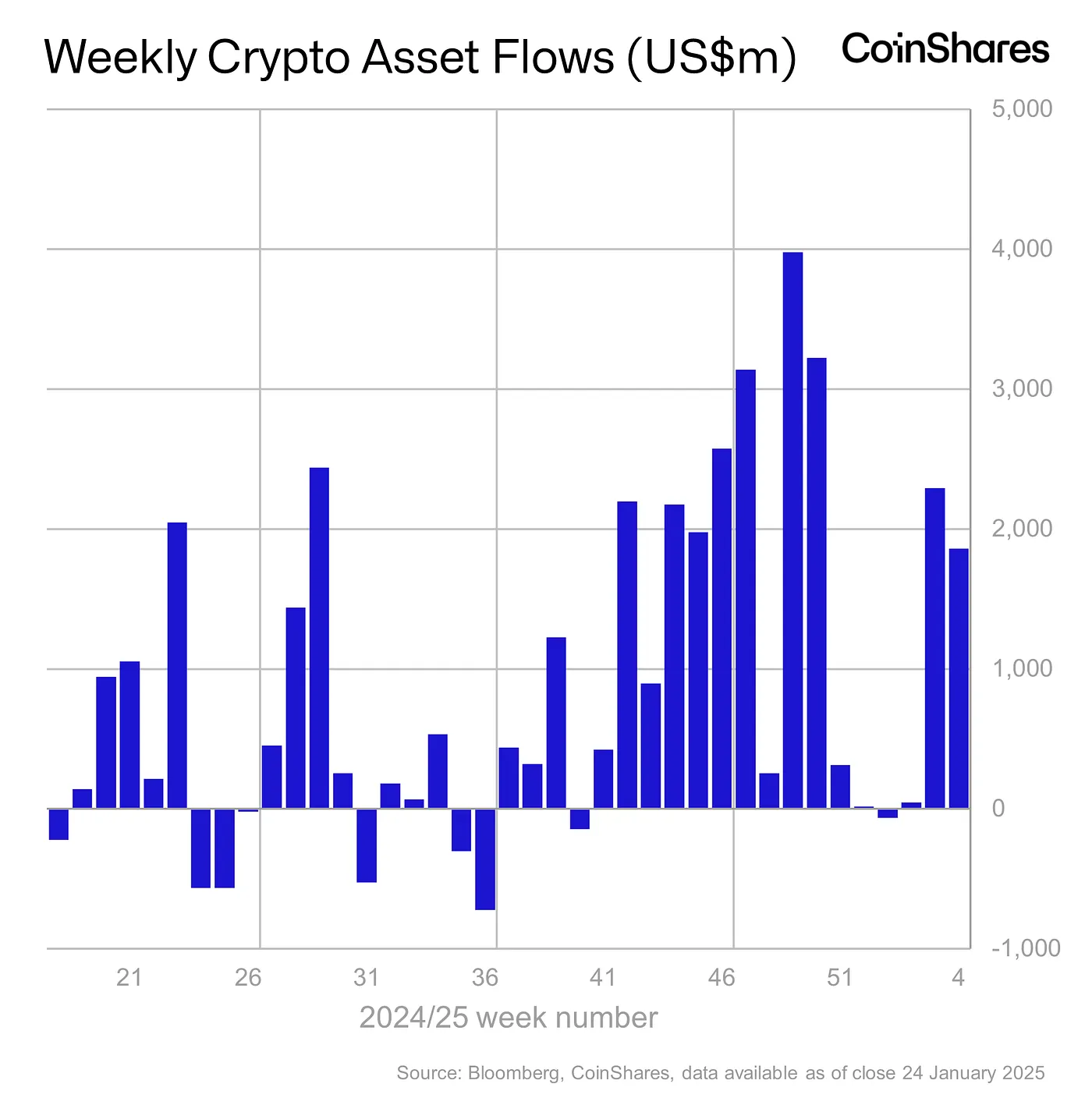
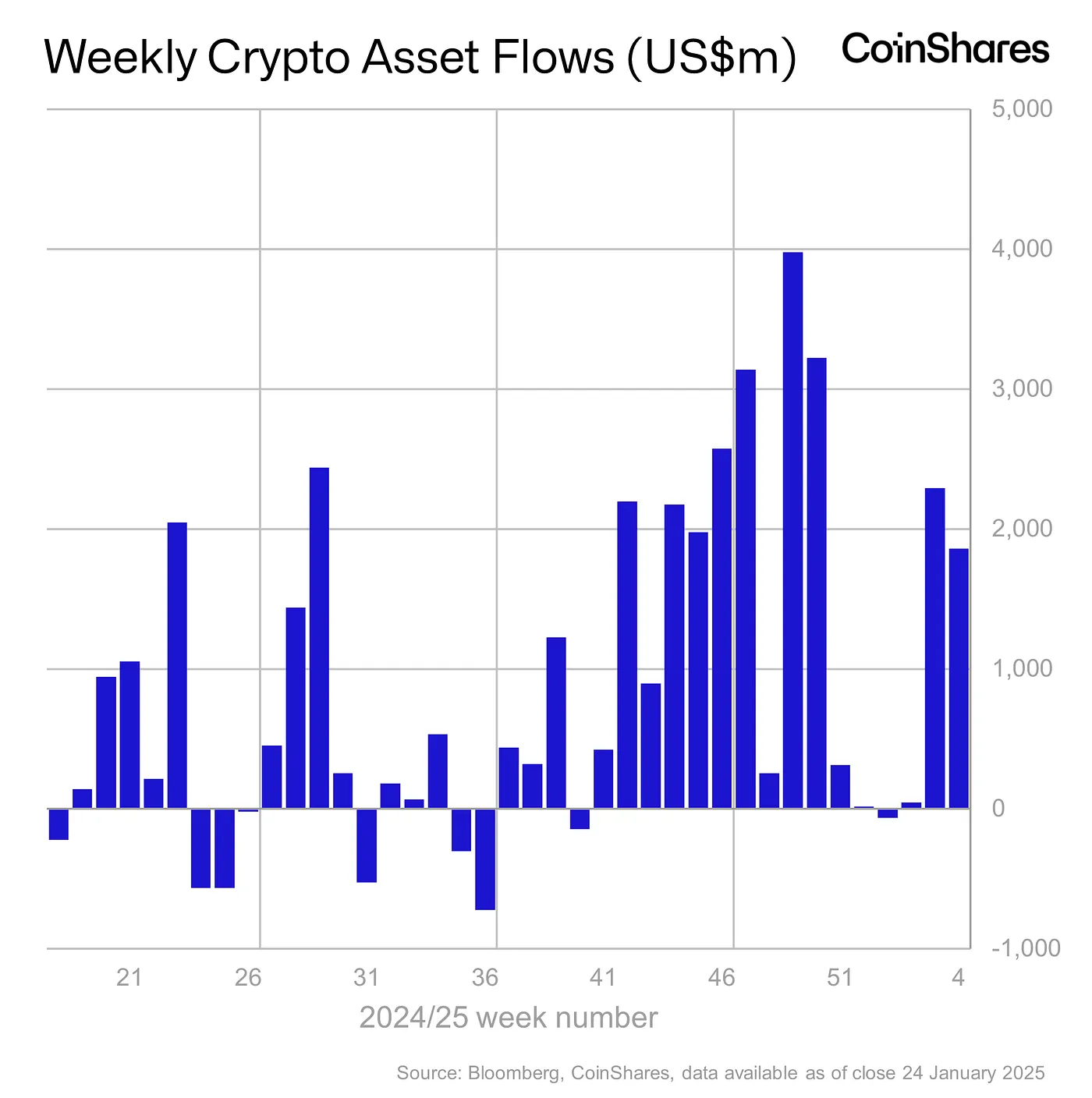
In a dramatic display of market confidence, institutional investors have accelerated their exposure to the digital asset sector, pouring nearly $2 billion into investment vehicles in a single week. According to the latest "Digital Asset Fund Flows" report from leading crypto asset manager CoinShares, the influx of capital is widely attributed to the recent policy signals emanating from the U.S. executive branch, specifically those related to the potential establishment of a strategic Bitcoin reserve.
As institutional appetite for crypto-assets reaches a fever pitch, the market is undergoing a structural shift. The influx of $1.9 billion last week has pushed year-to-date (YTD) inflows to a staggering $4.8 billion, signaling a robust recovery and renewed institutional commitment to the asset class.
Main Facts: A Record-Breaking Surge in Institutional Inflows
The data released by CoinShares highlights a significant divergence between the relatively flat price action observed in the broader spot markets and the aggressive accumulation occurring within institutional funds. Despite stagnant prices, trading volumes on trusted crypto exchanges surged to $25 billion for the week, representing 37% of total market activity—a clear indication that institutional players are the primary drivers of current market sentiment.
Key Highlights:
- Total Weekly Inflows: $1.9 billion.
- Year-to-Date Total: $4.8 billion.
- U.S. Dominance: $1.7 billion of the $1.9 billion total originated from the United States.
- Bitcoin’s Market Share: BTC accounted for 92% of all digital asset inflows.
- Secondary Market Activity: High trading volumes suggest that these inflows are not merely "buy and hold" strategies but active portfolio rebalancing.
Chronology: The Catalyst of Executive Action
The recent surge in capital did not occur in a vacuum. It follows a distinct timeline of political and economic developments in the United States that have fundamentally altered the perception of digital assets among traditional financial institutions.
Phase 1: The Pre-Inauguration Rally
Leading up to the inauguration, Bitcoin experienced a period of unprecedented volatility, ultimately clearing new all-time highs. This period acted as a "proof of concept" for institutional investors, demonstrating that Bitcoin could withstand macroeconomic headwinds and remain a viable hedge against traditional fiscal instability.
Phase 2: The Executive Order Pivot
Following the inauguration, the issuance of new executive orders directed at the digital asset industry marked a turning point. These directives, which explicitly explored the creation of a "strategic reserve asset" in Bitcoin, removed a significant layer of regulatory uncertainty. For institutional capital, which typically shuns policy ambiguity, this provided the green light to deploy funds that had previously been sidelined in cash or short-term fixed-income products.
Phase 3: The Post-Policy Inflow Spike
The week immediately following these announcements saw the reported $1.9 billion inflow. The market responded to the executive orders not just with excitement, but with a calculated reallocation of capital from traditional equity and bond products into the crypto-asset space.
Supporting Data: Regional and Asset-Specific Breakdown
While the United States remains the epicenter of the current movement, the trend is global. However, the data confirms that U.S.-based institutions are reacting more decisively to the domestic policy shifts than their international counterparts.
Regional Contributions
- United States: $1.7 billion.
- Switzerland: $35 million.
- Canada: $31 million.
- Germany: $23 million.
The massive gap between the U.S. and other nations confirms that the primary driver for this specific surge is internal American policy. International investors appear to be following the U.S. lead, albeit at a more cautious pace.
Asset Class Performance
Bitcoin continues to function as the "gateway" for institutional entry. With $1.6 billion in inflows, Bitcoin’s YTD total now stands at $4.4 billion. Notably, the report also identified that short-Bitcoin ETFs saw inflows of $5.1 million, suggesting that even those betting against the market are finding value in the current, highly liquid environment.
Ethereum, the second-largest digital asset by market capitalization, saw a resurgence of interest with $205 million in inflows, bringing its YTD total to $177 million. This shift indicates that institutional investors are beginning to diversify beyond Bitcoin, signaling a growing maturity in how these entities manage their digital portfolios. Aside from Cardano, which saw minor outflows, the rest of the altcoin market remained net-positive, reflecting a broad-based confidence across the ecosystem.

Official Responses and Market Analysis
While there have been few formal, granular "official responses" to the specific investment flow data, industry analysts and regulatory experts are closely monitoring the implications of a "strategic reserve."
"The concept of a strategic reserve is no longer a fringe idea," noted a lead analyst at a major fintech research firm. "When institutional capital flows move at this scale, they are essentially signaling to the federal government that the market is ready for a formal framework. The $1.9 billion in inflows is essentially a vote of confidence in the legislative trajectory of the new administration."
Conversely, some market skeptics warn that the high inflow of capital, combined with high trading volumes, could lead to a "liquidity trap" if regulatory policy shifts abruptly. However, for now, the prevailing sentiment in the C-suites of major hedge funds and family offices is one of optimism regarding the regulatory environment.
Implications: What This Means for the Future of Finance
The implications of this institutional shift are far-reaching, affecting both the regulatory landscape and the broader financial infrastructure.
1. Integration with TradFi
The sheer volume of capital moving through institutional crypto vehicles suggests that the barriers between Traditional Finance (TradFi) and Decentralized Finance (DeFi) are dissolving. Major custodial banks are now tasked with managing massive digital asset portfolios, forcing them to upgrade their cybersecurity and settlement infrastructure to meet the demands of their clients.
2. The "Strategic Reserve" Narrative
If the United States proceeds with even a limited version of a strategic Bitcoin reserve, it will likely trigger a "sovereign FOMO" (fear of missing out) effect. Other nations may feel compelled to diversify their own central bank reserves into digital assets, effectively turning Bitcoin into a global reserve asset alongside gold and the U.S. dollar.
3. Market Maturation and Volatility
While large inflows are generally viewed as bullish, they also bring increased scrutiny. The concentration of capital in institutional hands means that the market may become more sensitive to interest rate announcements and government fiscal policy than it was in its early, retail-driven days. We are likely to see a shift where crypto prices move in closer correlation with macro-economic indicators like the Consumer Price Index (CPI) and Treasury bond yields.
4. Regulatory Clarity as a Competitive Advantage
The U.S. lead in these inflows demonstrates that capital flows to where it is treated best. By offering clear guidelines and acknowledging the strategic importance of crypto-assets, the U.S. is positioning itself as the global hub for digital asset innovation. Other jurisdictions that remain hostile or ambiguous toward crypto risk seeing their own financial institutions relocate to more favorable climates.
Conclusion: A New Era of Institutional Adoption
The latest data from CoinShares confirms that the "institutionalization" of cryptocurrency is no longer a future prospect—it is the current reality. With $1.9 billion in weekly inflows and a clear policy roadmap provided by the recent executive orders, the digital asset market has entered a new phase of growth.
For investors, this represents a significant shift in the risk-reward profile of digital assets. While the risks remain—including market volatility, regulatory pivots, and technical challenges—the involvement of institutional capital provides a level of legitimacy and liquidity that was previously absent. As we move forward into the fiscal year, all eyes will be on Washington to see how the proposed strategic reserve manifests, and on the markets to see if this momentum can be sustained in the face of evolving global economic conditions.
Disclaimer: The information provided in this article is for informational purposes only and does not constitute financial, investment, or legal advice. Investing in digital assets, including Bitcoin and Ethereum, carries significant risk. Past performance is not indicative of future results. Investors should perform their own due diligence and consult with a professional financial advisor before making any investment decisions. The Daily Hodl and its contributors are not responsible for any financial losses incurred.