Institutional Appetite Surges: Crypto Investment Products Near Historic Inflows as Bitcoin Dominates Global Sentiment
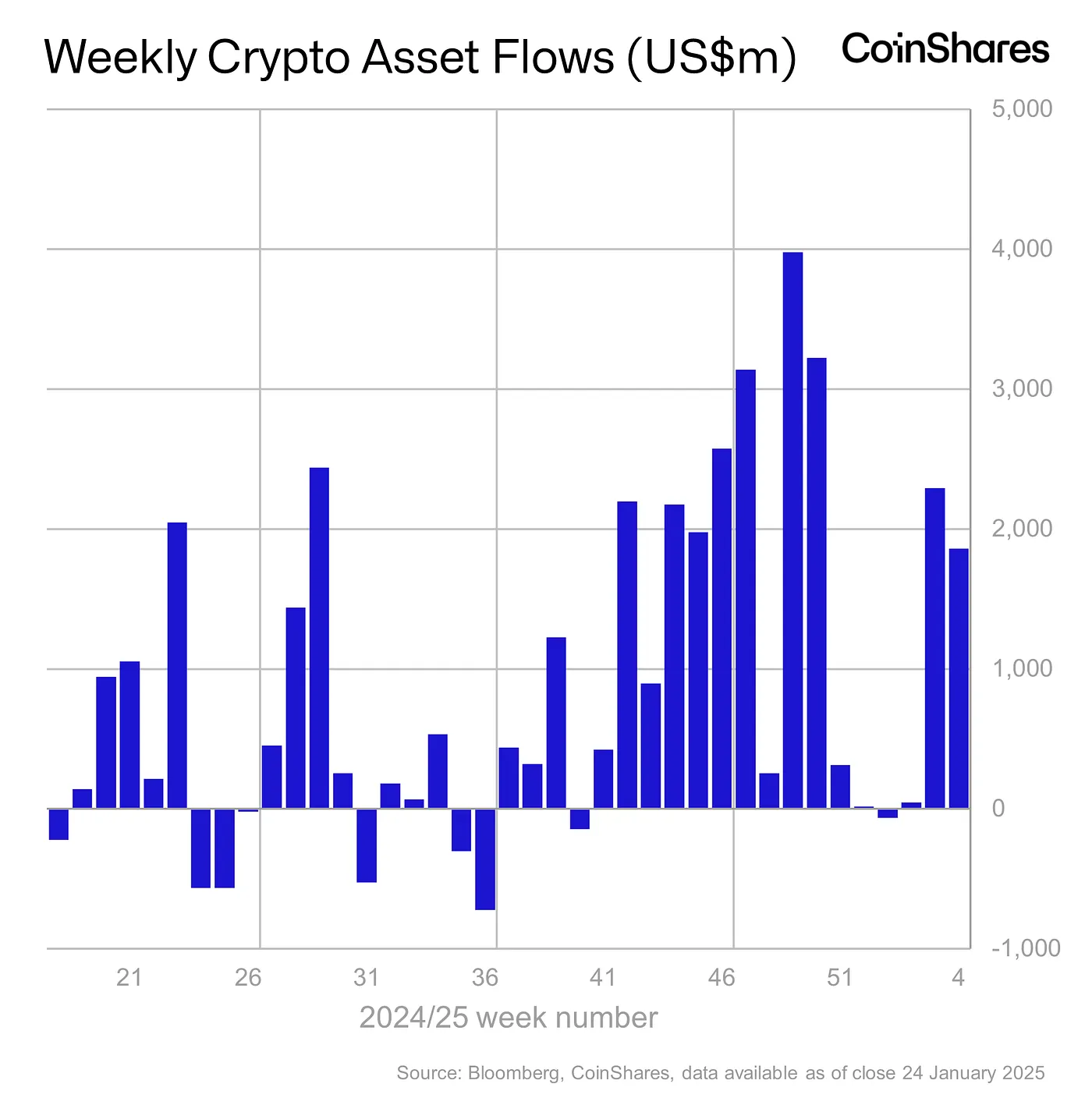
The digital asset landscape is currently undergoing a transformative period, marked by an aggressive return of institutional capital. According to the latest "Digital Asset Fund Flows Weekly" report released by the premier crypto asset management firm CoinShares, investment vehicles focused on digital assets have recorded their fourth consecutive week of robust inflows. With nearly $1 billion entering the market in a single week, the sector is rapidly closing in on its all-time high for year-to-date (YTD) inflows, signaling a renewed confidence among global investors.
Main Facts: A Billion-Dollar Wave of Institutional Capital
The most recent data from CoinShares confirms that the digital asset market is experiencing a significant "risk-on" phase. Last week alone, crypto exchange-traded products (ETPs) saw a staggering $882 million in global inflows. This momentum has pushed the YTD total to an impressive $6.7 billion, a figure that is now within striking distance of the $7.3 billion record established in early February of this year.
The resurgence is not merely a localized phenomenon; it represents a coordinated global movement. While specific regions like Canada and Hong Kong experienced minor outflows—totaling $8 million and $4.3 million respectively—these were vastly overshadowed by the massive influx of capital into the United States, which recorded $840 million. Germany and Australia also bolstered the upward trend, contributing $44.5 million and $10.2 million to the global total.
This surge is particularly notable because it reflects a structural shift in how institutional investors view digital assets. Once considered a speculative peripheral, crypto is increasingly being integrated into standard investment portfolios, facilitated by the maturation of regulated ETPs and ETFs.
Chronology of the Current Rally
To understand the current state of the market, one must look at the progression of the 2024 fiscal year. The year began with immense excitement surrounding the approval of spot Bitcoin ETFs in the United States, leading to an initial, historic inflow spike in January and early February.
- January 2024: The U.S. Securities and Exchange Commission (SEC) greenlights the first spot Bitcoin ETFs, triggering a massive wave of capital deployment.
- Early February 2024: Cumulative net inflows for U.S.-listed ETFs reach a peak of $61.6 billion, marking the previous benchmark for institutional interest.
- Q2–Q3 2024: The market experienced a period of volatility and consolidation, where fund flows fluctuated based on macroeconomic news and shifting interest rate expectations.
- Late October/Early November 2024: A renewed surge in institutional interest coincides with shifting geopolitical and monetary policy landscapes, leading to the current four-week streak of sustained inflows.
- Current Milestone: Cumulative net inflows for U.S. ETFs have officially surpassed the previous February high, reaching $62.9 billion.
Supporting Data: Bitcoin’s Hegemony and Market Diversification
Bitcoin remains the undisputed anchor of the digital asset market. According to CoinShares, the world’s largest cryptocurrency attracted $867 million in inflows last week, accounting for the vast majority of the total volume. This dominance is not merely reflected in weekly flows but in the historical cumulative data as well.
The Bitcoin Milestone
The significance of the $62.9 billion cumulative inflow figure cannot be overstated. It represents the total net capital injected into Bitcoin via U.S.-listed ETFs since their inception. The fact that the market has surpassed the $61.6 billion February high suggests that the current cycle is not just a repeat of the launch-day excitement, but a sustained, organic growth phase driven by long-term holders.
Altcoin Performance
While Bitcoin captures the lion’s share, the data highlights growing, albeit smaller, interest in alternative assets.
- SUI: Emerged as a notable performer, attracting $11.7 million in inflows. This suggests that investors are beginning to rotate capital into high-performance Layer-1 networks that offer unique technological utility.
- Ethereum (ETH): Recorded a modest $1.5 million. While this indicates a positive sentiment, Ethereum continues to lag behind Bitcoin in terms of institutional product traction, reflecting a potential shift in market preference toward the "digital gold" narrative of Bitcoin in the current economic climate.
Macroeconomic Drivers: Why Capital is Moving Now
The CoinShares report suggests that the "sharp increase in both prices and inflows is driven by a combination of factors." These are not isolated to the crypto industry but are deeply rooted in the broader global economy.
1. The Global M2 Money Supply
A primary driver is the expansion of the M2 money supply. As central banks potentially pivot toward more accommodative monetary policies, investors are seeking "hard" assets to hedge against the potential debasement of fiat currencies. Bitcoin, with its capped supply of 21 million units, is increasingly viewed as the premier hedge against monetary expansion.
2. Stagflationary Risks in the U.S.
The specter of stagflation—characterized by stagnant economic growth and high inflation—has returned to the forefront of investor concerns. Traditional portfolios, often reliant on a 60/40 split between stocks and bonds, are vulnerable in a stagflationary environment. Institutional investors are, therefore, reallocating capital into digital assets, which have historically demonstrated a low correlation to traditional equities during periods of high inflation.
3. The "Strategic Reserve" Narrative
Perhaps the most potent driver is the political shift in the United States. Several states have begun exploring the approval of Bitcoin as a strategic reserve asset. This institutionalization at the state and potentially national level creates a "legitimacy floor" for Bitcoin, encouraging institutional entities that were previously hesitant to participate due to regulatory uncertainty.
Implications for the Future of Finance
The transition of Bitcoin from a retail-driven asset to an institutional staple has profound implications for the global financial system.
Increased Market Maturity
As institutional capital becomes the primary driver of price action, we can expect a decrease in the extreme volatility that previously characterized the crypto markets. Large institutional players—pension funds, endowments, and insurance firms—typically employ long-term investment horizons, which may serve to stabilize the asset class over time.
Regulatory Pressure and Integration
With more than $60 billion flowing through regulated ETF products, the pressure on regulators to provide clear, consistent, and supportive frameworks will only increase. We are likely to see a "regulatory race" where jurisdictions vie to become the next hub for digital asset innovation, following the examples of the U.S., Germany, and Australia.
The Institutional "Standardization" of Crypto
The shift in capital allocation confirms that digital assets are being treated as a distinct asset class, similar to gold or commodities. This leads to a standardization of financial products. We can expect to see more complex investment vehicles, such as options-based ETFs or yield-bearing crypto products, as the infrastructure surrounding these assets matures.
Conclusion
The latest report from CoinShares serves as a bellwether for the digital asset industry. We are witnessing a clear divergence from the speculative cycles of the past. Today, the movement of capital is dictated by macroeconomic analysis, institutional risk-management protocols, and the realization that digital assets play a critical role in a diversified, inflation-resistant portfolio.
As we look toward the end of the year, the combination of $6.7 billion in YTD inflows and the ongoing political developments regarding Bitcoin reserves suggests that the industry is entering a new chapter. For investors, the takeaway is clear: the bridge between traditional finance and the digital economy is no longer a concept—it is a multi-billion-dollar reality.
Disclaimer: The information provided in this article is for educational and informational purposes only and does not constitute financial, investment, or legal advice. Digital assets, including Bitcoin and cryptocurrencies, are subject to high volatility and significant risk. Investors should conduct their own thorough due diligence and consult with a qualified financial advisor before making any investment decisions. The Daily Hodl does not recommend the buying or selling of any specific asset. Your capital is at risk.