
Bitcoin’s Mining Paradox: Record Difficulty Meets Market Volatility as Miners Face a Crucial Squeeze
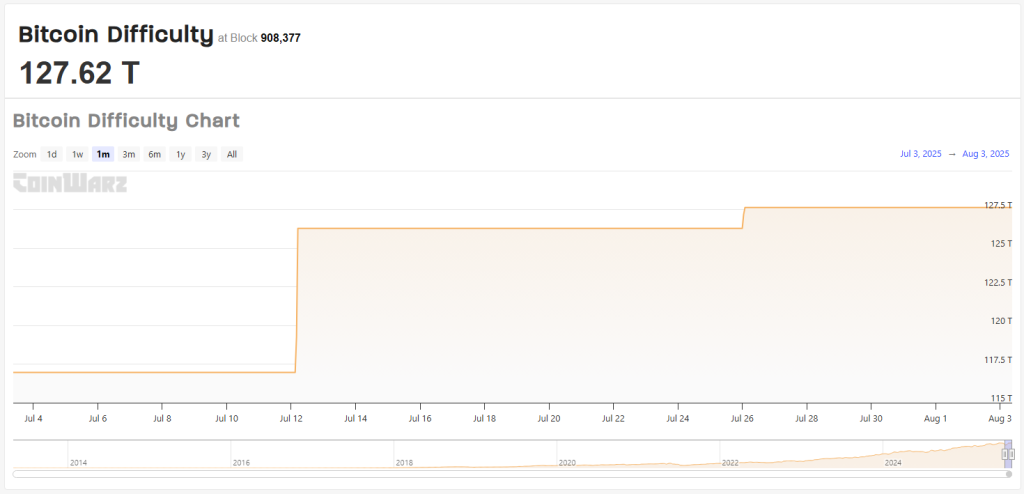
The Bitcoin ecosystem is currently navigating a period of intense structural pressure. As the network reaches unprecedented levels of mining difficulty, the cryptocurrency’s price has concurrently experienced a sharp downward correction, creating a "perfect storm" for mining operations worldwide. According to the latest data from CoinWarz, Bitcoin’s mining difficulty hit an all-time record of 127.6 trillion this week, signaling that the computational effort required to secure the network and mint new blocks has never been higher.
This surge in difficulty occurs against a backdrop of market turbulence. Bitcoin recently retreated by approximately 3%, touching an intraday low of $113,005 before finding a fragile equilibrium near $113,250 by 7:30 pm ET. This convergence of high operational costs and diminished market value has placed the mining sector—the backbone of the Bitcoin blockchain—under significant financial scrutiny.
Main Facts: The Anatomy of Difficulty
Bitcoin’s mining difficulty is a self-regulating mechanism inherent to the protocol’s design. It acts as an automated "governor" that ensures the time taken to find a new block remains consistent at approximately 10 minutes, regardless of how much collective computing power (hashrate) is being directed at the network.
When the aggregate hash power of the network increases—often due to more miners coming online or the deployment of more efficient hardware—the difficulty rises to prevent blocks from being produced too quickly. Conversely, when miners exit the network or hardware is powered down, the difficulty adjusts downward.
The current record of 127.6 trillion represents the zenith of network security. While this confirms that Bitcoin is more decentralized and harder to attack than ever before, it also represents a significant barrier to entry and profitability. For the average miner, this means the "cost per coin" is currently at its highest point in history.
Chronology: A Trajectory of Growth and Correction
The path to this record-breaking difficulty has been marked by significant volatility throughout the summer:
- June 2025: The network experienced a lull in computational intensity, with mining difficulty retreating to a low of approximately 117 trillion. This period was characterized by a relative stabilization in hardware deployment.
- Late July 2025: A sustained rally in both hashrate and network participation began, signaling a massive influx of updated infrastructure and capital investment into mining facilities.
- Early August 2025: The network peaked at the record 127.6 trillion mark, forcing the protocol to initiate the next re-calibration phase.
- August 9, 2025 (Projected): Analysts predict a 3% decrease in difficulty, which will bring the metric down to roughly 124 trillion. This adjustment is part of the standard 2,016-block cycle, which occurs every two weeks to recalibrate the network’s internal clock.
Current data indicates that blocks are currently being generated at an average pace of 10 minutes and 20 seconds. Because this exceeds the 10-minute target, the network is naturally inclined to reduce the difficulty burden during the next cycle to bring the block times back into alignment with the protocol’s design.

Supporting Data: Understanding the Hashrate Feedback Loop
The relationship between price, difficulty, and hashrate is a complex, circular feedback loop. When Bitcoin’s price is high, mining becomes more lucrative, attracting more players who deploy more powerful ASICs (Application-Specific Integrated Circuits). This causes the hashrate to climb, which in turn forces the difficulty upward.
However, when the price of Bitcoin falls—as seen with the recent 3% dip—the revenue generated by mining drops, while the cost of electricity and hardware maintenance remains constant. This creates a "margin squeeze."
Key Data Metrics:
- Current Difficulty: 127.6 Trillion (Record High)
- Projected Difficulty: 124 Trillion (Upcoming Adjustment)
- Current Average Block Time: 10 minutes, 20 seconds
- Price Action: 3% intraday decline, testing the $113,000 support level.
The current block time drift of 20 seconds beyond the target is a classic indicator that the network is "over-mined" relative to the current difficulty, confirming that even with the most efficient hardware, the market is currently struggling to maintain the target 10-minute cadence.
Industry Implications: The Survival of the Fittest
The current climate of high difficulty and suppressed prices is forcing a "culling" of the mining sector. Mining companies, which operate on razor-thin margins, are now facing the reality that only the most efficient operations—those with access to the cheapest electricity and the most advanced, power-efficient mining rigs—will remain profitable.
Operational Challenges
For smaller, older, or less efficient operations, the "break-even" price of Bitcoin has likely surged above the current market value. When a miner’s cost to produce a single Bitcoin exceeds its market price, the operation becomes a liability. This leads to:
- Hardware Depreciation: Older machines are being retired prematurely as they can no longer generate a profit.
- Strategic Hashing: Some firms are choosing to switch off their machines during peak energy-cost hours to preserve capital.
- Consolidation: We are likely to see a trend of larger, well-capitalized firms acquiring the assets of smaller, failing miners, leading to increased industrial centralization.
The 3% Relief Valve
The anticipated 3% drop in difficulty on August 9 serves as a "relief valve." By lowering the computational burden, the protocol effectively lowers the energy requirement to produce a block. While this will not solve the long-term price volatility, it provides a temporary lifeline to marginal players who are currently teetering on the edge of insolvency.
Market Analysis: The Interplay of Mining and Price
The recent price swing—slipping to $113,005 before recovering slightly—is highly symptomatic of the sentiment surrounding the mining industry. Investors and analysts often look at mining profitability as a proxy for the network’s long-term health.
When miners are forced to sell their holdings to cover electricity costs, it adds downward sell-side pressure to the market. This creates a reflexive effect:
- Price drops.
- Miners face tighter margins.
- Miners sell BTC to cover costs.
- Price drops further.
Conversely, when the difficulty adjusts downward, the operational burden lightens. This can reduce the necessity for miners to liquidate their reserves, potentially stabilizing the price.
Expert Perspective
Market observers suggest that the current volatility is a standard phase of the Bitcoin economic cycle. As the network matures, the "shakeout" of inefficient miners is a necessary process to ensure the long-term sustainability of the blockchain. While the headline of "record difficulty" sounds intimidating, it is ultimately a testament to the security and resilience of the Bitcoin network.
The current situation is a reminder that Bitcoin is not just a digital asset, but an industrial-scale economic engine. The interplay between energy consumption, global market pricing, and cryptographic difficulty ensures that the network remains robust, even when market participants are feeling the heat.
Conclusion
As of the latest trading sessions, Bitcoin remains in a state of watchful waiting. The industry is looking toward the August 9 difficulty adjustment as a critical turning point that could stabilize the mining landscape.
While the 3% dip in price and the record-high difficulty present a challenging environment for miners, the fundamental mechanics of the Bitcoin protocol remain unchanged. The system is designed to handle this exact type of pressure through its automated adjustments. Whether the market recovers to support higher mining margins or enters a period of further consolidation will depend largely on macroeconomic factors and the continued evolution of mining efficiency. For now, the "sharpest setups" continue to lead the charge, ensuring that despite the price volatility, the Bitcoin network remains the most secure, immutable, and persistent ledger in the world.