
The Mining Paradox: Bitcoin Hits Record Difficulty as Market Volatility Mounts
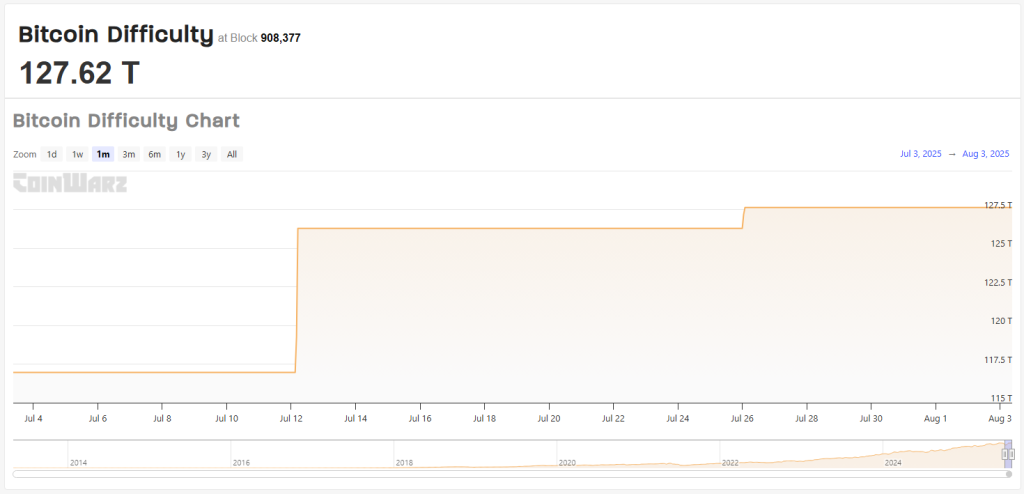
The Bitcoin network, the world’s most robust decentralized financial infrastructure, has reached a critical juncture. According to the latest data from CoinWarz, the network’s mining difficulty—the metric that defines the computational effort required to secure the blockchain—has ascended to an unprecedented all-time high of 127.6 trillion. This milestone, while a testament to the security and resilience of the Proof-of-Work (PoW) consensus mechanism, arrives at a precarious moment for the asset’s price, which saw a 3% retraction earlier this week, testing support levels at $113,000.
The intersection of record-breaking mining difficulty and market price fluctuation creates a complex environment for industry stakeholders. As the protocol self-regulates to ensure consistent block production, miners find themselves in an increasingly competitive race, where operational efficiency is no longer just a metric of success—it is a prerequisite for survival.
Main Facts: The Anatomy of a Record-High Difficulty
Mining difficulty is a dynamic parameter within the Bitcoin protocol, designed to maintain a consistent block generation time of approximately 10 minutes, regardless of how many miners are active on the network. When the aggregate computational power—or "hashrate"—increases, the difficulty rises to prevent blocks from being produced too quickly.
The current surge to 127.6 trillion reflects an aggressive expansion of global hashrate. This indicates that more mining equipment, likely newer and more efficient generations of ASIC (Application-Specific Integrated Circuit) miners, has been deployed to the network. Despite this record-setting surge in security, Bitcoin’s market price has struggled to maintain momentum, recently dipping to an intraday low of $113,005 before settling at $113,250 as of 7:30 PM ET.
This phenomenon creates a "margin squeeze." Miners are spending more capital on electricity and infrastructure to solve increasingly difficult cryptographic puzzles, all while the value of the rewards they receive—denominated in Bitcoin—faces downward pressure.
Chronological Overview: A History of Recent Fluctuations
To understand the current state of the network, one must look at the recent trajectory of mining activity:
- June 2025: The network experienced a temporary reprieve as mining difficulty slid to a relative low of 117 trillion. During this period, lower operational costs allowed a wider range of mining hardware to remain profitable.
- Late July 2025: As market confidence shifted and institutional investment increased, miners ramped up operations. This surge in participation triggered a steady climb in difficulty.
- Early August 2025: The difficulty hit the record 127.6 trillion mark. Currently, block generation times are hovering at approximately 10 minutes and 20 seconds, slightly lagging behind the protocol’s ideal 10-minute cadence.
- August 9, 2025 (Projected): Analysts anticipate a 3% downward adjustment in difficulty, bringing the metric to approximately 124 trillion. This routine correction, occurring every 2,016 blocks, acts as a self-correcting valve for the network.
Supporting Data and Market Dynamics
The relationship between price and mining difficulty is cyclical and reflexive. When prices are high, miners have more incentive to deploy capital, leading to higher hashrate and, subsequently, higher difficulty. Conversely, when prices drop, miners with less efficient hardware or higher electricity costs may find their operations "underwater," forcing them to shutter their machines.

The 10-Minute Target
The Bitcoin protocol is programmed to target a block time of exactly 10 minutes. When the network grows faster than expected, the difficulty adjustment mechanism acts as an automatic brake. Currently, the slight delay in block production (10 minutes and 20 seconds) indicates that the network is slightly over-saturated with competition, necessitating the upcoming downward adjustment to recalibrate the ecosystem.
Price Sensitivity
The recent 3% drop in Bitcoin’s price serves as a stress test for the mining industry. As mining firms report their quarterly earnings, the focus has shifted toward "Hashprice"—a metric that defines how much a miner earns per unit of hashrate. With difficulty at record levels, Hashprice is currently compressed, forcing firms to lean heavily on cash reserves or pivot toward more energy-efficient, liquid-cooled hardware setups.
Implications for the Mining Industry
The current environment is a "survival of the fittest" scenario. The implications for the sector are profound and far-reaching.
Operational Consolidation
Smaller, independent mining operations are facing an existential threat. Those unable to secure energy contracts at low, fixed rates or those relying on older-generation hardware (such as Antminer S19 series or older) are increasingly finding it impossible to turn a profit. We are likely to see further consolidation in the industry, where smaller mining pools merge with larger, publicly traded entities that have access to institutional-grade capital and cheaper, renewable energy sources.
The Role of Energy Efficiency
The record difficulty level underscores the importance of technological innovation in the mining space. The industry is rapidly moving toward more efficient chips and sustainable energy utilization, such as flared gas mining and integration with grid-balancing services. Companies that treat Bitcoin mining as an energy management business—rather than just a speculative venture—are the ones poised to survive this volatility.
Market Reflexivity
The price of Bitcoin is not independent of these mining costs. If a significant percentage of the hashrate goes offline due to the current difficulty-to-price ratio, the difficulty will eventually drop, making it easier for the remaining miners to earn more. This acts as a natural floor for the network’s security. If the price continues to stay depressed, we may witness a "capitulation" phase where inefficient miners liquidate their equipment, providing a buy-side opportunity for more efficient entities.
Official Industry Perspectives: The Road Ahead
Industry experts remain divided on the long-term impact of these record levels. Some argue that the high difficulty is an indicator of the network’s unparalleled health and institutional adoption. "The fact that the network continues to secure itself at record levels, regardless of short-term price movements, proves that Bitcoin is the most resilient asset in human history," noted one industry analyst.
However, others caution that the "squeeze" is real. Mining executives have publicly stated that the current economic climate requires "extreme discipline." In recent earnings calls, several leading mining firms emphasized the need to prioritize liquidity and reduce debt, anticipating that the high-difficulty/low-price environment could persist for several months.
The anticipated 3% correction on August 9 is viewed as a "short-term relief valve." While it will provide a minor reduction in operational costs, it is unlikely to change the fundamental landscape for miners who are currently operating on thin margins. The consensus among market observers is that until Bitcoin initiates a significant upward price breakout, the mining sector will remain in a state of hyper-competitiveness.
Conclusion: A Resilient Architecture
The current situation surrounding Bitcoin’s record mining difficulty and recent price volatility highlights the genius of the Satoshi Nakamoto protocol. The system is designed to be difficult, to be competitive, and to be self-regulating. While individual miners may face insolvency or profit compression, the network itself remains perfectly functional, secure, and decentralized.
As we look toward the August 9 difficulty adjustment, the market will continue to watch closely. The interaction between the digital asset’s price and the physical reality of energy consumption remains one of the most fascinating aspects of the modern financial world. Whether the price recovers or continues to test lower support levels, the Bitcoin network will continue its relentless, 10-minute heartbeat, undeterred by the fluctuations of the global economy.
For the average investor, this serves as a reminder: Bitcoin mining is the backbone of the entire ecosystem. Its current record-high difficulty is not a sign of weakness, but a sign that the network has never been more secure, even as the participants within that network navigate one of the most challenging economic cycles in recent years.