The Gateway to Mass Adoption: Why a16z Believes Web3 Gaming is the Future of Crypto
In the ever-evolving landscape of digital finance, the quest for mass adoption remains the industry’s "Holy Grail." While decentralized finance (DeFi) and non-fungible tokens (NFTs) have dominated the headlines for years, venture capital titan Andreessen Horowitz (a16z) suggests that the true catalyst for mainstream integration lies in an unexpected sector: Web3 gaming.
In its latest "State of Crypto" report, a16zcrypto—the firm’s dedicated arm for blockchain investment—argues that the convergence of interactive entertainment and blockchain technology is not merely a niche experiment, but a structural bridge poised to usher millions of new users into the digital asset ecosystem.
Main Facts: The Intersection of Play and Finance
The core thesis presented by a16z is straightforward yet profound: Web3 games serve as the most effective "on-ramp" for the next generation of crypto users. Unlike traditional financial tools, which often present a steep learning curve, gaming provides a fun, incentivized environment that naturally integrates blockchain features such as asset ownership, interoperability, and player-driven economies.
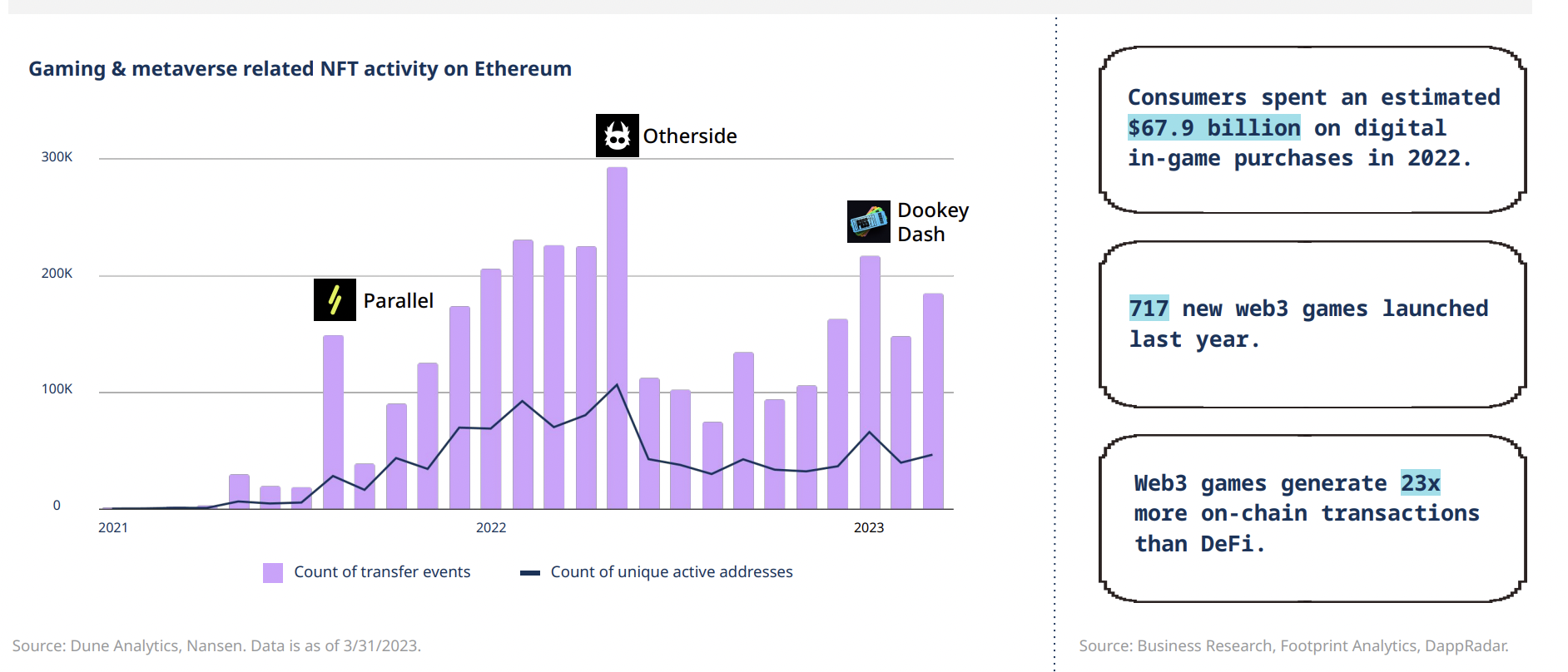
According to the report, the gaming industry is already a multi-billion dollar juggernaut. In 2022 alone, consumers spent a staggering $67.9 billion on in-game digital purchases. This figure represents a massive, pre-existing market of consumers already accustomed to spending real-world money on virtual assets—a behavior that aligns perfectly with the Web3 value proposition of true digital ownership.
The data indicates that the shift is already underway. In the last year, 717 new Web3 games have launched, signaling a massive influx of developer talent and capital into the space. Perhaps most notably, these games are currently generating 23 times more on-chain transactions than the entire decentralized finance (DeFi) sector. This suggests that while DeFi provides the infrastructure, gaming is providing the daily, high-frequency utility that sustains a blockchain network.
Chronology: From Internet Pioneers to the Crypto Frontier
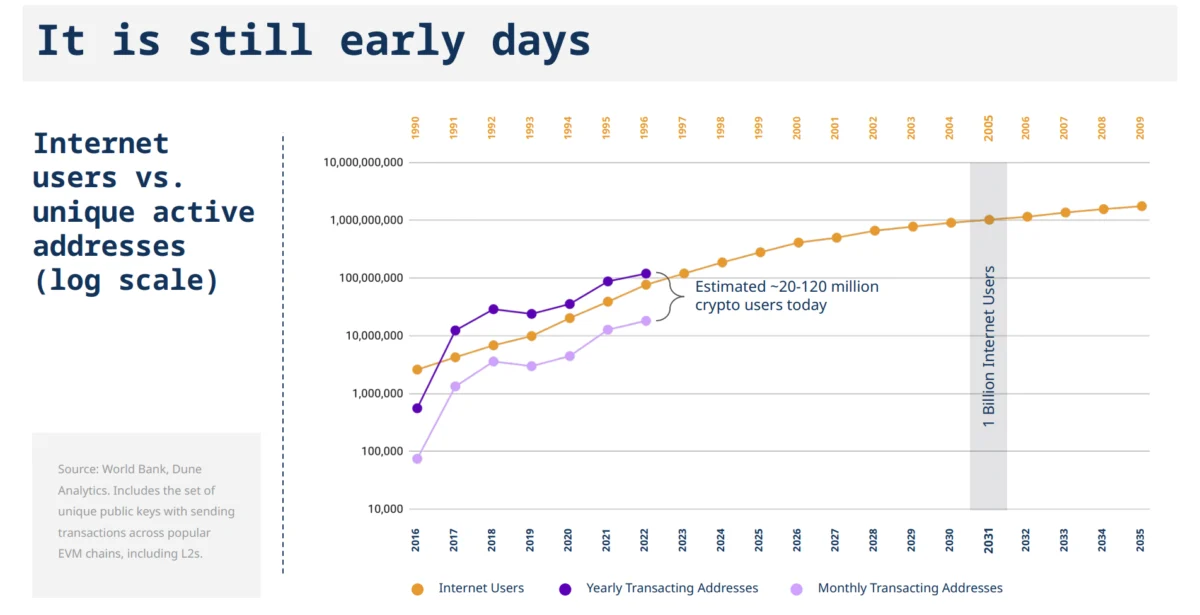
To understand the current state of crypto, a16z encourages observers to look back at the history of the internet. The report draws a compelling parallel between the adoption curves of the early web and the current trajectory of the blockchain ecosystem.
The 1990s Internet Parallel
In the early 1990s, the internet was a fragmented, technically complex, and often dismissed experiment. It took years of infrastructure building, browser development, and the eventual rise of user-friendly interfaces before the internet became a ubiquitous part of daily life. By 1996, there were approximately 100 million internet users worldwide.

The Crypto Trajectory
A16z aligns this growth with the crypto industry’s timeline, starting from 2016. While the volatility of Bitcoin and Ethereum often dominates public discourse, the underlying growth of active addresses tells a different story. In 2022, the report identified roughly 20 million monthly transacting crypto addresses and 120 million yearly transacting addresses.
This data point is critical: it suggests that we are currently in the "1996 equivalent" of the internet era. If history serves as a reliable guide, the industry is on the cusp of a massive expansion phase, moving from an era of "early adopters" to "early majority." The firm posits that Web3 gaming is the "browser" of this cycle—the application layer that will simplify complexity and make digital assets accessible to the average person.
Supporting Data: Why Gaming Outpaces Finance
The sheer volume of activity within Web3 gaming ecosystems is difficult to ignore. The report highlights several key metrics that illustrate why gaming has become the primary engine of on-chain activity:
- Transactional Density: By outpacing DeFi 23-to-1 in on-chain transactions, Web3 games are proving that they can sustain consistent, high-volume network usage. This is essential for the long-term scalability and security of blockchain protocols.
- Market Readiness: The $67.9 billion spent on in-game items in 2022 proves that the "ownership economy" is not a crypto-native invention; it is a human preference that has existed for decades. Web3 simply allows users to retain value from these purchases rather than losing it to a centralized gaming publisher’s closed ecosystem.
- Developer Influx: The launch of over 700 games in a single year demonstrates a massive pivot in the developer community. Large studios and independent creators alike are exploring how blockchain can enhance player retention, enable secondary markets, and provide unique reward structures that traditional gaming cannot replicate.
Official Responses and Strategic Implications
The industry response to the a16z report has been largely optimistic, though cautious. Proponents of Web3 gaming argue that the current market is moving away from the "play-to-earn" models that characterized the 2021 boom—which were often criticized for being unsustainable—toward "play-and-own" models that prioritize fun, gameplay, and community sustainability.
However, the report also acknowledges the significant hurdles that remain. The firm notes that crypto is still in its "early" stages, meaning that user experience (UX) is still a primary barrier. For gaming to truly reach the masses, the blockchain elements must become "invisible." Players should not necessarily need to know they are using a private key or navigating a decentralized exchange to enjoy a game; these processes must be abstracted away behind seamless interfaces.
Furthermore, the report touches upon the regulatory landscape. While a16z does not provide specific legal advice, the implication is clear: the integration of digital assets into entertainment requires a robust, transparent, and user-protective framework. As Web3 games become more sophisticated, the intersection of digital asset regulation and consumer protection laws will become a central focus for policy makers.
Implications: The Future of Digital Identity
The implications of a16z’s findings extend far beyond the gaming industry. If Web3 gaming succeeds in onboarding the next 100 million users, it will effectively normalize digital ownership.
1. Digital Identity and Portability
When a player owns their assets—be they skins, characters, or virtual land—in the form of NFTs, those assets are no longer confined to one game. They become part of the user’s broader digital identity. This portability allows for the emergence of a cross-game economy, where a player’s reputation and assets can follow them from one digital world to another.
2. The Decentralized Creator Economy
By enabling secondary markets for in-game items, Web3 gaming empowers players to become stakeholders in the game’s success. This aligns the incentives of the developers and the players, creating a more symbiotic relationship that contrasts sharply with the top-down, exploitative models often found in traditional "free-to-play" mobile gaming.
3. Sustainability and Governance
As these games grow, the role of decentralized autonomous organizations (DAOs) in governing in-game economies will become increasingly relevant. This gives players a voice in the direction of the game, fostering a sense of community ownership that is historically unprecedented in the entertainment industry.
Conclusion: The Long View
The "State of Crypto" report by Andreessen Horowitz serves as a powerful reminder that the "crypto winter" narrative is only one part of the story. Beneath the market volatility, there is a fundamental shift occurring in how digital value is created, distributed, and owned.
By identifying gaming as the primary driver of this shift, a16z is highlighting a transition from the era of "speculative finance" to an era of "utility and engagement." The road ahead will undoubtedly be marked by technical challenges, regulatory scrutiny, and the inevitable "growing pains" of a nascent technology. Yet, as the data shows, the infrastructure is being built, the games are being played, and the user base is steadily growing.
If the 1990s taught us anything about the internet, it is that the most transformative technologies often begin as toys. Web3 gaming may well be the "toy" that grows up to redefine the global digital economy. For investors, developers, and players alike, the message is clear: keep your eyes on the game. The future of digital assets is being written in the virtual worlds of today.
Disclaimer: Opinions expressed at The Daily Hodl are not investment advice. Investors should do their due diligence before making any high-risk investments in Bitcoin, cryptocurrency, or digital assets. Please be advised that your transfers and trades are at your own risk, and any losses you may incur are your responsibility. The Daily Hodl does not recommend the buying or selling of any assets including cryptocurrencies, nor is The Daily Hodl an investment advisor. Please note that The Daily Hodl participates in affiliate marketing.