The New Frontier: Why Web3 Gaming is the Catalyst for Mass Crypto Adoption
In the rapidly evolving landscape of digital assets, the question of "what comes next" often dominates industry discourse. While decentralized finance (DeFi) and non-fungible tokens (NFTs) have laid the groundwork for blockchain utility, venture capital giant Andreessen Horowitz (a16z) suggests that the next wave of mass adoption will not arrive through financial services, but through entertainment.
In its comprehensive "State of Crypto 2023" report, a16zcrypto—the dedicated crypto investment arm of the venture capital powerhouse—identifies Web3 gaming as the primary engine poised to onboard millions of new users into the blockchain ecosystem. By bridging the gap between immersive digital experiences and true digital ownership, the firm argues that gaming could be the "killer app" the industry has been searching for since the inception of Bitcoin.
Main Facts: A Paradigm Shift in Digital Interaction
The core thesis presented by a16z is that Web3 gaming is not merely a niche sub-sector, but a fundamental change in how users interact with digital ecosystems. Unlike traditional "Web2" games, where players spend billions on in-game assets that remain the property of the game developer, Web3 gaming introduces the concept of sovereign ownership.
Key highlights from the report include:
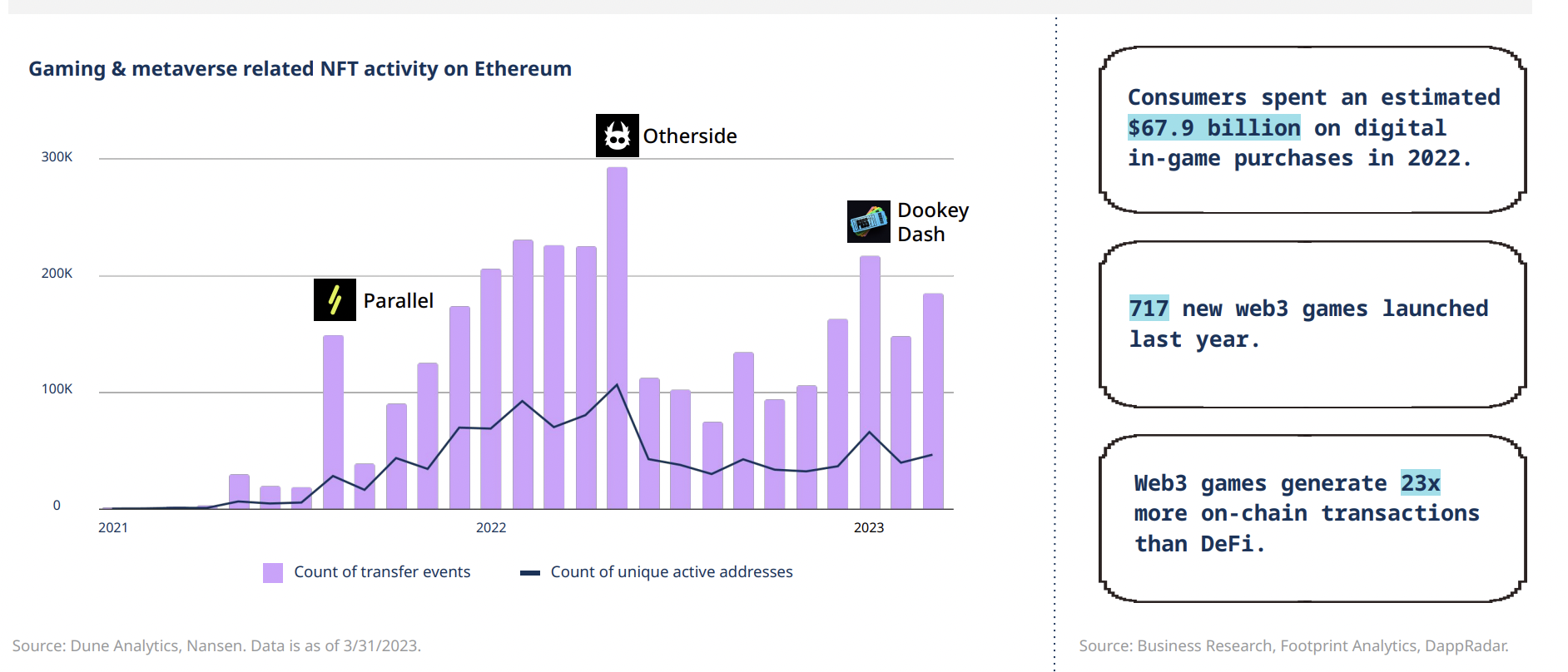
- Massive Market Potential: In 2022 alone, consumers spent approximately $67.9 billion on digital in-game purchases. This figure underscores a pre-existing user base that is already comfortable with spending real currency on digital goods, providing a seamless entry point for blockchain integration.
- Rapid Ecosystem Growth: The sector is experiencing an explosion in development, with 717 new Web3 games launching within the last year. This rapid influx of titles signifies a shift from experimental prototypes to functional, playable ecosystems.
- Transaction Dominance: Web3 games are currently generating 23 times more on-chain transactions than decentralized finance (DeFi) protocols. This suggests that the utility of these games is fostering high-frequency engagement that far outpaces traditional financial dApps.
Chronology: From Internet Evolution to Crypto Maturation
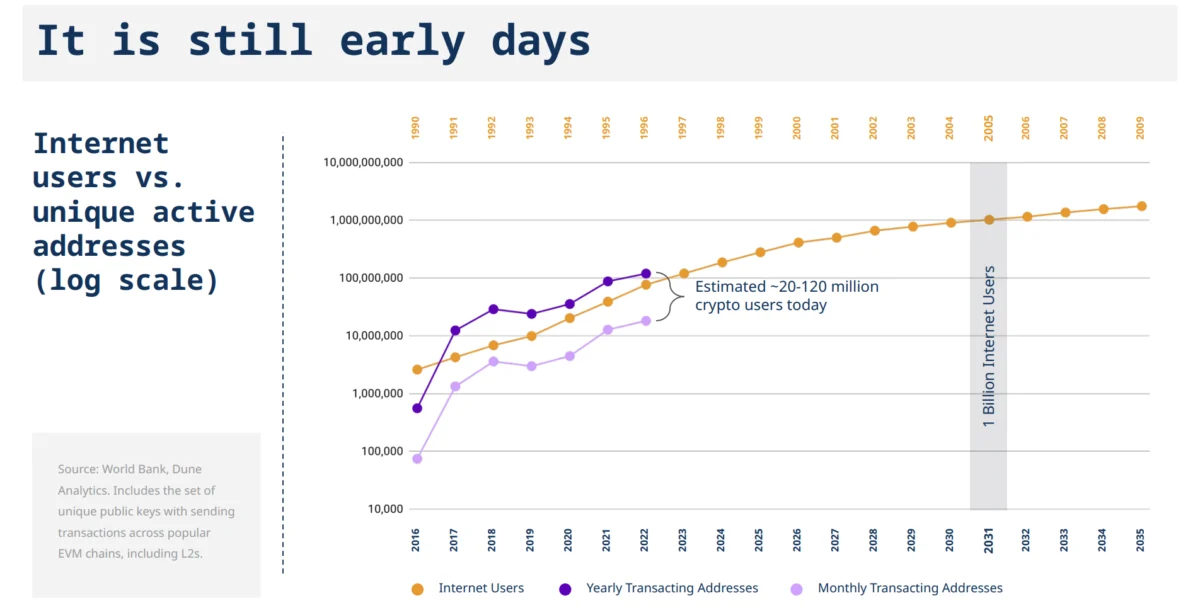
To contextualize the current state of the industry, a16z compares the growth of the crypto sector to the early expansion of the internet during the 1990s. This comparison is not merely a metaphor; it is a structural observation of technological adoption curves.
The 1990s Internet Analogy
In the early 1990s, the internet was a fragmented, complex landscape dominated by early adopters and developers. It took nearly a decade for browsers and consumer-friendly user interfaces to bring the technology to the mainstream. A16z posits that crypto is currently in a similar "early-to-mid" phase of development. By overlaying the growth of internet users starting in 1990 with the growth of crypto addresses starting in 2016, the firm illustrates a striking parallel.
2022: A Benchmark Year
The report identifies 2022 as a critical threshold. With an estimated 20 million monthly transacting crypto addresses and 120 million yearly transacting addresses, the industry has crossed the initial barrier of obscurity. For perspective, the report notes that by 1996, the internet had reached roughly 100 million users. While the growth trajectories differ in speed, the underlying patterns of infrastructure build-out and consumer onboarding remain consistent.

Supporting Data: Why Gaming Holds the Edge
The transition from passive consumption to active participation is the central narrative of Web3 gaming. Data provided by a16z highlights that the friction previously associated with blockchain—such as wallet management and gas fees—is being mitigated by game developers who prioritize user experience (UX) above all else.
The Financial Scale of In-Game Assets
The $67.9 billion spent on in-game purchases in 2022 highlights a deep-seated consumer desire to personalize and optimize their digital identities. In a traditional setting, these purchases are "sunk costs." In a Web3 environment, these assets become transferable, tradable, and portable across platforms. This creates a secondary economy that increases the value proposition for the player, effectively turning leisure time into a potential economic opportunity.
On-Chain Transaction Velocity
The fact that Web3 gaming produces 23 times more transactions than DeFi is a testament to the "stickiness" of gaming. While DeFi users often engage with protocols sporadically to rebalance portfolios or stake assets, gamers interact with the blockchain continuously as they progress through levels, acquire gear, or trade items. This constant flow of data on the blockchain provides the network effects necessary to secure and decentralize the ecosystem at scale.
Official Perspectives: What the Experts Say
The a16z report serves as a manifesto for the firm’s investment strategy, but it also reflects a broader consensus among venture capitalists regarding the necessity of "stealth adoption." By integrating blockchain into gaming, the underlying technology becomes invisible to the end-user.
Industry experts aligned with the report’s findings argue that the next generation of gamers will not care about the underlying ledger technology; they will care about the sovereignty of their assets. "When a player realizes they can sell their sword or skin for real value on an open market, they don’t ask what blockchain it is on—they ask how they can trade more," notes one lead researcher in the space.
Furthermore, the report emphasizes that the industry must move beyond "Play-to-Earn" models, which often suffer from inflationary tokenomics, and transition toward "Play-and-Own" models, where the focus is on fun and engagement rather than purely speculative financial gain.
Implications: The Road Ahead for Web3
The implications of this shift are profound for both the developer community and traditional financial institutions.
1. The Death of the "Walled Garden"
Web3 gaming threatens the traditional gaming business model where companies like Sony, Microsoft, and Valve hold total control over user data and assets. If successful, this movement will force a shift toward interoperability, where digital items can move between different games and platforms, significantly increasing the total addressable market for digital goods.
2. Infrastructure and Scaling
To support the millions of users projected by the report, the infrastructure must scale. This implies a continued focus on Layer-2 solutions, ZK-rollups, and optimized blockchain architectures that can handle high-throughput, low-cost transactions without sacrificing security.
3. Regulatory Challenges
As gaming becomes the primary gateway for mass adoption, regulatory scrutiny will likely intensify. Policymakers are already examining the intersection of virtual economies and real-world financial laws. The challenge for developers will be to create robust, compliant ecosystems that protect users without stifling the permissionless nature of blockchain technology.
4. A New Demographic
The "State of Crypto" report hints that the next wave of users will look very different from the crypto-natives of the 2017-2020 era. These users will be mobile-first, gaming-centric, and largely indifferent to the technical jargon of DeFi. They represent a demographic that is comfortable with digital scarcity and online social spaces, making them the ideal cohort to propel crypto into the mainstream.
Conclusion: The "Killer App" has Arrived
Andreessen Horowitz’s report serves as a vital reminder that while prices and market sentiment may fluctuate, the underlying trend of technological adoption is relentless. By focusing on the massive, already-thriving gaming market, the crypto industry is positioning itself to solve the "adoption problem" that has plagued it for years.
The transition from the speculative, finance-heavy early days of crypto to a utility-focused, gaming-driven future is already underway. As the 717 games launched last year begin to mature, the barriers between traditional gaming and decentralized digital ownership will continue to dissolve. In the final analysis, the success of Web3 will not be measured by the total market capitalization of tokens, but by the number of people who interact with the blockchain every day, without even realizing they are doing so.
Disclaimer: Opinions expressed in this report are for informational purposes only and do not constitute financial, investment, or legal advice. Investors are encouraged to perform their own due diligence before engaging with any high-risk assets, including cryptocurrencies, NFTs, or Web3 gaming projects. All trades and transfers are conducted at the user’s own risk.