Institutional Capital Shifts: Digital Asset Markets See $582 Million Weekly Influx to Kick Off 2026
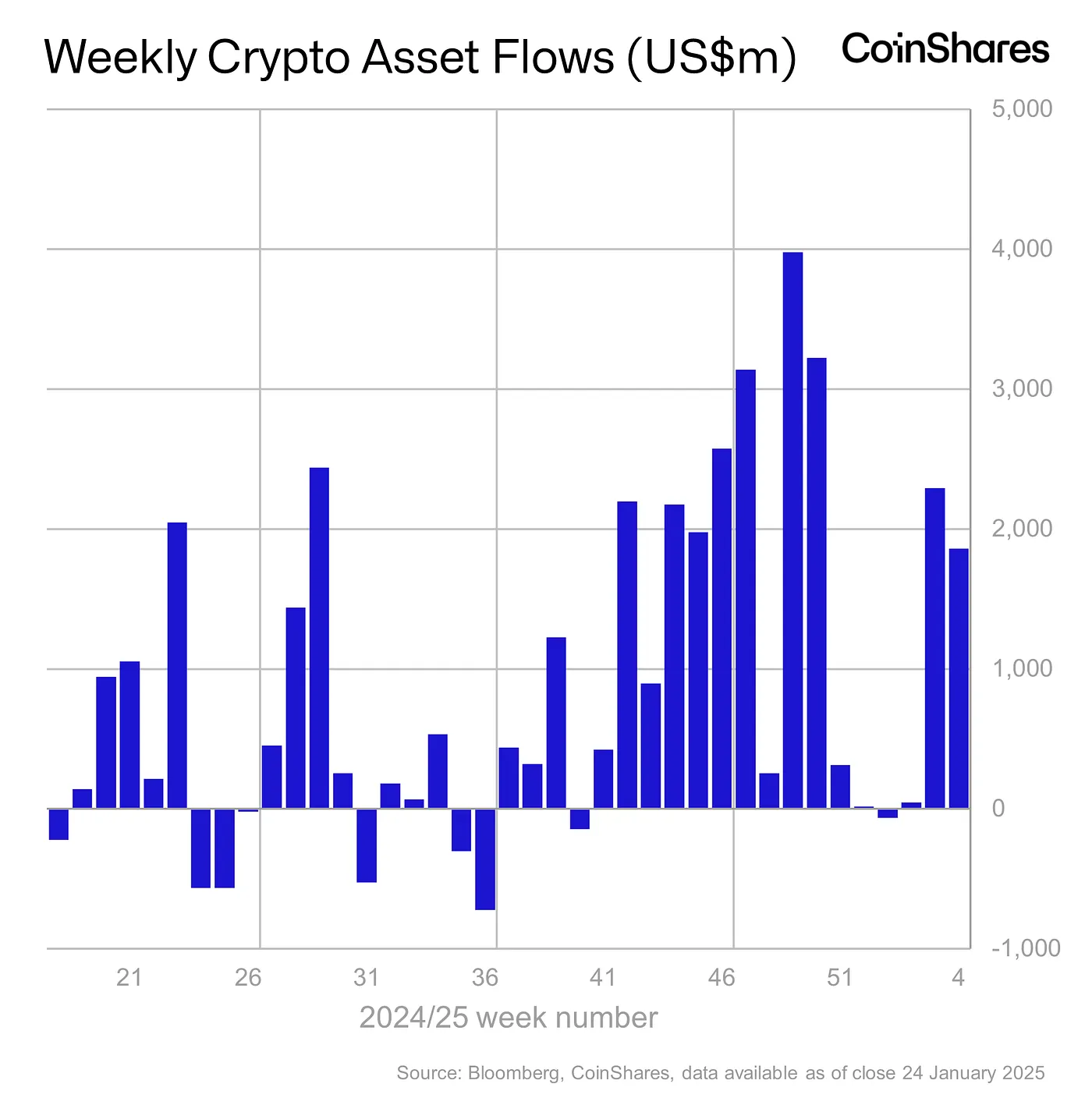
The institutional appetite for digital assets has shown no signs of cooling as the calendar turns to a new year. According to the latest market intelligence report from CoinShares, the global digital asset investment landscape witnessed a significant surge in activity, recording $582 million in net inflows over the first week of 2026. This robust start underscores a persistent trend of capital allocation into decentralized finance and blockchain-based financial products, even as market participants navigate a complex macroeconomic environment.
The State of the Market: A $582 Million Weekly Rebound
The year 2026 has commenced with a display of institutional resilience. While the week began with a period of volatility characterized by early outflows, the momentum shifted decisively toward the end of the week. CoinShares noted that the final Friday of the opening week saw a massive spike, with $671 million in inflows recorded in a single day. This late-week surge effectively neutralized earlier selling pressure, bringing the total net inflow for the week to $582 million.
This performance follows a historic 2025, which served as a benchmark year for institutional adoption. Global digital asset products concluded 2025 with an aggregate inflow of $47.2 billion, narrowly missing the all-time record of $48.7 billion established in 2024. As investors move into the new fiscal year, the data suggests that large-scale market participants remain confident in the long-term utility and value proposition of digital assets.
Chronology of Institutional Movement
The trajectory of institutional flows over the last twelve months reveals a strategic rotation of capital. In 2025, the United States remained the undisputed epicenter of crypto-related investment, accounting for $44.5 billion of the total global inflow. While this represented a 12% decline from the previous year’s record-breaking figures, the U.S. market continues to dominate the narrative due to the maturation of exchange-traded products and clearer regulatory frameworks.
Conversely, international markets displayed remarkable dynamism. Germany emerged as a standout performer in 2025, recording a massive turnaround with $2.5 billion in net inflows, a sharp pivot from the net outflows observed in the prior cycle. Canada and Switzerland also remained pivotal hubs for institutional liquidity, contributing $1.1 billion and $775 million, respectively, to the global coffers.
As we transition into 2026, the first week of trading has set a tone of aggressive accumulation for blue-chip assets. The following breakdown illustrates the weekly institutional appetite:
- Bitcoin (BTC): $512 million in net inflows.
- Ethereum (ETH): $119 million in net inflows.
- XRP: $10.7 million in net inflows.
- Solana (SOL): $30 million in net outflows.
Supporting Data: The 2025 Performance Review
To understand the current institutional sentiment, one must look at the structural changes that occurred throughout 2025. Institutional portfolios have become increasingly nuanced, moving beyond simple Bitcoin exposure to include a broader spectrum of blockchain technologies.
The Dominance of Bitcoin
Bitcoin maintained its status as the "digital gold" of institutional portfolios, attracting $26.9 billion in inflows throughout 2025. While the market saw some interest in short-bitcoin products—totaling $105 million—these remain a niche segment of the market, indicating that institutional sentiment remains overwhelmingly bullish on the long-term price trajectory of the flagship asset.
The Rise of Altcoin Allocation
The most compelling story of the past year has been the rapid institutional adoption of Ethereum and select altcoins. Ethereum led the charge in growth, recording $12.7 billion in total inflows for 2025, a staggering 138% increase compared to the previous year. This growth is largely attributed to the expansion of the Ethereum ecosystem and its role as the primary settlement layer for decentralized finance (DeFi) and enterprise tokenization.
XRP and Solana also saw explosive interest. XRP inflows reached $3.7 billion, a 500% year-over-year increase, while Solana saw $3.6 billion in inflows, marking a 1,000% gain compared to the previous year’s figures. However, it is worth noting that while these assets saw massive annual growth, sentiment in the broader "other altcoins" category has weakened, with inflows falling 30% year-over-year as investors consolidate their holdings into the most established and liquid assets.
Official Industry Perspective and Market Implications
The sustained inflow of capital into digital asset funds carries significant implications for the broader financial ecosystem. Institutional participation is no longer a speculative trend; it is now a fundamental component of global asset management.
The Shift Toward Liquidity
The fact that Bitcoin and Ethereum remain the primary targets for institutional capital suggests a "flight to quality." As investors look to protect capital against inflation and macroeconomic instability, they are gravitating toward the most liquid and battle-tested digital assets. The $30 million outflow in Solana during the first week of 2026—despite its stellar performance in 2025—indicates that institutional investors are currently in a "risk-off" or rebalancing phase, prioritizing the largest market caps while trimming exposure to high-beta assets.
Geographic Diversification
The geographic spread of these investments reflects a global regulatory environment that is becoming increasingly welcoming of crypto-assets. The turnaround in Germany, for example, serves as a case study for how proactive regulatory alignment can attract billions in capital. As other nations move to finalize their own digital asset frameworks, the pool of investable capital is expected to expand further, potentially challenging the United States’ current dominance in the space.
Institutional Strategy: The "Buy the Dip" Mentality
The chronology of the first week of 2026—starting with outflows and ending with massive inflows—demonstrates that institutional players are actively utilizing volatility to accumulate. The $671 million single-day inflow on the final Friday of the week is a testament to the fact that large institutions are not deterred by short-term price fluctuations. Instead, they are viewing entry points through a long-term lens, viewing price dips as strategic opportunities to increase their holdings of Bitcoin and Ethereum.
Conclusion: What to Expect for 2026
As we move deeper into the first quarter of 2026, the data suggests that the institutional "onboarding" phase is far from over. The convergence of high-level financial products and decentralized technology is entering a new stage of maturity.
Investors should monitor two key indicators in the coming months:
- The "Alt-Rotation": Whether the outflows seen in Solana are a temporary rebalancing or a broader shift back toward the two largest assets, Bitcoin and Ethereum.
- Regulatory Developments: How further legislative clarity in the European Union and Asia impacts the flow of capital, and whether it disrupts the heavy concentration of volume currently originating from the United States.
While the market remains volatile, the consistent inflow of hundreds of millions of dollars on a weekly basis suggests that institutional entities are building long-term positions. For the average observer, this serves as a clear signal that the infrastructure of global finance is undergoing a permanent transformation.
Disclaimer: The information provided in this article is for educational and informational purposes only and does not constitute financial, investment, or legal advice. Digital assets, including Bitcoin, Ethereum, XRP, and Solana, are subject to extreme price volatility and carry significant risk. Investors should conduct their own thorough due diligence and consult with a professional financial advisor before making any investment decisions. The Daily Hodl is not an investment advisor and does not recommend the purchase or sale of any specific digital asset.