Institutional Capital Floods Crypto Markets: Assessing the Impact of the Federal Reserve’s Pivot
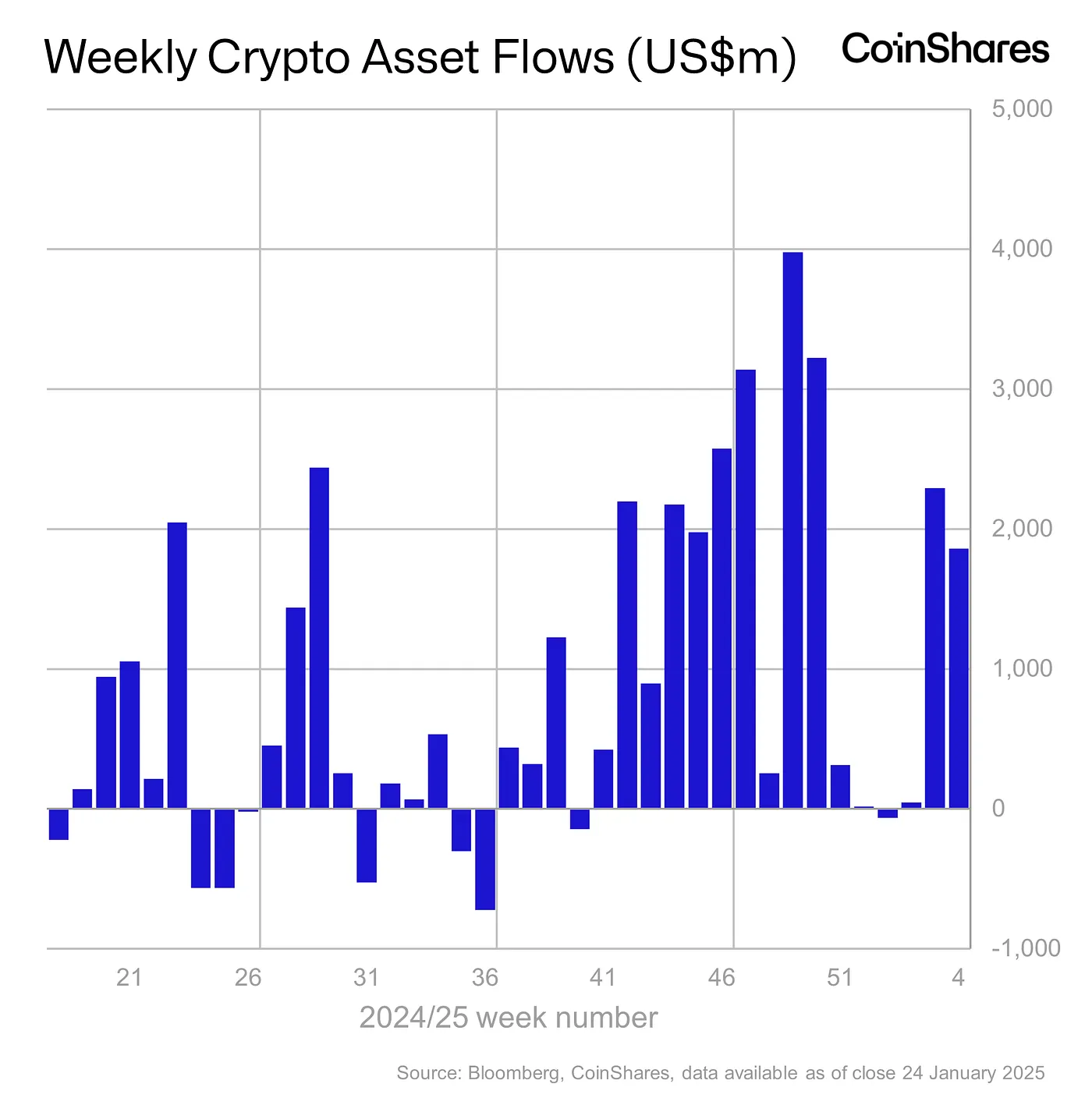
The landscape of digital asset investment has witnessed a dramatic shift in momentum, with institutional capital pouring back into the sector following the United States Federal Reserve’s recent monetary policy adjustment. According to the latest Digital Asset Fund Flows Weekly Report from CoinShares, the global cryptocurrency market experienced a robust influx of $1.9 billion last week, marking the second consecutive week of significant capital accumulation. This surge suggests that institutional investors have moved past their initial trepidation regarding the Federal Reserve’s "hawkish" interest rate cuts, signaling a renewed appetite for risk in the digital assets space.
Main Facts: A Resurgent Market Sentiment
The primary takeaway from the past week’s market activity is the overwhelming confidence displayed by institutional players. The $1.9 billion in total inflows underscores a critical trend: despite macroeconomic uncertainty, institutional sentiment remains overwhelmingly bullish. This inflow represents a pivot point for the industry, as the initial reaction to the Federal Reserve’s decision—the first rate cut in years—was characterized by caution.
However, as the market digested the implications of the Fed’s policy shift, the sentiment transformed into aggressive buying. On Thursday and Friday alone, approximately $746 million flowed into digital asset exchange-traded products (ETPs), suggesting that the "hawkish" nature of the rate cut—often perceived as a signal of a cooling economy—was ultimately viewed by investors as a green light for risk-on assets.
Chronology of Market Reaction: From Hesitation to Momentum
The narrative of the past week can be defined by two distinct phases of investor behavior.
The Initial "Hawkish" Chill
When the Federal Reserve announced its interest rate adjustment, the immediate reaction across global financial markets was one of guarded analysis. The terminology surrounding the cut—labeled by many analysts as a "hawkish cut"—implied that while the central bank was easing policy, it remained vigilant about inflationary pressures and economic stability. Investors in crypto ETPs initially pulled back, hesitant to commit capital until the volatility of the announcement settled.
The Mid-to-Late Week Pivot
As the dust settled, institutional investors began to reassess the long-term implications of lower interest rates. Lower borrowing costs generally improve liquidity in the broader financial system, which historically benefits non-yielding or high-growth assets like Bitcoin and Ethereum. By Thursday, the "wait-and-see" approach evaporated, replaced by a massive influx of capital. This late-week surge accounted for nearly 40% of the total weekly inflows, confirming that the institutional appetite was not just a knee-jerk reaction but a calculated strategic reallocation.
Supporting Data: Regional Dominance and Asset Performance
The distribution of these inflows reveals a clear hierarchy in market participation. The United States continues to function as the primary engine for global crypto investment, accounting for $1.8 billion of the $1.9 billion total.
Regional Breakdown
While the U.S. led the pack, other major financial hubs also saw positive movement, albeit on a smaller scale:
- Germany: Recorded $51.6 million in inflows.
- Switzerland: Added $47.3 million.
- Brazil: Saw $9.3 million in new investments.
- Hong Kong: Remained an outlier with minor outflows of $3.1 million, suggesting localized market sentiment that contrasts with the broader global trend.
Asset-Specific Performance
Bitcoin (BTC) maintained its status as the "king" of digital assets, capturing the lion’s share of the inflow volume.
- Bitcoin: Attracted $977 million, cementing its role as the primary vehicle for institutional crypto exposure. Notably, short-bitcoin investment products continued to face downward pressure, recording $3.5 million in outflows. This has driven the total assets under management (AuM) for short-BTC products to a multi-year low of $83 million, indicating that bears are losing their conviction.
- Ethereum (ETH): Enjoyed a significant resurgence with $772 million in inflows. This performance is particularly noteworthy given the recent debates surrounding Ethereum’s price action compared to Bitcoin.
- Solana (SOL) & XRP: These assets continued to attract capital, with $127.3 million and $69.4 million in inflows, respectively. This data suggests that institutional investors are diversifying beyond the two primary giants, showing increased confidence in the utility and ecosystem growth of alternative Layer-1 and payment-focused blockchains.
Official Responses and Expert Analysis
Market analysts have characterized this shift as a "maturation of the institutional investor." The resilience of the market during the initial volatility caused by the Federal Reserve is seen by many as evidence that the "crypto-winter" mentality has been replaced by a long-term strategic outlook.

"The inflows we are seeing are no longer just speculative retail gambles," notes one analyst following the CoinShares report. "These are institutional portfolios being rebalanced to include digital assets as a hedge against fiat currency devaluation."
Furthermore, the contraction in short-bitcoin product AuM serves as a strong signal from the institutional sector. When institutions stop betting against the market leader, it usually precedes a period of sustained price appreciation. The data from Rekt Capital and other market observers on social media platforms like X further corroborate this, showing that the technical and fundamental indicators are beginning to align in favor of the bulls.
Implications for the Broader Economy and Crypto Future
The implications of this institutional inflow are multifaceted, touching on regulatory expectations, market liquidity, and the future of digital asset adoption.
1. Macro-Financial Normalization
The Federal Reserve’s pivot to rate cuts is a fundamental change in the global economic climate. For digital assets, which have struggled against the backdrop of high interest rates since 2022, the transition to an easier monetary policy environment provides a massive tailwind. If the Fed continues to lower rates, the "opportunity cost" of holding non-yielding assets like Bitcoin decreases, likely fueling further inflows.
2. The Institutionalization of Crypto
The concentration of inflows in U.S.-based ETPs suggests that the launch of spot ETFs has successfully bridged the gap between traditional finance and the crypto ecosystem. Institutional investors, who were previously sidelined by regulatory or technical barriers, now have a secure and compliant pathway to gain exposure. This influx of $1.9 billion is not merely capital; it is a vote of confidence in the underlying infrastructure of the crypto market.
3. Future Volatility and Market Stability
While inflows are currently high, the market remains sensitive to macroeconomic data. Future reports on inflation (CPI), unemployment, and further Fed commentary will likely trigger localized volatility. However, the consistent nature of these inflows—two consecutive weeks of growth—suggests a level of "buy-the-dip" behavior that provides a floor for asset prices.
4. A Shift in Narrative
Perhaps the most significant implication is the changing narrative around "hawkish" versus "dovish" policies. The market’s ability to absorb the Fed’s messaging and still push capital into digital assets suggests that crypto is increasingly being viewed as a macro-asset rather than a niche tech experiment. Investors are looking past the immediate policy rhetoric and focusing on the long-term utility and scarcity of digital assets.
Conclusion
The latest report from CoinShares serves as a testament to the resilience and growing sophistication of the digital asset market. By navigating the volatility surrounding the Federal Reserve’s interest rate policy with poise, institutional investors have signaled that they are ready to commit capital at scale.
With nearly $2 billion in new inflows, the market is currently experiencing a momentum phase that favors the bulls. As Bitcoin continues to command the lead and alternative assets like Ethereum, Solana, and XRP see healthy participation, the foundation for a potential year-end rally appears to be solidifying. However, as always in the volatile world of crypto, investors are urged to maintain a perspective of due diligence, recognizing that while institutional trends are positive, the market remains subject to rapid shifts in global sentiment and economic policy.
The stage is now set for a Q4 that could be defined by this renewed institutional commitment, as the world of traditional finance and digital assets continues to weave closer together in the wake of a shifting monetary paradigm.