Institutional Capital Flood: Bitcoin and Digital Assets Surge Following U.S. Policy Shifts
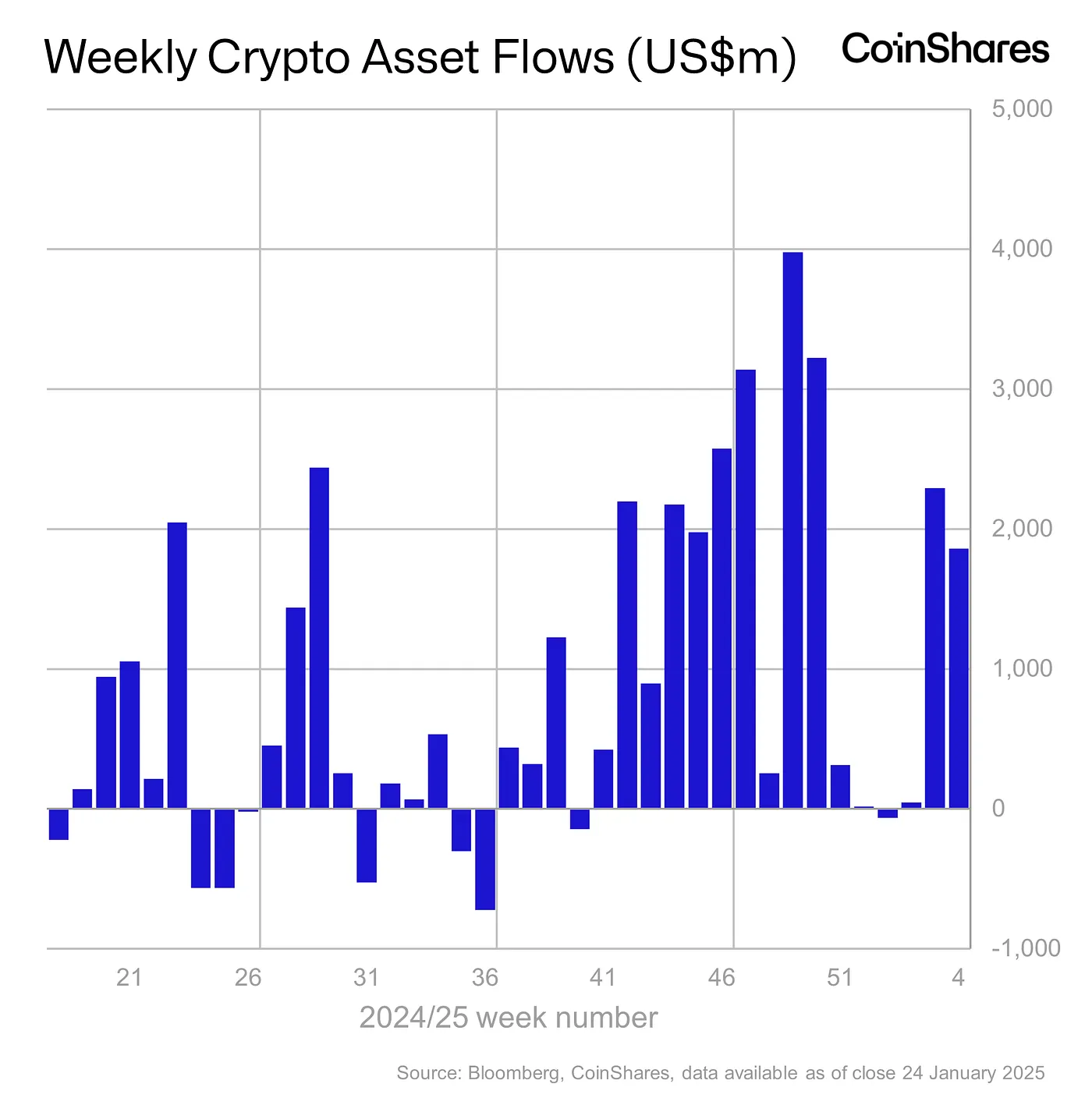
The global cryptocurrency market is witnessing a seismic shift in institutional sentiment, characterized by a massive influx of capital into digital asset investment vehicles. According to the latest "Digital Asset Fund Flows" report from leading asset manager CoinShares, institutional investors injected nearly $2 billion into the sector last week alone. This historic surge, which brings year-to-date inflows to a staggering $4.8 billion, is widely attributed to the evolving political landscape in the United States, specifically the recent executive orders proposed by President Donald Trump regarding the strategic integration of Bitcoin.
The Catalyst: Executive Orders and Strategic Reserves
The primary driver behind this massive capital allocation appears to be a newfound confidence in the U.S. regulatory and policy outlook. President Trump’s recent executive directives have signaled a potential sea change for the industry, most notably the proposal to establish a national strategic reserve asset in Bitcoin.
For institutional players—who have long demanded regulatory clarity before committing significant portions of their portfolios to digital assets—these developments represent a transition from "speculative interest" to "strategic allocation." By floating the idea of a state-sanctioned Bitcoin reserve, the U.S. government is effectively moving digital assets from the fringes of financial technology to the core of national economic policy. This shift has served as a green light for hedge funds, pension funds, and asset managers to increase their exposure to the digital asset class.
Chronology of the Recent Influx
The current surge in institutional activity did not occur in a vacuum. It follows a period of intense market volatility and legislative anticipation.
- Pre-Inauguration Momentum: In the weeks leading up to the presidential inauguration, Bitcoin experienced a series of historic all-time highs. This rally created a "fear of missing out" (FOMO) dynamic among institutional desks that had previously been underweight in their crypto allocations.
- The Executive Order Announcement: Shortly after the administration signaled its intent to pursue a strategic Bitcoin reserve, trading volumes on trusted crypto exchanges spiked to $25 billion for the week. This activity represented a remarkable 37% of total market volume, indicating that institutional players were driving the majority of the price action.
- The Post-Announcement Inflow: Last week, that momentum crystallized into the $1.9 billion inflow reported by CoinShares, marking one of the most significant single-week accumulation phases in the history of institutional crypto investment products.
Data Analysis: Where the Money is Flowing
A granular look at the data provided by CoinShares reveals a clear hierarchy of investor preference, with Bitcoin maintaining its status as the "digital gold" standard, while Ethereum and other altcoins show signs of renewed institutional appetite.
The Dominance of Bitcoin
Bitcoin remains the undisputed primary beneficiary of the current institutional trend. With $1.6 billion in inflows last week, the asset accounts for 92% of all capital directed into the sector year-to-date. The sheer volume of this accumulation suggests that institutional investors view Bitcoin as a hedge against inflation and a foundational asset for the coming decade.
Notably, the report also highlighted that "short-Bitcoin" ETFs saw inflows of $5.1 million. This is a crucial data point; it indicates that while the overwhelming sentiment is bullish, the market remains sophisticated. Some institutional actors are utilizing hedging strategies to protect against potential short-term pullbacks, which actually points to a maturing market structure where diverse financial instruments are being actively utilized.
Ethereum and the Altcoin Landscape
While Bitcoin dominates, Ethereum is showing impressive resilience. The second-largest cryptocurrency by market capitalization recorded $205 million in inflows last week. This indicates that investors are not merely satisfied with Bitcoin’s "store of value" proposition but are also looking toward Ethereum’s utility-heavy ecosystem for growth.
With the exception of Cardano (ADA), which experienced minor outflows, the rest of the altcoin sector saw positive momentum. This broad-based interest suggests that the institutional "smart money" is beginning to look beyond the two market leaders, potentially sensing value in decentralized finance (DeFi) protocols and smart-contract platforms.
Regional Breakdown
The geographical concentration of these flows further highlights the U.S.’s role as the current epicenter of the crypto revolution:
- United States: $1.7 billion
- Switzerland: $35 million
- Canada: $31 million
- Germany: $23 million
The fact that the United States accounts for the vast majority of these inflows confirms that domestic policy shifts are the primary driver of current market behavior. While European and Canadian markets remain steady, the American financial engine is clearly operating at a different velocity.

Official and Industry Responses
The reaction from the broader financial community has been one of cautious optimism. Institutional analysts have noted that the "official" endorsement of Bitcoin by the U.S. government changes the risk-adjusted return profile for traditional investment firms.
Financial commentators have pointed out that when a sovereign nation treats a digital asset as a strategic reserve, it legitimizes the asset class for risk-averse institutions, such as insurance companies and state-backed pension funds. Several major Wall Street firms, previously vocal about their skepticism, have recently shifted their tone, citing the "inevitability" of digital asset integration in modern portfolio theory.
However, regulatory bodies remain watchful. While the executive orders provide a framework for growth, they also imply a higher level of scrutiny. The industry is currently in a "honeymoon phase" with the new policy, but market participants are keeping a close eye on how these executive orders will be translated into concrete legislative action by Congress.
Implications for the Future
The implications of this massive capital inflow are profound and extend far beyond the immediate price appreciation of Bitcoin.
1. Market Maturation and Stability
High institutional participation usually leads to increased market efficiency. As more "long-only" institutional capital enters the space, the volatility that has historically plagued crypto markets may begin to dampen. Large-scale, long-term investors tend to hold their positions, reducing the "churn" that causes wild price swings.
2. Integration with Traditional Finance (TradFi)
The influx is a clear signal that the wall between traditional finance and decentralized finance is crumbling. We are witnessing the birth of a hybrid financial system where digital assets serve as collateral, reserves, and settlement layers within the global banking infrastructure.
3. Geopolitical Competition
The U.S. move to consider a Bitcoin reserve is already triggering conversations among other G20 nations. If the U.S. successfully integrates Bitcoin into its national balance sheet, it will likely spark a "digital asset race," where other countries may seek to accumulate Bitcoin to ensure their own economic sovereignty. This could lead to a systemic increase in global demand that far outstrips current supply.
4. Regulatory Evolution
The influx of billions of dollars necessitates a more robust regulatory framework. Investors are moving into the space with the expectation of protection and clarity. This will force regulators to move faster in defining the legal status of various digital assets, potentially leading to more favorable tax treatments and reporting standards for crypto-assets.
Conclusion
The recent $1.9 billion inflow is not just a statistical anomaly; it is a clear message from the institutional world. The era of treating digital assets as a niche experiment is over. With the U.S. government pivoting toward a strategic recognition of Bitcoin, the institutional appetite for crypto has shifted from curiosity to necessity.
As we look toward the remainder of the year, the primary question for investors will be whether this trend can be sustained. If the proposed executive orders materialize into policy, we may well be looking at the beginning of a multi-year supercycle for digital assets. For now, the data is unequivocal: the smart money is betting on a digital future, and they are doing so at a scale that the market has never seen before.
Disclaimer: The information provided in this article is for educational and informational purposes only and does not constitute financial, investment, or legal advice. Cryptocurrency investments involve a high degree of risk, including the total loss of principal. Investors should conduct their own thorough research and consult with a qualified financial advisor before making any investment decisions. The Daily Hodl does not endorse or recommend the purchase or sale of any specific cryptocurrency or digital asset.