Grid Resilience vs. Hashrate: How the Recent Winter Storm Exposed the Flexibility of Bitcoin Mining
Executive Summary: A Stress Test for the Network
Over the past weekend, a ferocious winter storm system tore through the United States, bringing sub-zero temperatures and widespread power disruptions to critical energy hubs. As the mercury plummeted, the nation’s electrical infrastructure faced an acute surge in demand for residential and commercial heating. In response, a significant portion of the United States’ Bitcoin mining fleet—a sector that now accounts for approximately 38% of global network capacity—intentionally throttled or completely shuttered its operations.
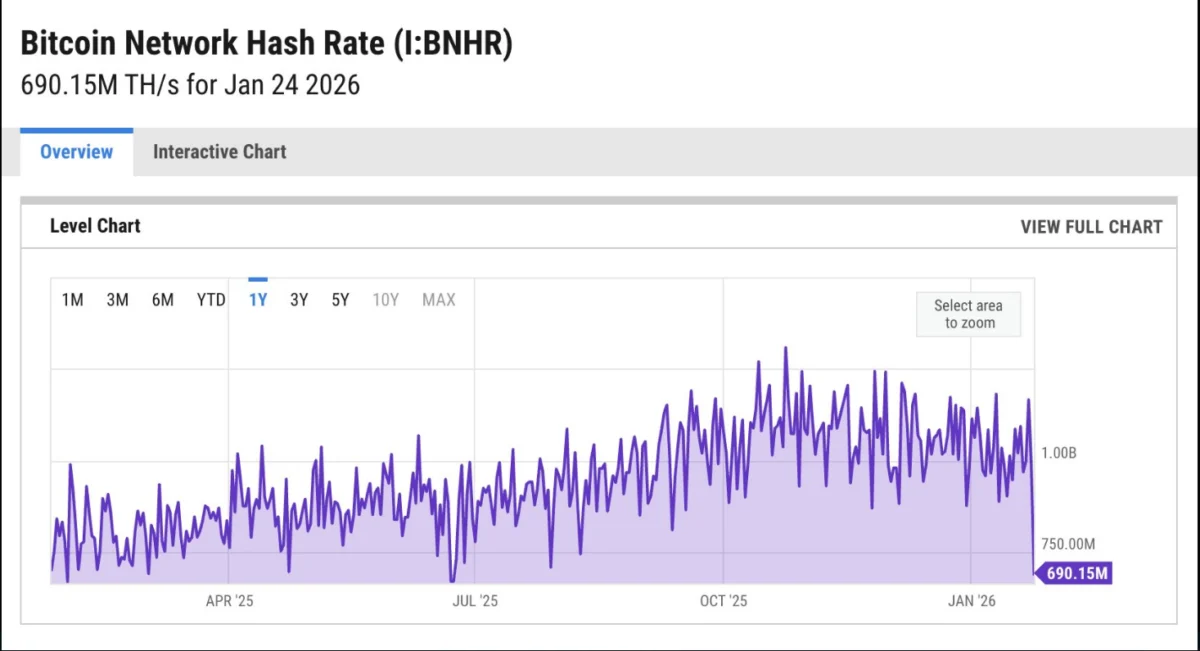
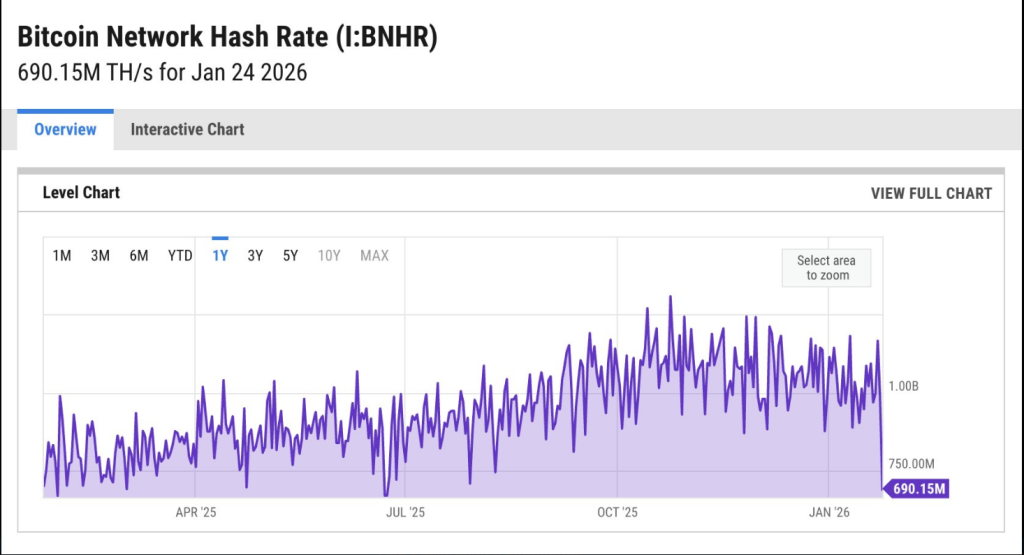
The move, while defensive, led to a sharp and immediate decline in the Bitcoin network’s total hashrate, which serves as the primary metric for the security and computational power of the blockchain. As miners in Texas and the Southeast bowed out to alleviate pressure on local grids, the network experienced a temporary but dramatic cooling period. However, the event has reignited a crucial conversation regarding the role of industrial-scale Bitcoin mining as a "demand-response" asset—a flexible electrical load that can be toggled on or off to preserve the stability of public utility infrastructure during extreme weather events.
Chronology: The 48-Hour Network Squeeze
The sequence of events began on Friday, January 23, as weather forecasts confirmed the arrival of a major polar front. By early Saturday, as the storm intensified across the central and southern United States, mining operators began executing pre-planned contingency protocols.
- Friday, Jan 23: Initial signs of grid strain emerge as temperatures begin their rapid descent. Mining pools report a marginal decline in hash contributions from North American IP addresses.
- Saturday, Jan 24: The "Great Throttling" begins. As residential demand for heating peaks, utility providers signal the need for load shedding. Major mining farms in the Texas ERCOT (Electric Reliability Council of Texas) footprint disconnect their rigs.
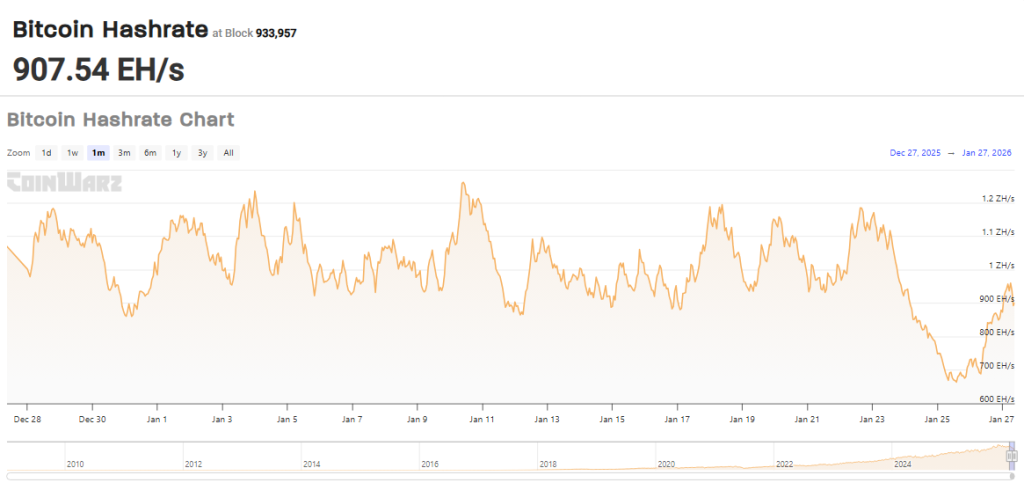
- Sunday, Jan 25: The hashrate reaches its nadir. Analytics trackers confirm that global hashrate dipped below 700 EH/s, hitting a low of approximately 663 EH/s—a figure unseen in seven months.
- Monday, Jan 26: As the storm front moves eastward and temperatures begin a slow crawl back toward seasonal norms, grid stability improves. Mining operations begin a phased re-energization process.
- Tuesday, Jan 27: By midday, the network shows significant signs of recovery, with the hashrate climbing back toward the 854 EH/s mark, signaling a full return to pre-storm operational capacity.
The Mechanics of Disconnection: Why Miners Shut Down
The rapid scaling back of mining operations was not a failure of the network, but rather a deliberate demonstration of its architecture. Bitcoin mining is uniquely modular; unlike traditional industrial manufacturing, which may require days to cool down or restart complex machinery, Bitcoin ASIC (Application-Specific Integrated Circuit) rigs can be powered down in seconds and restarted with equal ease.
Abundant Mines, a crypto mining firm based in Oregon, noted that roughly 40% of the total global mining capacity was effectively offline during the peak of the storm. This capacity acts as a "shock absorber" for the electrical grid. In many regions, mining firms operate under contracts that incentivize them to curtail energy usage when the grid faces peak demand. By shedding this load, miners prevent brownouts and rolling blackouts for the general public, effectively functioning as a balancing force for regional utility operators.

Supporting Data: Impact on Production and Hashrate
The impact on production for publicly traded mining entities was stark. Data provided by market intelligence firms and analysts, including Julio Moreno of CryptoQuant, highlighted the drastic reduction in daily Bitcoin yields during the peak of the storm.
Production Declines (Snapshot)
| Company | Pre-Storm (BTC/Day) | During Peak (BTC/Day) |
|---|---|---|
| Marathon Digital (MARA) | 45 | 7 |
| CleanSpark (CLSK) | 22 | 12 |
| Riot Platforms (RIOT) | 16 | 3 |
| IREN | 18 | 6 |
The volatility in production was most pronounced for companies like Marathon, which engages in "solo" mining or carries a larger, more concentrated operational footprint. The cumulative effect of these individual shutdowns resulted in the aforementioned drop to 663 EH/s. While the drop was mathematically significant, the Bitcoin protocol’s difficulty adjustment mechanism ensures that the network remains secure regardless of the total hashrate. The protocol automatically compensates for the reduced computational power, ensuring that block times remain consistent even as the total network hash ebbs and flows.
Official Responses and Grid Integration
Energy policy experts have long pointed to the U.S. mining industry as a potentially vital component of energy infrastructure. According to the federal Energy Information Administration (EIA), there are more than 130 dedicated crypto mining sites currently operating across the United States.
In Texas, the collaboration between mining firms and grid managers like ERCOT has become a blueprint for industrial energy management. During the recent storm, these miners did not simply stop working; they shifted their consumption patterns to ensure that household heaters, hospital power systems, and emergency services had priority access to the grid’s energy supply. This "load-shifting" is increasingly viewed by policymakers as a hedge against the intermittency of renewable energy sources, as miners can "soak up" excess energy when supply is high and vacate the grid when demand spikes.
Market Implications: Bitcoin’s Price Resilience
Despite the dramatic headlines regarding the hashrate, the market value of Bitcoin remained relatively stable throughout the weekend. Trading around the $88,300 mark, Bitcoin displayed a decoupling from the operational news of the mining sector.
Historically, observers might have feared that a massive hashrate drop would trigger panic among retail investors. However, the market has matured significantly, with investors now recognizing that hashrate volatility due to weather is a feature, not a bug, of a decentralized, global network. While the temporary drop did raise questions regarding short-term profitability for mining firms—who saw their daily revenue streams evaporate—the long-term security of the blockchain remained uncompromised.
The price action was, however, influenced by broader macroeconomic factors and geopolitical tensions. While the mining sector was grappling with the storm, the wider financial market was reacting to reports of global instability, which kept Bitcoin trading within a tight range of $87,000 to $89,000.
Long-term Implications: Is the Network Stronger?
The weekend’s events serve as a successful "live-fire" drill for the Bitcoin industry. By proving that the mining fleet can rapidly vacate the grid during an energy crisis, the industry has provided a compelling argument for its continued existence in the eyes of energy regulators.
1. Proof of Flexibility
The ability to shed 40% of global load in under 24 hours without significant infrastructure damage is a testament to the agility of the mining sector. This characteristic makes them ideal partners for grid operators who are struggling to integrate variable renewable energy sources into aging infrastructure.
2. Economic Adaptation
For the miners themselves, the event highlights the necessity of diversified power contracts. Companies that rely solely on fixed-rate power without the ability to curtail operations during grid emergencies found themselves in a difficult position. Moving forward, we can expect mining firms to emphasize "demand-response" revenue streams, where they are paid by utilities to stay offline during peak demand.
3. Network Decentralization
The fact that the network could lose over 100 EH/s of power and still process transactions without a single second of downtime reinforces the fundamental value proposition of Bitcoin: decentralization. The network is not reliant on any single mining farm, state, or region. When the US fleet went dark, miners in other jurisdictions continued their work, ensuring that the global ledger remained immutable and functional.
Conclusion
The winter storm of late January 2026 will likely be remembered in industry circles not as a crisis of mining, but as a coming-of-age moment for the sector’s relationship with the electrical grid. While the hashrate charts show a violent, downward spike, the reality on the ground was one of coordinated, intentional, and highly efficient energy management.
As Bitcoin continues to grow in institutional importance, the industry’s role as a flexible, grid-balancing asset will likely become a pillar of its integration into the national energy strategy. The miners are no longer just consumers of electricity; they are now active participants in the stabilization of the very grids that power the modern world.