Whale Activity and Market Volatility: Shiba Inu’s Brutal Week of Liquidations
The volatile landscape of the meme coin market was on full display this week as Shiba Inu (SHIB) found itself caught in a perfect storm of technical breakdowns and mysterious, large-scale wallet movements. As the token struggled to maintain critical support levels, the broader market volatility triggered a cascade of liquidations that disproportionately punished bullish traders.
In a single 24-hour window, over $382,000 in SHIB futures positions were forcibly closed. The data paints a grim picture for those betting on an upward trend: roughly $365,660 was wiped from long positions, while short-sellers—who correctly anticipated the downturn—suffered only a negligible $17,320 in losses. This lopsided liquidation profile underscores a market sentiment that was caught off guard by a sudden shift in momentum.
The distress in the derivatives market coincided with a development that sent ripples through the SHIB community: the sudden reawakening of a dormant whale wallet. After lying silent for nearly ten months, an address holding a massive quantity of SHIB initiated a series of high-volume transactions, effectively emptying its balance and fueling speculation about the future of the token’s price action.
The Chronology of the Whale Movement
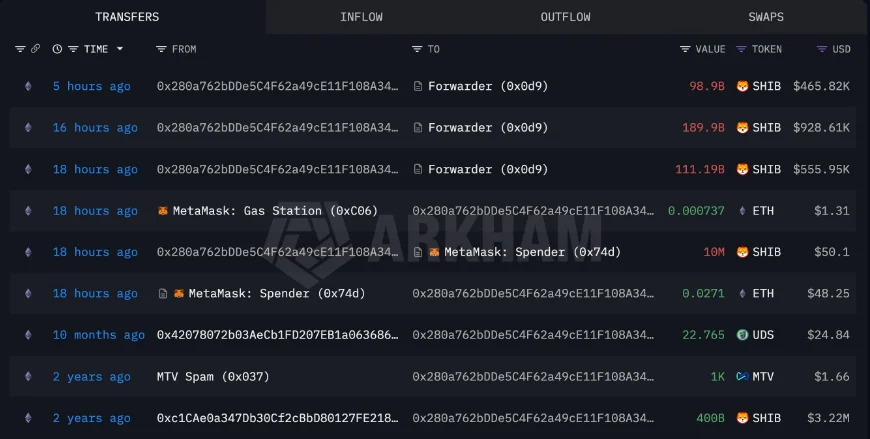
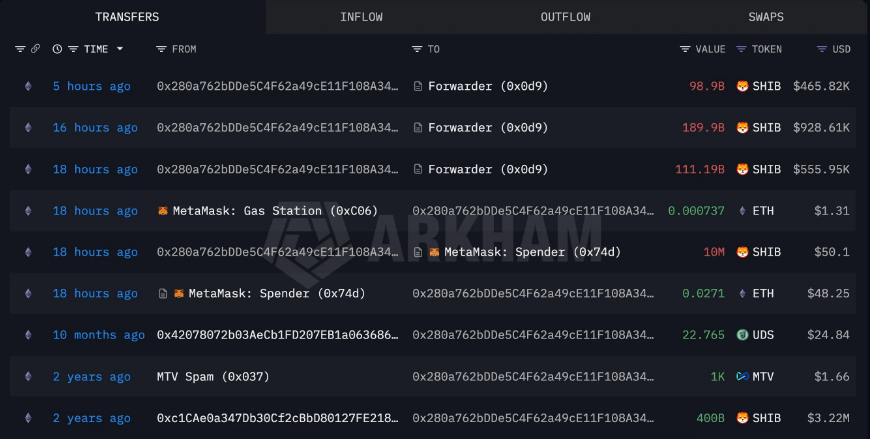
The reactivation of the dormant wallet, which had remained untouched since August of last year, began with a calculated series of maneuvers. According to on-chain data provided by Arkham Intelligence, the wallet’s owner did not immediately offload the entire position. Instead, they opted for a "test run"—a minor transfer of 10 million SHIB through a MetaMask swap.
Once the initial transaction confirmed that the wallet was functional and the path was clear, the holder accelerated their activity with clinical precision. In a matter of hours, nearly 400 billion SHIB tokens were moved through BitGo’s Forwarder Smart Contract. The divestment occurred in three distinct, rapid-fire tranches:
- Tranche 1: Approximately 112 billion SHIB.
- Tranche 2: Almost 190 billion SHIB.
- Tranche 3: A final transfer of 99 billion SHIB.
By the time the dust settled, the wallet, which had once held a significant portion of the circulating supply, was left with a residual balance of just 110 SHIB. The total volume transferred amounted to 399,989,999,938 SHIB. The speed and efficiency of these transactions suggest a well-planned exit strategy or a strategic reallocation of assets, rather than a frantic market sale.
Analyzing the Infrastructure: The BitGo Factor
The use of BitGo’s infrastructure has become a focal point for analysts trying to decipher the motive behind this massive movement. BitGo is a premier provider of institutional-grade digital asset custody and security solutions. Unlike retail-focused exchanges, BitGo’s infrastructure is frequently utilized for Over-the-Counter (OTC) deals, institutional rebalancing, or the migration of assets into cold storage for long-term safekeeping.
Crucially, movements through BitGo do not automatically register as "sells" on public order books. Because these transactions often occur off-exchange, it is impossible to definitively state that the whale dumped their holdings directly onto the market. However, the sheer scale of the move—amounting to hundreds of millions of tokens—creates a psychological overhang that the market has struggled to shake.
The fact that an entity holding such a substantial position chose this specific window of time to move their assets is highly significant. The crypto market was already grappling with a broader downturn, and the timing of this move served to amplify existing fears, contributing to the negative sentiment that ultimately triggered the wave of liquidations observed in the futures market.
Supporting Data: A Token Under Siege
Shiba Inu’s recent price performance reflects the exhaustion of the bulls. Over the past seven days, the token has shed approximately 16% of its value. Most concerning to technical analysts was the loss of the $0.000005 psychological support level, a floor that had previously provided a safety net for investors.
At the time of reporting, SHIB was trading at $0.000004535, marking a further decline of 3.50% over the previous 24-hour period. This downward slide has pushed the token toward the precarious edge of the top 30 cryptocurrencies by market capitalization. Currently, SHIB occupies the 29th position with a total market valuation of approximately $2.65 billion.
The correlation between the whale’s activity and the price slide suggests that even if the tokens were not sold directly on a retail exchange, the market’s perception of "whale movement" acts as a leading indicator of downward pressure. When large holders move, the market reacts, and when the market reacts in a bearish climate, liquidations become inevitable.
Institutional and Community Perspectives
While there have been no official comments from the Shiba Inu development team regarding the wallet movement, the broader crypto community has been vocal. On platforms like X (formerly Twitter) and Telegram, investors have engaged in intense debate regarding the "BitGo mystery."
Some market participants argue that the movement is a sign of institutional accumulation, suggesting that the tokens were moved to a more secure custodial environment rather than being offloaded. Others, however, remain skeptical, pointing to the historical correlation between large wallet transfers and subsequent price drops.
From an institutional standpoint, movements of this size are routine. For large holders, managing liquidity and security involves periodic rebalancing. The "mystery" is largely a byproduct of the transparent, yet opaque nature of blockchain technology—we can see what happened, but we cannot see the intent behind it.
The Broader Implications for SHIB
The events of this week highlight three critical realities for the Shiba Inu ecosystem:
1. The Fragility of Retail Sentiment
The $382,000 in liquidations demonstrates how sensitive the SHIB market remains to retail sentiment. When large amounts of capital are tied up in leverage, even moderate price fluctuations can cause a cascading effect. The current market structure is heavily reliant on sentiment-driven momentum, making it highly susceptible to "stop-loss hunting" when whales shift positions.
2. The Influence of "Old Money"
The fact that this wallet had been dormant for ten months reminds investors that there is a vast amount of "old" SHIB held by early adopters. As these wallets reactivate, they introduce significant liquidity risks. The market must now account for the possibility that other large, long-term holders may also look to rebalance their portfolios as the market experiences extended volatility.
3. The Need for Technical Consolidation
SHIB is currently at a crossroads. Having broken below the $0.000005 support level, the token is now searching for a new floor. Technical analysts suggest that without a major catalyst—such as new utility features or a broader recovery in the altcoin market—SHIB may continue to experience "grinding" volatility as it tests lower ranges.
Conclusion
The recent turbulence in the Shiba Inu market serves as a stark reminder of the complexities inherent in decentralized finance. A combination of macroeconomic headwinds, the liquidation of over-leveraged long positions, and the sudden movement of nearly 400 billion SHIB by a long-dormant whale has created a perfect storm of uncertainty.
While the exact purpose behind the BitGo transfers remains unknown, the market impact is indisputable. For investors, the takeaway is clear: the current environment requires extreme caution. As SHIB maneuvers to find a new support level, the eyes of the community remain fixed on the blockchain, waiting to see if this whale movement is a one-off event or the beginning of a larger trend in asset redistribution. Whether Shiba Inu can reclaim its lost ground depends not only on the actions of its whales but on the ability of the broader market to stabilize in the face of ongoing pressure.