Crypto Investment Surge: Institutional Capital Floods Digital Asset Markets as YTD Inflows Approach Historic Highs
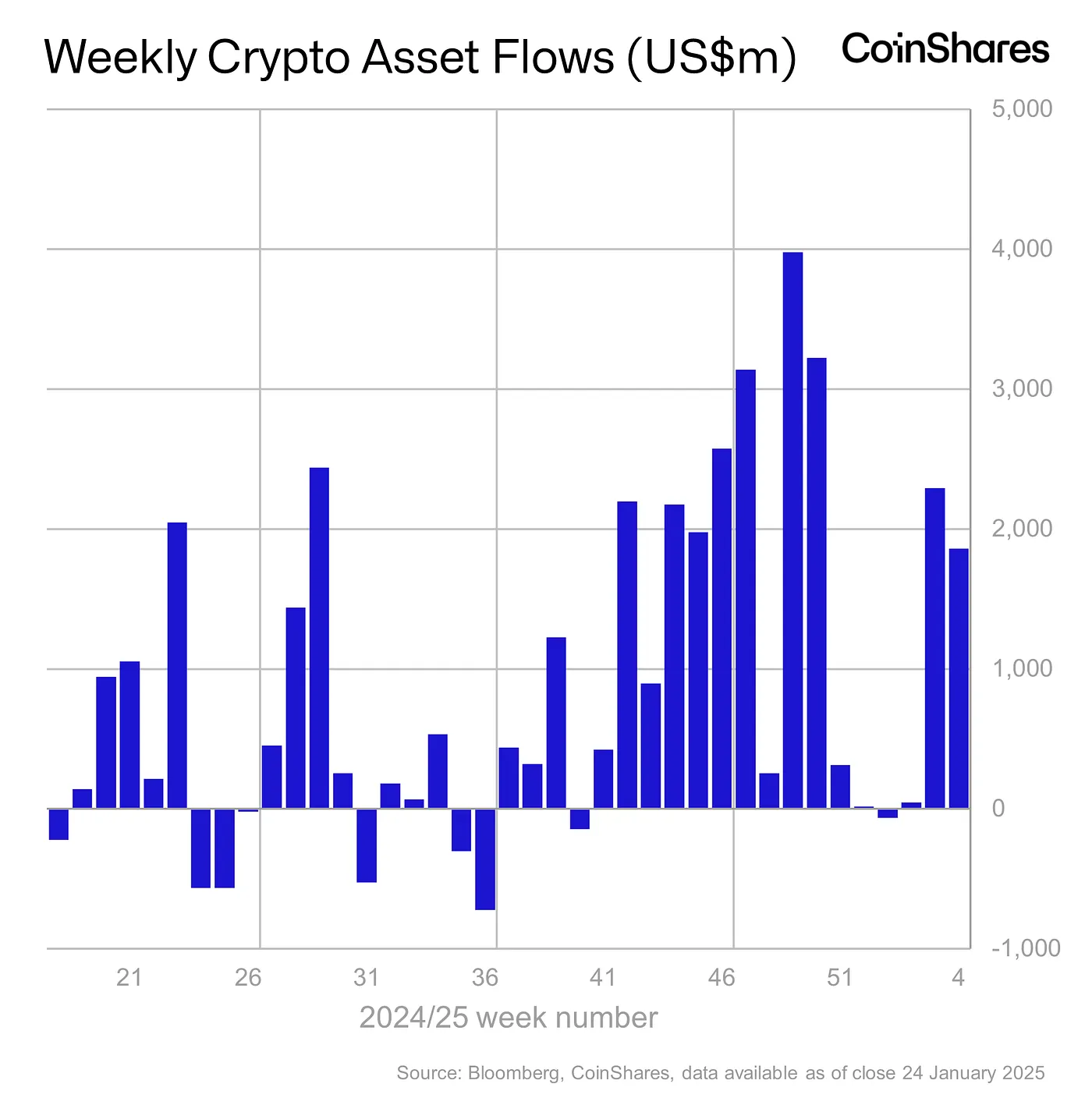
The institutional embrace of digital assets has reached a fever pitch. According to the latest Digital Asset Fund Flows Weekly Report from CoinShares, the global cryptocurrency market is witnessing a profound transformation, characterized by aggressive capital allocation into exchange-traded products (ETPs). With nearly $1 billion in net inflows recorded in a single week, the sector is rapidly closing in on its all-time high for year-to-date (YTD) investment flows, signaling a robust shift in sentiment among sophisticated investors.
Main Facts: A Billion-Dollar Wave of Institutional Capital
The data provided by CoinShares paints a picture of a market defined by renewed conviction. In the most recent reporting period, digital asset investment vehicles captured a staggering $882 million in global inflows. This momentum marks the fourth consecutive week of positive sentiment, effectively reversing the stagnation seen earlier in the quarter.
The aggregate YTD inflows have now climbed to $6.7 billion. This figure is particularly significant as it nears the $7.3 billion record established in early February 2024. Market observers note that this surge is not merely a reflexive bounce but a structural shift in how global portfolios are being constructed.
While the majority of the world’s major financial hubs saw significant inflows, the United States remains the undisputed engine of this growth. The U.S. market accounted for $840 million of the total weekly inflows, dwarfing activity in other regions. In contrast, Canada and Hong Kong experienced modest outflows of $8 million and $4.3 million, respectively, suggesting a localized redistribution of capital toward the more liquid and high-profile U.S. spot ETF market.
Chronology of the 2024 Institutional Rally
To understand the current state of the crypto market, one must examine the timeline of 2024’s institutional activity:
- January 2024: The U.S. Securities and Exchange Commission (SEC) greenlit the launch of spot Bitcoin ETFs. This landmark decision catalyzed the initial wave of institutional adoption, setting the stage for record-breaking inflows.
- February 2024: The market hit an early-year peak of $7.3 billion in cumulative YTD inflows, establishing a high-water mark for the industry.
- Mid-2024 (Consolidation Phase): Following the initial frenzy, the market entered a period of volatility and consolidation. Capital flows fluctuated as investors gauged macroeconomic headwinds and the impact of the Bitcoin "halving."
- October/November 2024 (The Current Surge): Following a month of consistent buying, the market has regained its upward trajectory. The current momentum is being fueled by a confluence of geopolitical and macroeconomic factors, pushing cumulative net inflows for U.S.-listed ETFs to a historic $62.9 billion—officially surpassing the previous February record of $61.6 billion.
Supporting Data: The Dominance of Bitcoin and Emerging Altcoins
Bitcoin continues to act as the primary "risk-on" asset for institutional investors, capturing the overwhelming majority of market interest. Last week alone, Bitcoin-focused investment products attracted $867 million in inflows. This sustained demand underscores Bitcoin’s evolving role as a "digital gold" equivalent in institutional portfolios.
However, the report also highlights interesting movements in the altcoin space:
- SUI: Often viewed as a high-performance alternative to legacy Layer-1 blockchains, SUI ETPs recorded $11.7 million in inflows, demonstrating that investors are beginning to diversify beyond the market leaders.
- Ethereum: Interestingly, Ethereum vehicles saw a more muted performance, recording only $1.5 million in inflows. This discrepancy highlights a growing preference among institutional investors for the security and liquidity of the Bitcoin ecosystem compared to the more complex utility-based value proposition of Ethereum in the current cycle.
Macroeconomic Drivers: Why the Sudden Surge?
CoinShares analysts point to three primary catalysts for the current institutional inflow cycle:
1. Global Expansion of M2 Money Supply
The global M2 money supply—a measure of the total volume of cash, checking deposits, and easily convertible near-money assets—has begun to expand. Historically, an increase in money supply often leads to currency debasement concerns, prompting investors to seek "hard assets." Bitcoin’s programmatic scarcity makes it an attractive hedge against the inflationary pressures associated with monetary expansion.
2. Stagflationary Risks in the United States
The U.S. economy faces a unique and challenging environment characterized by persistent inflation coupled with sluggish growth—the classic definition of "stagflation." Traditional equities have struggled to provide a reliable hedge in such environments, leading portfolio managers to allocate toward uncorrelated digital assets as a defensive maneuver.
3. Bitcoin as a Strategic Reserve Asset
Perhaps the most significant development is the growing interest from state-level actors and policymakers. The recent movement in various U.S. states to classify or adopt Bitcoin as a "strategic reserve asset" has provided a sense of institutional legitimacy that was previously absent. This narrative shift—from Bitcoin as a speculative toy to Bitcoin as a sovereign financial tool—has fundamentally altered the risk-reward profile for large-scale institutional players.
Official Perspectives and Market Implications
The record-breaking performance of U.S.-listed ETFs is more than just a number; it represents a fundamental change in the plumbing of global finance. With $62.9 billion in cumulative inflows, the infrastructure surrounding digital assets is now too large for traditional financial institutions to ignore.
Financial analysts suggest that this trend is likely to continue as long as the macro environment remains uncertain. The implication for the broader crypto ecosystem is profound:
- Price Discovery: As more capital is locked into long-term investment vehicles, the available "float" of Bitcoin on exchanges is reduced, which historically exerts upward pressure on prices.
- Regulatory Legitimacy: The success of these ETPs acts as a feedback loop. High liquidity attracts more regulated participants, which in turn encourages regulators to provide clearer frameworks, further lowering the barrier to entry for conservative institutional capital.
- Portfolio Diversification: The shift from 100% equity/bond portfolios to "60/40/1" (where 1% is allocated to crypto) is becoming a standard conversation in wealth management firms, signaling that the "digital asset class" is here to stay.
Conclusion: A New Era of Financial Maturity
The data provided by CoinShares confirms that we have entered a new era of digital asset adoption. The days of crypto being an isolated, retail-driven experiment are over. Today’s market is defined by institutional mandates, macroeconomic hedging, and the integration of blockchain-based assets into the very foundation of the global financial system.
As investors look toward the remainder of the year, the focus will likely remain on whether these inflows can be sustained in the face of shifting monetary policies. However, one thing remains clear: the bridge between traditional finance and the decentralized digital economy has been built, and the capital flowing across it is reaching record-breaking levels.
Disclaimer: The information provided in this article is for informational purposes only and does not constitute financial, investment, or legal advice. Digital assets are highly volatile and carry a significant risk of loss. Investors should conduct thorough due diligence and consult with a certified financial advisor before making any investment decisions. The Daily Hodl does not endorse any specific asset, and any participation in crypto markets is at the user’s sole risk.