Ethereum Navigates Choppy Waters: On-Chain Data Suggests Underlying Strength Amidst Retail Apathy
London, UK – February 25, 2025 – Ethereum (ETH), the world’s second-largest cryptocurrency by market capitalization, is currently navigating a period of significant price stagnation, trading below the critical $1,700 mark. This lack of decisive momentum has fostered widespread apathy and uncertainty within the market, leaving traders on both sides of the spectrum frustrated. While the price is neither experiencing a convincing recovery nor a sharp decline, on-chain data analyzed by CryptoOnchain offers a compelling counter-narrative to the notion of a structurally weakening network. Instead, the data suggests a strategic consolidation of capital by larger, more influential holders, commonly referred to as "whales."
This divergence in on-chain activity paints a nuanced picture of the current Ethereum landscape. While headline figures might suggest a cooling interest, a deeper examination reveals a dynamic shift in how capital is being deployed within the ecosystem. This report will delve into the specifics of this on-chain analysis, juxtapose it with the prevailing market sentiment and technical indicators, and explore the potential implications for the future trajectory of Ethereum.
The Divergence: Shrinking Transactions, Soaring Values
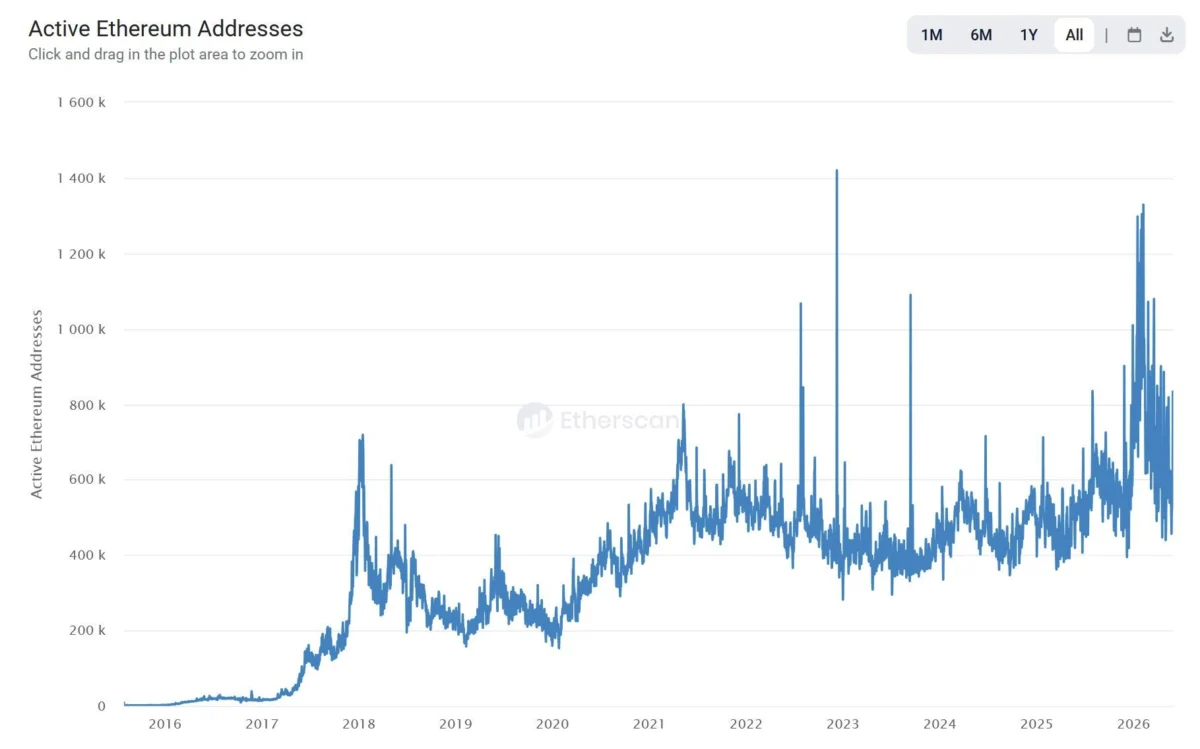
Over the past week, a notable divergence has emerged in Ethereum’s on-chain transaction patterns. Data reveals a significant drop of approximately 43% in daily transactions originating from regular user wallets. Viewed in isolation, this decline might be interpreted as a sign of waning engagement and relevance during a challenging market period. However, this is where the analysis, as presented by CryptoOnchain, begins rather than ends.
H2: The Widening Gap: Whales Accumulate as Retail Steps Aside
The narrative of a declining network loses traction when contrasted with another critical metric: the average value moved per transaction. This figure has surged by over 184% during the same period. Even more strikingly, the median transfer size has seen an even sharper increase. In essence, Ethereum is processing fewer transactions, but the transactions being executed are dramatically larger and more substantial than those that preceded them.

This specific combination of declining transaction counts and escalating transfer values is a well-recognized pattern in on-chain analysis, particularly during periods of market stress. Historically, smaller, routine participants tend to reduce their activity, adopting a wait-and-see approach until market clarity emerges. Conversely, larger holders, or whales, continue to operate, moving significant capital through fewer, but more substantial transactions. These larger movements often reflect deliberate strategic positioning rather than everyday network usage.
CryptoOnchain’s analysis posits that this divergence is not indicative of a network in structural decline. Instead, it strongly suggests a period of capital consolidation, where assets are being moved into fewer, more significant holdings at the current price levels. This "widening gap" between retail activity and whale movements is a key indicator of underlying strength, even in the face of apparent market apathy.
Supporting Data: Flows and Open Interest Signal Accumulation
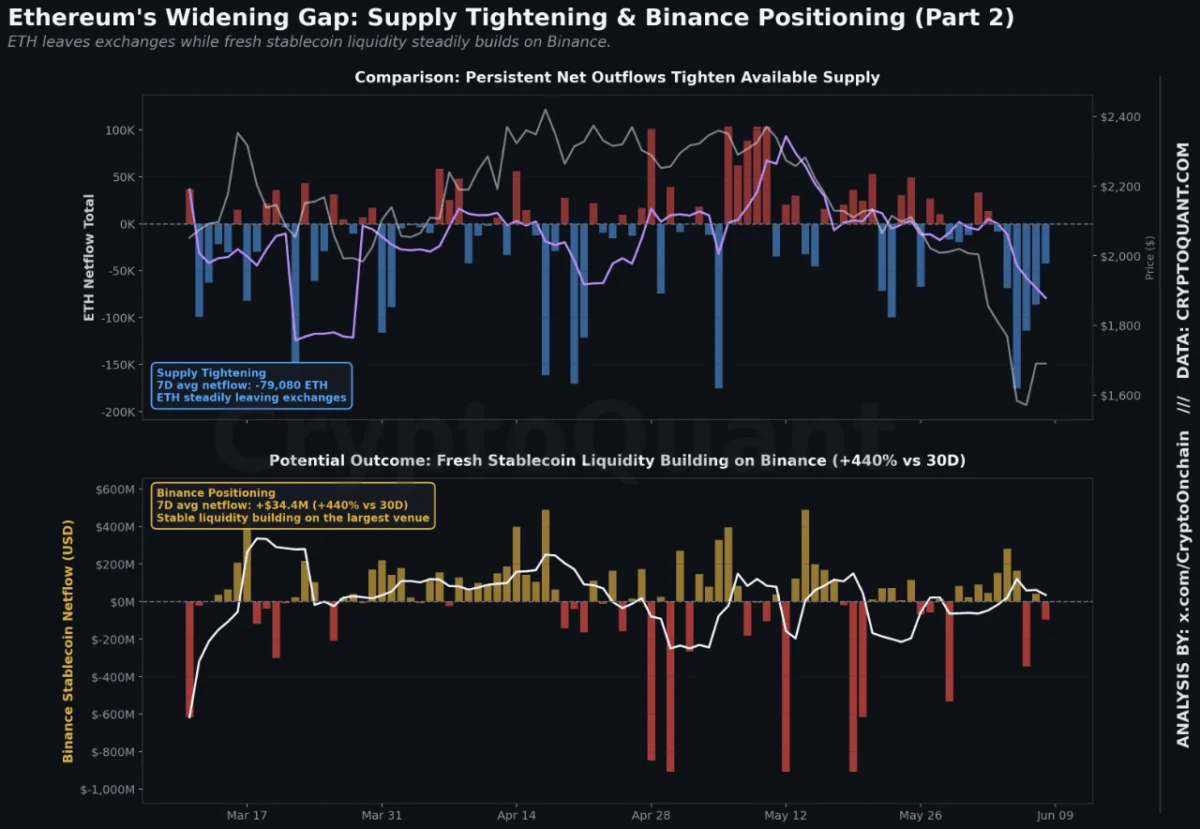
The on-chain transaction divergence is further corroborated by broader flow data, which confirms the same behavioral pattern from multiple independent angles. Total ETH netflows, a measure of the net movement of ETH into and out of exchanges, remain deeply negative, standing at approximately -79,080 ETH. This consistent outflow of large volumes from exchanges indicates that capital is being withdrawn from platforms where it would be readily available for sale, suggesting a deliberate intent to hold rather than liquidate. This ongoing contraction of available spot supply is a tangible and significant development.
H2: The Setup Is Consolidating: Accumulation Beyond the Headlines
Simultaneously, fresh capital is actively positioning itself on Binance, a major cryptocurrency exchange, through the stablecoin channel. Stablecoin netflows into Binance have turned strongly positive, reaching +$34.4 million, a substantial 440% increase compared to the 30-day average. This influx of buying power arriving on the exchange coincides with the outflow of spot ETH.

Furthermore, Open Interest on Binance has expanded by approximately 9% over the quarter. This expansion confirms that larger participants are not only accumulating spot ETH but are also quietly building their derivatives exposure. The combination of stablecoin inflows and increased Open Interest suggests a strategic build-up of positions by sophisticated market players.
The pattern identified by the analysis is specific and historically recognizable. A thinning of retail participation, coupled with larger entities withdrawing spot ETH and simultaneously parking stablecoin liquidity on major exchanges, describes a market structure where available float is tightening from the supply side, while potential demand is accumulating on the buy side. This creates a scenario where available ETH for trading is becoming scarcer, while a growing pool of capital is waiting to deploy.
Technical Downtrend: The Price Action Narrative
While the on-chain data paints a picture of underlying accumulation, the current price action of Ethereum presents a starkly different narrative. On the daily timeframe, Ethereum remains firmly under bearish control, trading near $1,630. This follows a sharp breakdown from a multi-month consolidation phase that dominated trading between February and May.
H2: Ethereum Tests New Lows as Market Searches for a Bottom
The most significant technical development has been the decisive loss of the $1,800-$1,900 support zone. This area had repeatedly acted as a demand floor throughout the first half of the year. Once this critical support failed, selling pressure accelerated rapidly, pushing ETH to fresh lows near $1,500.

From a market structure perspective, the sequence of highs and lows remains clearly bearish. The April-May recovery peaked near $2,400, forming a lower high relative to previous rallies, before sellers regained control. Since then, Ethereum has exhibited a consistent pattern of lower highs and lower lows, culminating in the recent collapse through support. Importantly, the current price is trading well below the 50-, 100-, and 200-day moving averages, confirming weakness across all major timeframes.
Volume behavior during the recent selloff further underscores the bearish momentum. The breakdown generated one of the largest volume spikes seen in months, signaling aggressive participation as ETH broke through key support levels. While a short-term bounce emerged from the $1,500 area, buyers have, thus far, struggled to reclaim any meaningful resistance.
The immediate battleground for Ethereum is the $1,500-$1,550 region, which now represents the year’s most critical support level. A sustained hold at this level could allow Ethereum to build a base after a significant decline of nearly 35% from its May highs. However, without a reclaim of the former support zone around $1,800, any rallies are likely to be viewed as corrective moves within a broader downtrend rather than the commencement of a durable recovery.
Implications: A Pre-Condition for the Next Move?
The confluence of seemingly contradictory data – bearish price action versus bullish on-chain accumulation – presents a complex scenario for market participants. The honest framing of the report by CryptoOnchain acknowledges that this specific combination does not guarantee an immediate price reversal. Structural setups, while indicative of potential, require catalysts to activate them.
However, what this data does describe is a specific pre-condition that has historically preceded more pronounced market moves. A tightening float, coupled with concentrated buying power and an environment where active participants during the apathy phase are strategically positioned, sets the stage for disproportionate benefits when market sentiment inevitably shifts.

H3: The Road Ahead: Navigating Uncertainty and Potential Catalysts
The current environment can be characterized by a period of consolidation and strategic positioning by informed market players. While retail investors may be sidelined by the prevailing bearish sentiment and price action, larger entities appear to be quietly accumulating ETH. This suggests a belief in the long-term value proposition of Ethereum, despite short-term market headwinds.
The critical question for investors and traders is what will serve as the catalyst for the next significant move. Potential catalysts could include:
- Macroeconomic Shifts: A change in global economic sentiment, a dovish turn from central banks, or a decrease in inflation could lead to increased risk appetite, benefiting cryptocurrencies like Ethereum.
- Regulatory Clarity: Positive developments in cryptocurrency regulation, particularly in major jurisdictions, could boost investor confidence and encourage institutional adoption.
- Ethereum Network Upgrades: Successful execution of future Ethereum network upgrades, such as those aimed at improving scalability and reducing transaction fees, could reignite enthusiasm and drive demand.
- Broader Market Sentiment: A general resurgence of bullish sentiment across the cryptocurrency market, potentially triggered by Bitcoin’s performance or other major altcoin rallies, could lift Ethereum along with it.
Until such catalysts emerge, Ethereum may continue to trade within its current range, characterized by low retail participation and ongoing whale accumulation. The on-chain data offers a compelling argument that the current weakness may not reflect a fundamentally deteriorating network, but rather a strategic re-distribution of assets, creating a potentially fertile ground for future upside once market sentiment pivots. Investors would be wise to monitor both the technical price action and the underlying on-chain fundamentals to gain a comprehensive understanding of Ethereum’s evolving market dynamics.
Disclaimer: This article is for informational purposes only and does not constitute financial advice. Investing in cryptocurrencies carries significant risk, and readers should conduct their own research and consult with a qualified financial advisor before making any investment decisions.