Institutional Capital Floods Crypto Market: A Surge Driven by U.S. Policy Shifts
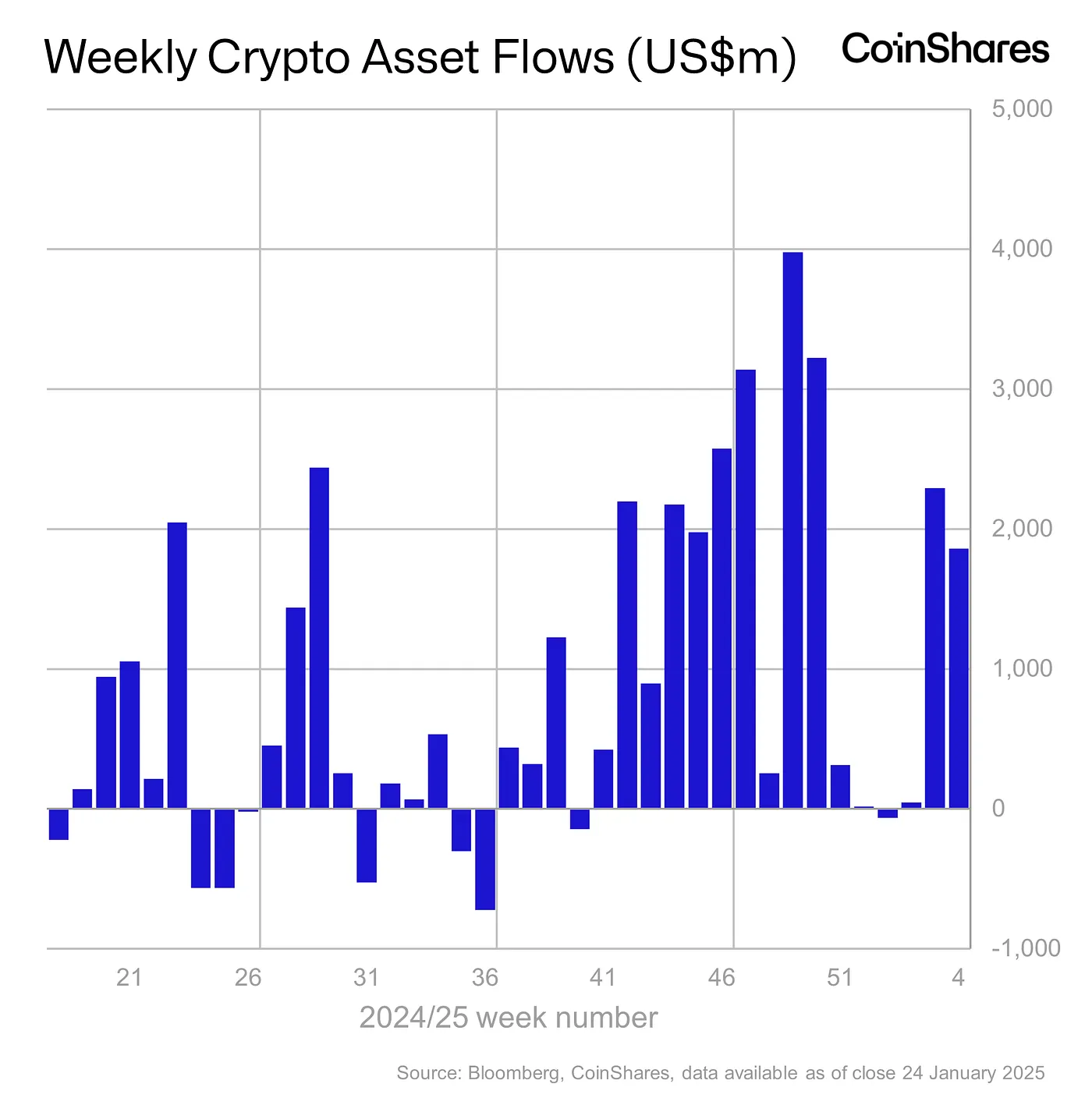
The digital asset landscape is witnessing a seismic shift in institutional sentiment. According to the latest "Digital Asset Fund Flows" report from industry leader CoinShares, institutional investors have funneled nearly $2 billion into crypto-related investment vehicles in a single week. This massive influx of capital, largely attributed to recent executive actions by the Trump administration, underscores a growing institutional confidence in the role of cryptocurrency within the global financial architecture.
As markets digest the implications of potential strategic reserves and clearer regulatory frameworks, the data suggests that the "smart money" is positioning itself for a new era of digital asset integration.
Main Facts: A $2 Billion Surge
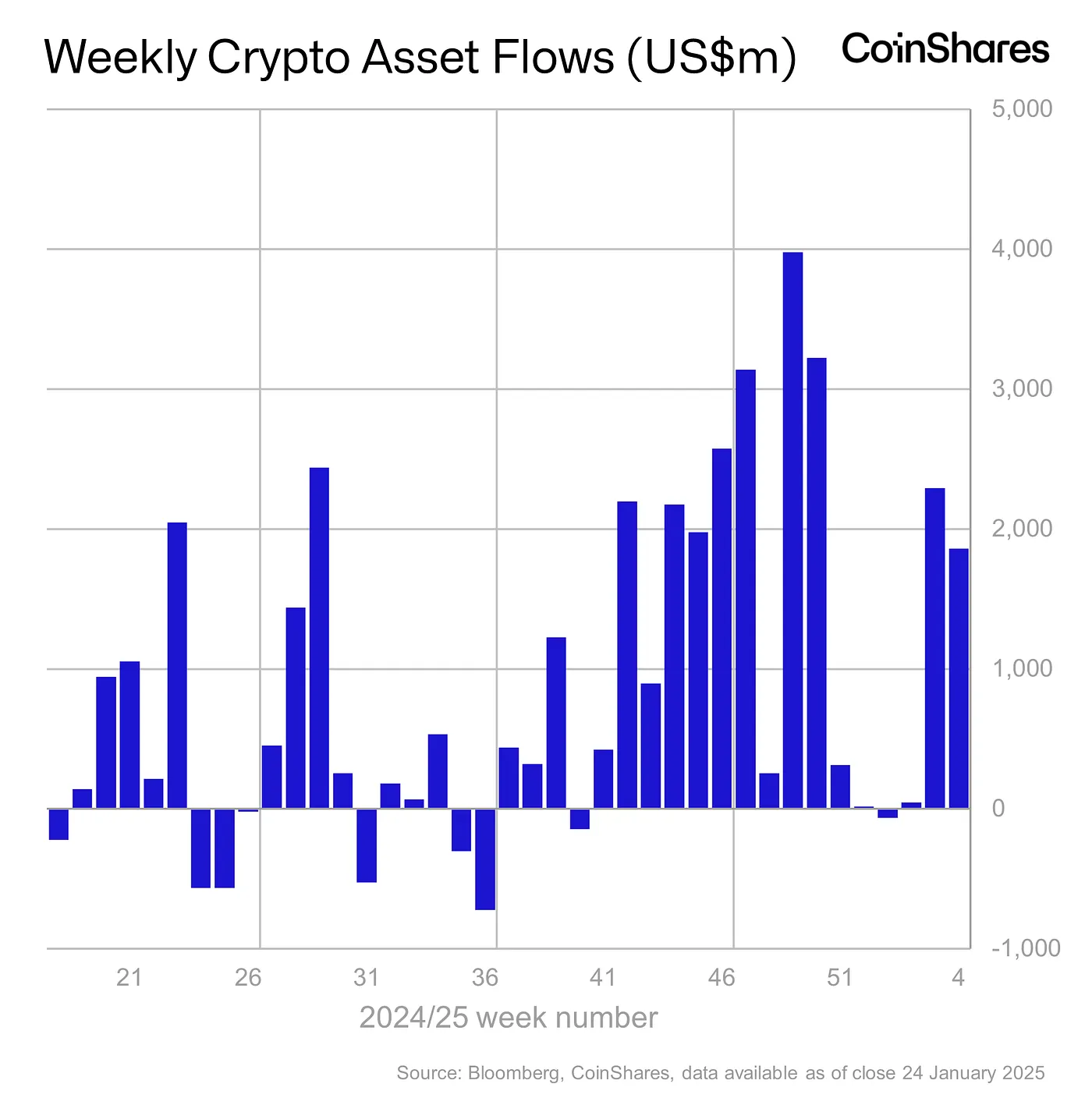
The CoinShares report confirms that institutional crypto investment products recorded inflows totaling $1.9 billion last week. This brings the year-to-date (YTD) total for these investment vehicles to a staggering $4.8 billion.
What makes this surge particularly noteworthy is the context in which it occurred. While the broader price action for major cryptocurrencies remained relatively flat throughout the week, trading volumes told a different story. Total trading volume on trusted exchanges reached $25 billion for the week, accounting for roughly 37% of all activity across the sector. This indicates that despite the lack of major price volatility, institutional players were aggressively accumulating positions, likely viewing the current market price as an attractive entry point following the recent executive orders.
Chronology: The Catalyst of Executive Action
The recent influx of capital cannot be viewed in isolation. It follows a direct sequence of policy-driven events that have changed the trajectory of the crypto industry:
- Pre-Inauguration Rally: In the lead-up to the presidential inauguration, Bitcoin reached new all-time highs, sparking widespread market optimism.
- The Executive Order: Following the inauguration, the administration issued executive orders directed at the digital asset industry. Most notably, these orders proposed the initiation of a strategic reserve asset in Bitcoin, signaling a monumental pivot in U.S. government policy.
- The Market Response: In the immediate aftermath of these announcements, institutional investors responded with record-breaking capital allocations. The $1.9 billion weekly inflow represents a vote of confidence in the U.S. government’s newfound willingness to legitimize and adopt Bitcoin as a reserve asset.
- Current Standing: The market is now in a state of high-volume consolidation, with institutions continuing to build their holdings while awaiting further legislative implementation of the proposed reserves.
Supporting Data: Regional and Asset-Specific Breakdown
The distribution of these inflows reveals a clear concentration of institutional interest, both geographically and across specific asset classes.
Regional Dominance
The United States is unequivocally the leader in this current cycle of institutional adoption. Of the $1.9 billion in total global inflows, $1.7 billion originated from U.S.-based entities. This dominance highlights the impact of domestic policy on global capital flows. Other regions contributed to the trend, albeit on a much smaller scale:
- Switzerland: $35 million in inflows.
- Canada: $31 million in inflows.
- Germany: $23 million in inflows.
Asset-Specific Performance
Bitcoin continues to act as the primary anchor for institutional portfolios. The leading cryptocurrency saw inflows totaling $1.6 billion last week alone, accounting for 92% of all inflows in the digital asset sector. Its YTD inflows now sit at $4.4 billion.
Interestingly, the rise in Bitcoin’s price has also led to renewed interest in "short-Bitcoin" ETFs, which saw inflows of $5.1 million. This suggests that while institutional sentiment is overwhelmingly bullish, professional traders are still utilizing hedging strategies to manage volatility.
Ethereum, the second-largest digital asset by market capitalization, led the altcoin space with $205 million in inflows. This is a significant reversal for Ethereum, which had previously struggled with outflows earlier in the year. With these recent additions, Ethereum’s YTD inflows have turned positive, reaching $177 million. With the notable exception of Cardano, which experienced minor outflows, nearly every major institutional crypto product saw positive growth during this period.
Official Responses and Industry Outlook
While official government representatives have kept their rhetoric focused on the potential for a "strategic reserve," industry analysts are interpreting these actions as the final nail in the coffin for the "crypto winter" narrative.

CoinShares’ researchers highlighted that the "recent presidential executive orders that proposed the initiation of a strategic reserve asset in Bitcoin" are likely the primary engine for this capital shift. Market analysts note that institutional players rarely move this much capital without clear signals from regulators. By moving toward a strategic reserve, the U.S. government has effectively provided the "regulatory green light" that many institutional investment committees were waiting for before allocating significant percentages of their portfolios to digital assets.
Implications for the Future
The implications of this institutional shift are far-reaching, affecting everything from market liquidity to the long-term viability of the decentralized finance (DeFi) ecosystem.
1. Market Stability and Liquidity
High institutional participation generally brings greater liquidity to the market, which can dampen the extreme volatility typically associated with retail-only trading. As more capital flows into regulated investment vehicles, the market depth increases, making it harder for single actors to manipulate prices.
2. The Normalization of Digital Assets
The inclusion of Bitcoin in a national strategic reserve would cement its status as a "digital gold." This shift moves crypto out of the periphery of speculative assets and into the core of institutional asset allocation models alongside equities, bonds, and precious metals.
3. Regulatory Clarity
The executive orders serve as a roadmap for future regulation. By explicitly discussing a Bitcoin reserve, the administration is forcing other federal agencies to define how they will interact with digital assets. This creates a more predictable environment, which is the single most important factor for long-term institutional investment.
4. The "Altcoin" Secondary Effect
While Bitcoin dominates, the spillover into Ethereum and other altcoins suggests that institutions are looking beyond just the flagship asset. As infrastructure matures, we may see institutional capital begin to diversify into smart-contract platforms that offer utility beyond simple value storage.
Conclusion
The $1.9 billion surge in institutional investment is more than just a momentary blip; it is a clear indicator of a changing tide. When the world’s largest economy signals an intent to integrate Bitcoin into its national strategy, it triggers a chain reaction that mandates institutional participation.
As we look toward the remainder of the year, the primary variable to watch will be the speed at which these executive orders are translated into concrete legislative action. If the U.S. maintains its current trajectory, we are likely looking at a sustained period of institutional accumulation that could reshape the global financial landscape. However, investors should remain cautious; as the market continues to evolve, the necessity of due diligence and risk management remains paramount.
The digital asset industry has clearly entered a new phase of maturity—one where institutional capital is not just a participant, but a driving force.
Disclaimer: The information provided in this article is for educational and informational purposes only and does not constitute financial, investment, or legal advice. Investing in digital assets, including Bitcoin and Ethereum, carries significant risk. Past performance is not indicative of future results. Always conduct your own research or consult with a qualified financial advisor before making any investment decisions. The Daily Hodl and its contributors are not responsible for any financial losses incurred through the use of this information.