Crypto Investment Surge: Institutional Capital Floods Market as Bitcoin Hits Historic Milestones
The digital asset landscape is currently undergoing a significant shift, characterized by a massive influx of institutional capital that is pushing investment vehicles toward record-breaking annual performance. According to the latest data from CoinShares, a premier European digital asset management firm, the cryptocurrency market has experienced a sustained period of growth, fueled by macroeconomic uncertainty and shifting geopolitical attitudes toward Bitcoin.
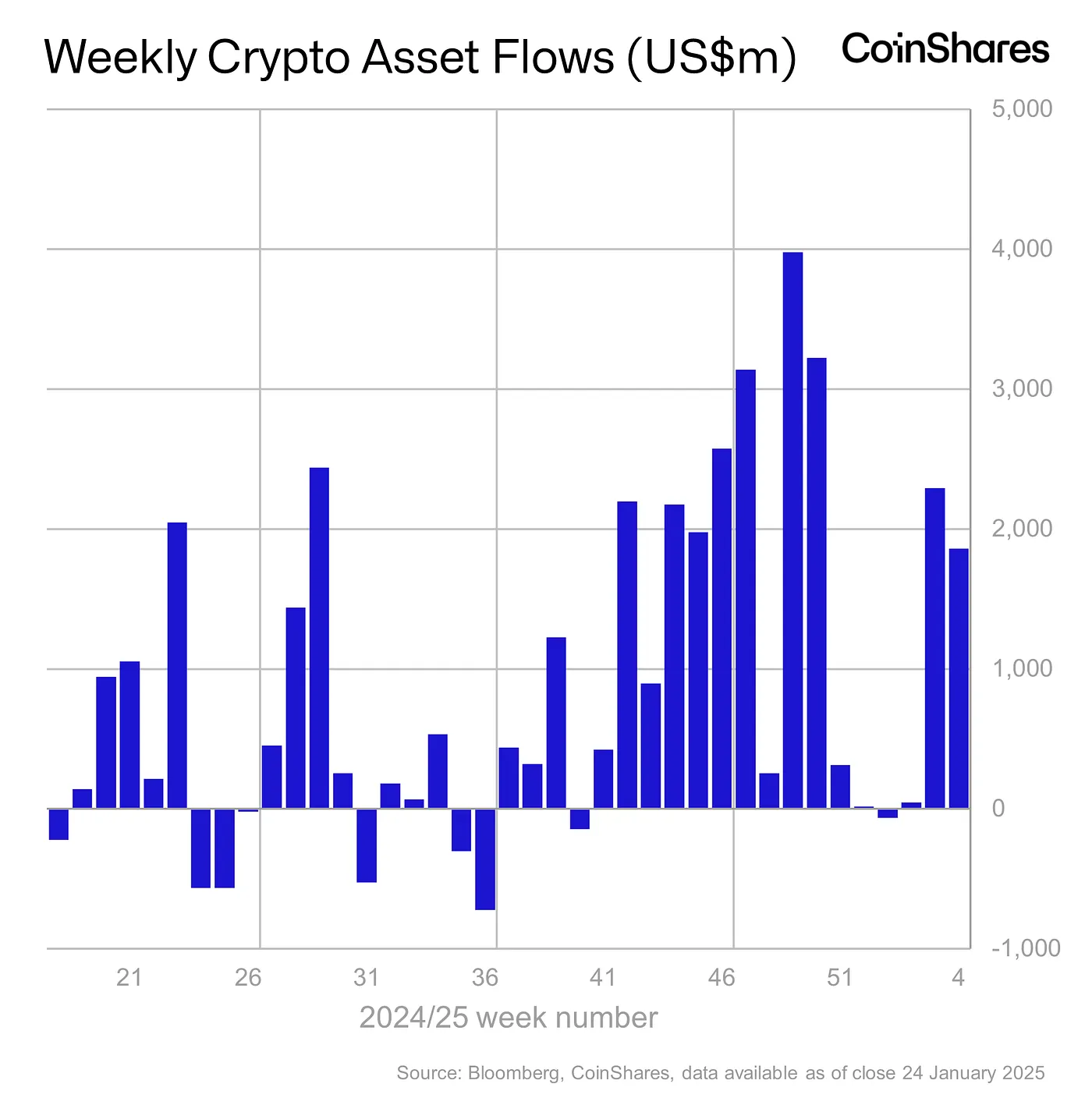
In its recent Digital Asset Fund Flows Weekly Report, CoinShares highlights a staggering $882 million in global inflows over the past week alone. This development marks the fourth consecutive week of net positive movement, signaling a robust appetite for crypto-exposure among institutional investors. With year-to-date (YTD) inflows now hitting $6.7 billion, the market is rapidly approaching the $7.3 billion annual peak recorded in February, suggesting that the current momentum may soon shatter all previous historical benchmarks.
The Macro-Drivers Behind the Inflow Surge
Market analysts and the team at CoinShares have identified a convergence of three critical factors driving this renewed institutional interest.
1. The Global M2 Money Supply Expansion
As central banks globally navigate the complexities of post-pandemic recovery, there has been a noticeable increase in the M2 money supply—a measure of liquid assets including cash and short-term deposits. Historically, when fiat currency supply expands, investors tend to seek "hard assets" or non-sovereign stores of value to hedge against the eroding purchasing power of traditional currencies. Bitcoin, with its programmatic scarcity, has increasingly been treated as a primary hedge against this global liquidity expansion.
2. Rising Stagflationary Risks in the United States
The U.S. economy faces the persistent threat of "stagflation"—a difficult environment characterized by stagnant economic growth and high inflation. When traditional equities and bond markets face volatility due to these conditions, institutional investors are diversifying their portfolios. Bitcoin’s performance in this high-inflation environment has bolstered its reputation as a "digital gold," encouraging a flight to safety within the crypto-asset space.
3. The Institutionalization of Bitcoin as a Strategic Reserve
Perhaps the most significant shift in the narrative is the movement at the state level. Several U.S. states have begun discussions or taken legislative steps toward approving Bitcoin as a strategic reserve asset. This institutional validation—moving from speculative retail interest to government-level adoption—has provided a safety net for risk-averse institutional managers to enter the market with increased confidence.
Geographic Breakdown: A Tale of Two Markets
While the global demand for digital assets remains strong, the concentration of capital is distinctly skewed toward specific regions.
- The United States Dominance: The U.S. market led the charge with a commanding $840 million in inflows. This dominance is largely attributed to the maturity of the U.S.-listed spot Bitcoin Exchange-Traded Funds (ETFs), which have provided a regulated, secure, and tax-efficient pathway for traditional capital to enter the crypto market.
- The European and Australian Footprint: Germany ($44.5 million) and Australia ($10.2 million) also saw healthy inflows, reflecting a global trend of adoption. However, it is important to note that these markets operate with different regulatory frameworks compared to the U.S., influencing the speed at which capital is deployed.
- Outliers: Conversely, Canada and Hong Kong saw modest outflows of $8 million and $4.3 million, respectively. These figures are relatively small in the broader context of the $882 million total, likely representing routine portfolio rebalancing by regional funds rather than a fundamental shift in sentiment.
Bitcoin’s Unrivaled Market Dominance
Bitcoin remains the undisputed "king" of the current investment cycle. The data from CoinShares confirms that BTC attracted $867 million of the total $882 million in global inflows. This overwhelming preference highlights that while investors are interested in the broader blockchain ecosystem, Bitcoin remains the primary gateway for institutional entry.
A pivotal milestone was reached this week: U.S.-listed Bitcoin ETFs have now recorded cumulative net inflows of $62.9 billion since their inception in January 2024. This figure officially surpasses the previous all-time high of $61.6 billion set in early February. This record is not merely a number; it represents a fundamental change in the depth and liquidity of the Bitcoin market. By clearing this hurdle, the asset class has demonstrated that it has moved beyond the volatility of its early years into a phase of deep-seated institutional adoption.
Beyond Bitcoin: The Altcoin Narrative
While Bitcoin commands the lion’s share, the institutional interest is beginning to trickle down into specific alternative assets, albeit at a much smaller scale.
- SUI’s Emergence: SUI, a layer-1 blockchain known for its high-performance throughput, attracted $11.7 million in inflows. This suggests that sophisticated investors are beginning to hunt for "utility" plays that offer scalable solutions to the limitations of older networks.
- Ethereum’s Stagnation: Interestingly, Ethereum (ETH) vehicles saw only $1.5 million in inflows. This disparity between Bitcoin and Ethereum, and the interest in emerging chains like SUI, suggests a shifting focus. Investors are currently prioritizing the "digital gold" narrative of Bitcoin and the high-tech potential of newer networks over the current smart-contract dominance of Ethereum.
Implications for the Future of Finance
The transition of digital assets from a retail-driven experiment to an institutional asset class has profound implications for the global financial order.
The Regulatory Horizon
The success of the U.S. spot ETFs has forced regulators to engage more constructively with digital assets. As more capital flows into these products, the pressure for a clear, comprehensive regulatory framework increases. This cycle of investment and regulation is likely to continue, eventually lowering the barrier to entry for pension funds, sovereign wealth funds, and insurance companies.
Price Discovery and Market Stability
Increased institutional participation often leads to increased market efficiency. While crypto remains volatile, the presence of large-scale institutional players—who often employ longer time-horizon strategies compared to retail day traders—may eventually contribute to a more stable price discovery process. As the "HODL" culture is adopted by large funds, the supply of liquid Bitcoin on exchanges is expected to tighten, potentially creating a long-term upward pressure on price.
The Challenge of Diversification
For the average investor, the current data offers a clear lesson: institutional money is playing a long-term game. However, the concentration of capital into Bitcoin underscores the difficulty of diversifying within the crypto space. While projects like SUI are gaining traction, the overwhelming majority of inflows remain tethered to the flagship asset. Investors must weigh the potential for high returns in smaller projects against the relative stability and liquidity of Bitcoin.
Final Analysis: An Asset Class Reaching Maturity
The figures provided by CoinShares serve as a barometer for the state of the crypto-economy. We are no longer in the phase of "will it survive?" but rather in the phase of "how does it integrate?"
The record-breaking inflows suggest that the institutional skepticism that defined the previous decade has largely evaporated. In its place, we see a pragmatic, data-driven approach to digital assets. As the U.S. election cycles, global monetary policy, and state-level adoption policies continue to evolve, the demand for digital investment vehicles is expected to remain high.
However, investors are cautioned that past performance is not indicative of future results. The crypto market remains high-risk, and the sudden shifts in geopolitical landscapes that act as a tailwind today could, under different circumstances, create headwinds. As always, rigorous due diligence and a balanced view of macroeconomic conditions are essential for any participant in this rapidly evolving sector.
The trajectory of the last month confirms one undeniable truth: digital assets have moved from the periphery to the center of global finance, and the momentum shows no signs of slowing down. As we look toward the remainder of the year, the focus will remain on whether these inflows can be sustained and whether Ethereum and other altcoins can reclaim a larger portion of the institutional capital pie. For now, the world is watching, and the capital is moving.