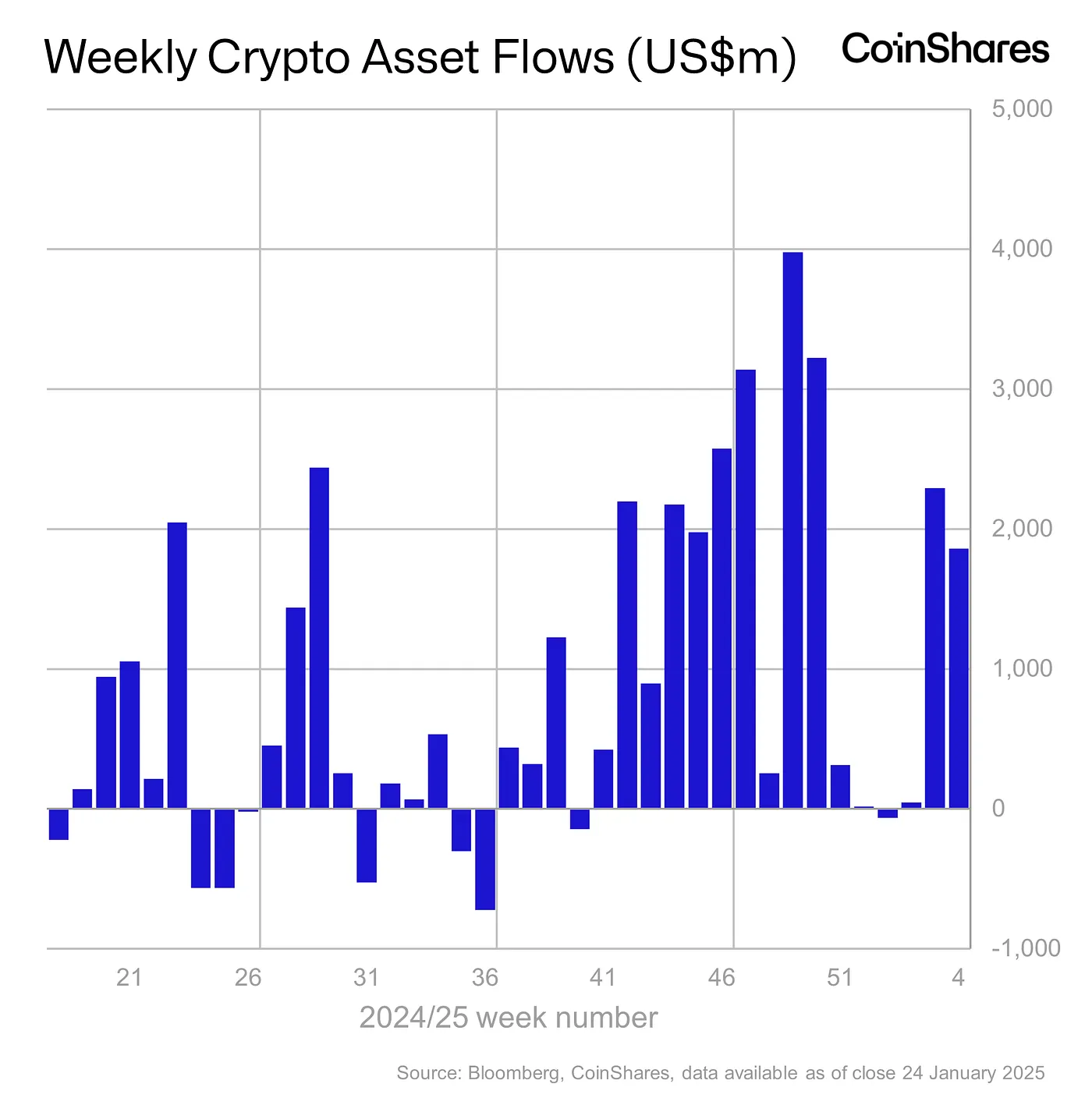
Institutional Appetite Surges: Crypto Markets Defy "Hawkish Cut" Anxiety with $1.9 Billion Inflow
The landscape of digital asset investment has undergone a significant shift in the wake of the U.S. Federal Reserve’s long-awaited monetary policy pivot. According to the latest Digital Asset Fund Flows Weekly Report published by CoinShares, institutional investors have demonstrated a renewed and aggressive appetite for cryptocurrency, funneling $1.9 billion into digital asset investment products over the past week. This surge marks the second consecutive week of positive sentiment, signaling that the broader market is beginning to find its footing following the Federal Reserve’s decision to initiate interest rate cuts.
The Federal Reserve’s Pivot and Market Volatility
The catalyst for the recent market movement was the Federal Open Market Committee’s (FOMC) decision to lower the benchmark interest rate. While the move was widely anticipated, the market’s initial reaction was defined by uncertainty. Investors, wary of the Fed’s messaging—which some analysts characterized as a "hawkish cut"—initially exercised caution, leading to a tepid start to the week for crypto exchange-traded products (ETPs).
However, as the dust settled and market participants digested the long-term implications of a lower-rate environment, the sentiment shifted dramatically. By Thursday and Friday, the momentum accelerated, with $746 million in capital entering the ecosystem in just 48 hours. This trend highlights a fundamental change in how institutional players view digital assets: no longer merely as speculative vehicles, but as legitimate components of a diversified, interest-rate-sensitive portfolio.
Chronology of the Week’s Institutional Activity
The week began with a palpable sense of hesitation. As news of the rate cut broke, institutional ETP flows were relatively flat, as investors waited to see if the Federal Reserve would signal a more aggressive easing cycle or adopt a "wait-and-see" approach.
- Monday – Wednesday: During this period, trading volumes remained steady but cautious. Institutional investors, particularly those managing large-scale portfolios, were recalibrating their risk models in response to the macroeconomic shifts.
- Thursday – Friday: Once the market interpreted the Fed’s commentary as a definitive transition toward monetary easing, the "floodgates" appeared to open. The surge of $746 million in the final two days of the week accounts for a significant portion of the total $1.9 billion influx, suggesting that the institutional community has moved past the fear of volatility and is now positioning for growth.
Global Distribution of Capital
While the United States remains the epicenter of the current inflow cycle, the trend is global. The United States led the charge with a commanding $1.8 billion in inflows, reinforcing the country’s position as the primary hub for regulated crypto-financial products.
Secondary markets also saw significant activity, proving that the bullish sentiment is not confined to North American borders:
- Germany: Recorded $51.6 million in inflows.
- Switzerland: Added $47.3 million.
- Brazil: Continued to show growth with $9.3 million.
Conversely, the market did not see uniform gains across all regions. Hong Kong, a burgeoning hub for crypto-ETPs in the Asia-Pacific region, experienced minor outflows totaling $3.1 million. This regional divergence suggests that while the macroeconomic impact of the Fed’s rate cut is global, local regulatory environments and regional liquidity needs continue to influence investor behavior on a granular level.
Bitcoin and the Decline of Short-Selling
Bitcoin (BTC), the cornerstone of the institutional crypto market, dominated the weekly flows, capturing nearly $1 billion of the total capital influx. This reinforces the narrative that Bitcoin is increasingly viewed by institutions as a "digital gold" hedge against the devaluation of fiat currency, especially as the U.S. central bank begins to relax monetary policy.
Perhaps more telling than the growth in long-only products is the decline in short-Bitcoin investment vehicles. Short-Bitcoin products experienced $3.5 million in outflows, driving the total Assets under Management (AuM) for these bearish products to a multi-year low of $83 million. This contraction suggests that the "smart money" is effectively capitulating on the idea that Bitcoin is poised for a significant downward correction in the near term, favoring instead a long-term bullish thesis.

Ethereum and the Altcoin Resurgence
While Bitcoin grabbed the lion’s share, other assets saw notable institutional interest, indicating a broadening of risk appetite among professional investors:
- Ethereum (ETH): Enjoyed a substantial $772 million in inflows. This is a critical development for the Ethereum ecosystem, which has struggled to maintain momentum compared to Bitcoin throughout much of 2024.
- Solana (SOL): Continued its strong performance with $127.3 million in inflows, further cementing its status as the preferred alternative to the Bitcoin-Ethereum duopoly.
- XRP: Attracted $69.4 million, reflecting renewed institutional confidence in the token as legal and regulatory hurdles in the U.S. continue to clear.
Implications for the Broader Financial Market
The data from CoinShares carries several profound implications for the future of digital asset adoption.
The "Interest Rate Sensitivity" Paradigm
The fact that institutional flows surged immediately following the Fed’s rate cut is evidence that crypto assets are becoming increasingly correlated with the broader "risk-on" asset class. As interest rates decline, the opportunity cost of holding non-yielding assets like Bitcoin decreases, theoretically making them more attractive. This cycle suggests that if the Federal Reserve continues its path toward further rate cuts, the institutional appetite for digital assets could remain elevated throughout the remainder of the year.
The Institutionalization of Crypto
The shift from speculative retail trading to institutional ETP-driven volume is a maturation milestone for the sector. Institutional investors bring a different set of priorities: long-term time horizons, rigorous risk management, and a focus on regulatory compliance. The heavy inflows into ETPs, rather than direct wallet transfers, indicate that traditional financial institutions are now the primary conduits for this capital, which in turn brings greater stability to the market.
Regulatory and Macroeconomic Outlook
The "hawkish cut" phrasing used by analysts highlights the ongoing tug-of-war between inflation control and economic stimulus. While the market initially feared a "hawkish" stance—implying the Fed might keep rates higher for longer—the subsequent surge in inflows suggests that investors are more concerned with the eventual easing of liquidity constraints. If inflation remains under control, the Fed may have the "green light" to continue cutting rates, which many market analysts believe will provide a long-term tailwind for digital assets.
Final Analysis: What to Expect Next
The current data set provides a clear window into the mindset of modern institutional investors. They are no longer waiting on the sidelines; they are actively rebalancing their portfolios to account for a new macroeconomic reality.
However, investors should remain cautious. While the inflows are undeniably positive, the market remains susceptible to external shocks. As noted in the disclaimer, the digital asset space is inherently high-risk, and past performance—even institutional flows—is not a guarantee of future results. The coming weeks will be crucial. If the trend of consecutive inflows continues, it may confirm that the market has entered a new phase of sustained institutional growth.
For now, the message from the markets is clear: despite the initial apprehension surrounding interest rate adjustments, institutional capital has found its confidence, and the digital asset sector is currently the beneficiary of this newfound momentum. Whether this represents the start of a prolonged bull market or a temporary shift in allocation will depend on the Federal Reserve’s upcoming policy decisions and the resilience of the global economy.
Disclaimer: Opinions expressed in this report are for informational purposes only and do not constitute financial or investment advice. Investors are encouraged to perform their own due diligence before engaging in high-risk investments. Cryptocurrency markets are volatile, and the risk of loss can be significant. The Daily Hodl does not endorse the purchase or sale of any specific asset.