Institutional Appetite for Crypto Surges: A Mid-Year Analysis of Global Fund Flows
The landscape of institutional finance is undergoing a profound transformation as digital assets increasingly transition from the periphery of speculative trading into the core of mainstream investment portfolios. According to the latest "Digital Asset Fund Flows Weekly" report from CoinShares, institutional capital is flooding into cryptocurrency investment vehicles at a staggering rate, signaling a robust recovery and a deepening institutional commitment to the asset class as the first half of 2025 draws to a close.
Main Facts: The $16 Billion Surge
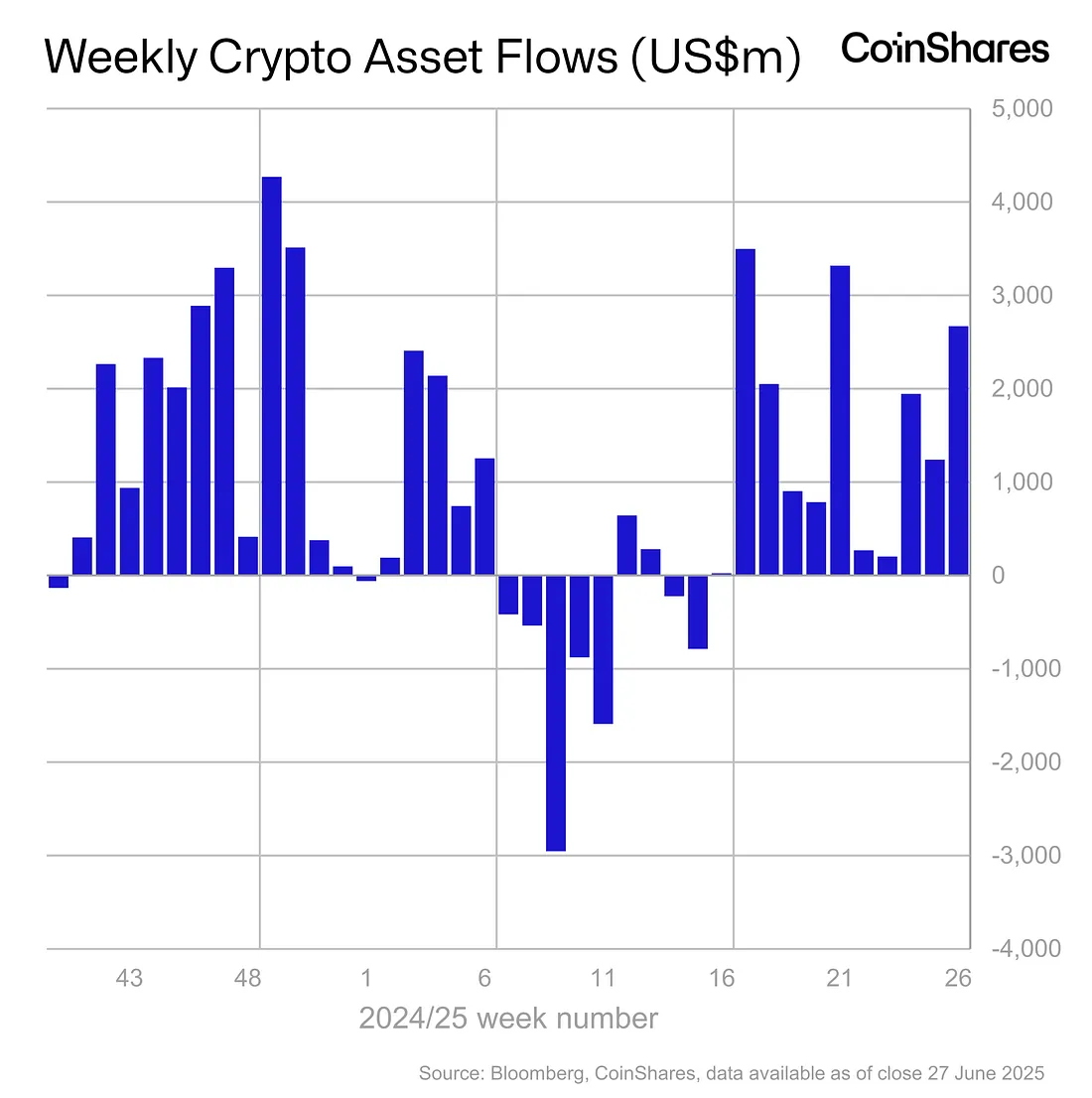
Over the past eleven weeks, institutional digital asset investment products have attracted a cumulative inflow of $16.9 billion. This unprecedented wave of capital highlights a decisive shift in market sentiment. For the most recent reporting week alone, these products saw $2.7 billion in new inflows, underscoring the relentless demand from institutional players—ranging from hedge funds and family offices to pension funds and asset managers—seeking exposure to the digital economy.
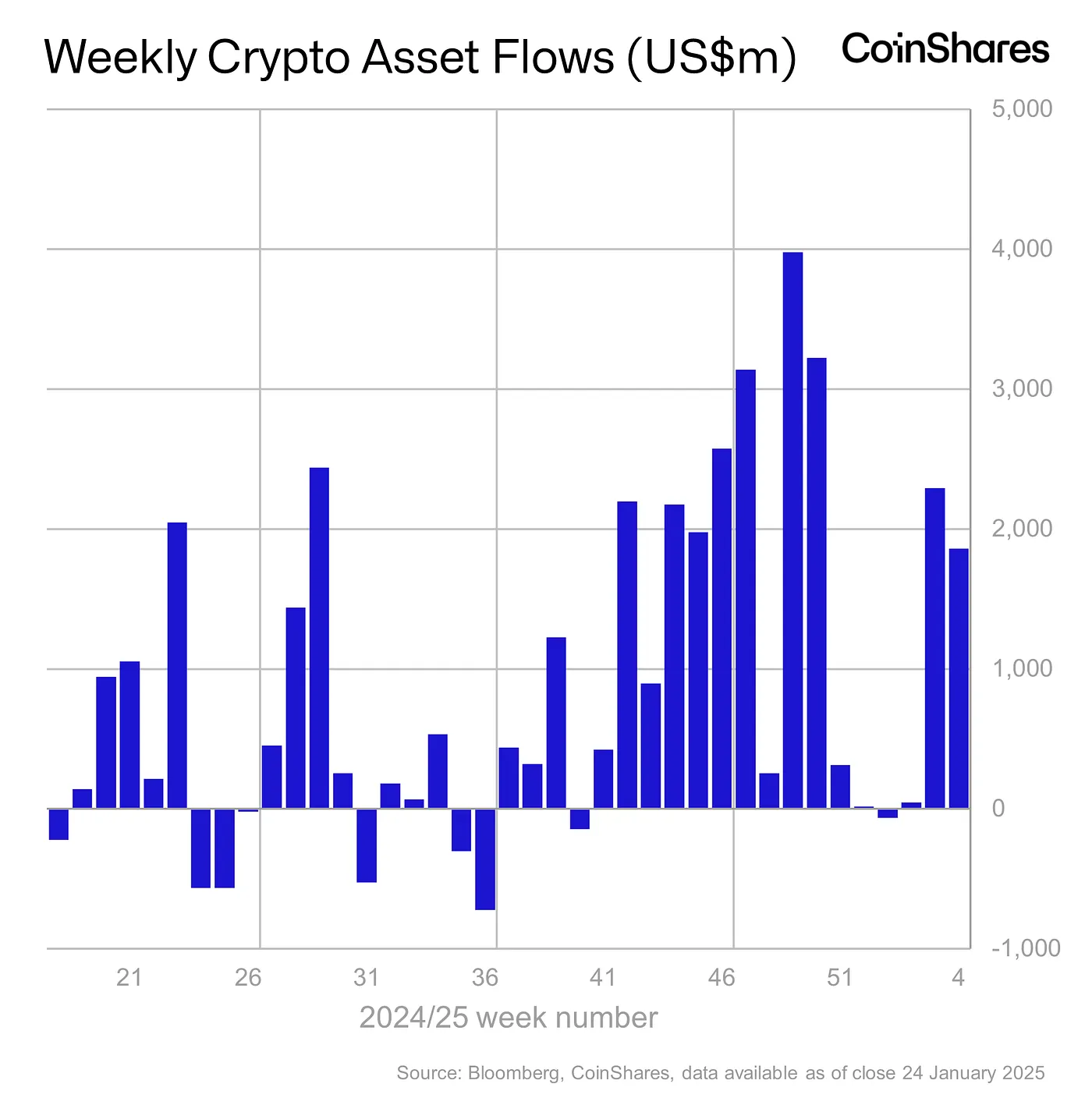
The data suggests that the first half of 2025 (H1) is mirroring the frenetic pace of 2024. During the same period last year, total inflows reached $18.3 billion by the end of June. Despite the immense scale of last year’s figures, 2025 is currently tracking closely behind, proving that the institutional interest witnessed in previous cycles was not merely a transient trend but the start of a sustained structural shift in portfolio allocation.
Chronology of the 2025 Institutional Shift
The trajectory of 2025 has been marked by a consistent, weekly accumulation of assets. While market volatility has been a recurring theme, the institutional "buy the dip" mentality has remained a stabilizing force.
- Q1 2025: The year began with a cautious optimism, as regulatory clarity in key jurisdictions and the anticipation of macroeconomic shifts pushed institutional managers to increase their digital asset exposure.
- April–May 2025: As geopolitical tensions intensified and global inflationary pressures fluctuated, institutional investors sought "digital gold" as a hedge, leading to a steady climb in weekly inflows.
- June 2025: The most recent month has been characterized by aggressive accumulation. Even as certain regions saw outflows, the sheer volume of capital entering the United States market neutralized global volatility, cementing an eleven-week streak of positive inflows.
Supporting Data: Regional Divergence and Asset Performance
The global distribution of these inflows paints a nuanced picture of where institutional capital is currently concentrating. The United States remains the primary engine of the digital asset market, accounting for a massive $2.65 billion in inflows during the most recent week. This dominance reflects the impact of spot-market investment vehicles and the maturity of the U.S. regulatory environment, which continues to attract capital that is often restricted in more fragmented markets.
Regional Breakdown
While the U.S. dominates, other jurisdictions have shown mixed results:
- Switzerland & Germany: These European hubs maintained positive momentum, recording inflows of $23 million and $19.8 million, respectively.
- Outflows: Conversely, Canada, Hong Kong, and Brazil faced headwinds, recording outflows of $13.6 million, $2.3 million, and $2.4 million, respectively. Notably, Hong Kong experienced significant pressure, with $132 million exiting the market over the course of June. This regional divergence suggests that investors are increasingly sensitive to local regulatory nuances and interest rate environments.
Asset-Specific Performance
Bitcoin (BTC) remains the undisputed king of institutional portfolios, accounting for 83% of the total inflows last week ($2.2 billion). Perhaps more tellingly, "short-Bitcoin" products saw $2.9 million in outflows, bringing year-to-date outflows for short vehicles to $12 million. This indicates a near-unanimous consensus among institutional managers that the directional trend for Bitcoin is bullish.
Ethereum (ETH) is also enjoying a significant resurgence, securing $429 million in inflows last week. This momentum suggests that institutional interest is broadening beyond Bitcoin to include major smart-contract platforms that offer utility beyond simple store-of-value propositions.
Official Analysis and Expert Perspectives
CoinShares, in its comprehensive report, attributes this resilient investor demand to two primary drivers: geopolitical volatility and uncertainty surrounding global monetary policy.
"We believe this resilient investor demand has been driven by a combination of factors, primarily heightened geopolitical volatility and uncertainty surrounding the direction of monetary policy," the report states.

Market analysts suggest that as central banks grapple with sticky inflation and the potential for recessionary pressure, traditional hedges like bonds and fiat currencies are losing their luster for institutional treasurers. Digital assets, characterized by their finite supply and decentralized nature, are increasingly viewed as a "neutral" asset that can act as a shock absorber during periods of systemic financial instability.
Implications for the Future of Finance
The implications of a $16.9 billion inflow over an eleven-week period are profound. This level of institutional participation suggests that the "crypto winter" is a distant memory, replaced by a "crypto spring" of institutional adoption.
1. Market Maturation and Liquidity
As institutional capital continues to flow into these regulated vehicles, the overall liquidity of the digital asset market improves. This reduces the extreme volatility that once defined the sector, making it more palatable for conservative institutional allocators.
2. The Shift in Portfolio Allocation
The traditional 60/40 portfolio—comprising 60% stocks and 40% bonds—is undergoing a re-evaluation. Many institutional managers are now advocating for a 1–5% allocation to digital assets as a non-correlated diversifier. If this trend continues, the current $16 billion inflow could be viewed as merely the tip of the iceberg, as institutional mandates globally shift to include digital assets as a core component of long-term wealth preservation.
3. Regulatory Implications
The heavy concentration of inflows in the U.S. will likely place additional pressure on international regulators to provide clearer frameworks. As capital flows to where it is treated best, regions experiencing outflows, such as Hong Kong or Canada, may be compelled to re-evaluate their restrictive policies to remain competitive in the global race for digital asset dominance.
4. The Role of Bitcoin as Digital Gold
The sustained decline in short-Bitcoin product interest is a powerful signal. It suggests that the institutional community has largely abandoned the narrative that Bitcoin is a fleeting bubble. Instead, they are positioning it as a fundamental asset for the digital age, akin to gold but with the portability and divisibility of modern technology.
Conclusion: A New Era of Institutional Finance
The data from CoinShares confirms that we are in the midst of a significant structural transition. The $16.9 billion in inflows over the last eleven weeks is not merely a number; it is a vote of confidence from the world’s most sophisticated investors.
As we look toward the second half of 2025, the key indicators to watch will be the persistence of these inflows during periods of market consolidation and the expansion of institutional interest into alt-assets beyond Bitcoin and Ethereum. If the current trajectory holds, 2025 will be remembered as the year institutional finance officially integrated digital assets into the bedrock of the global economy.
Disclaimer: The information provided in this report is for educational purposes only and does not constitute financial, investment, or legal advice. Investing in digital assets involves high risk, including the total loss of capital. Investors should conduct thorough due diligence and consult with a qualified financial advisor before making any investment decisions. The Daily Hodl does not endorse the purchase or sale of any specific cryptocurrency or digital asset and participates in affiliate marketing.