The Psychology of the Bottom: Why CZ’s “Buy the Fear” Mantra is Testing Crypto Investors
In the high-stakes theater of digital assets, few voices carry as much weight as that of Binance founder Changpeng Zhao (CZ). As the cryptocurrency market navigates a period of profound volatility and structural uncertainty, CZ recently issued a stark, classic reminder to the trading community: "Unpopular opinion, but it’s better to sell when there is maximum greed, and buy when there is maximum fear."
While the aphorism is as old as the financial markets themselves, its delivery in late November 2025 landed with significant gravity. The market is currently trapped in a tug-of-war between technical resilience and macroeconomic dread, leaving investors to wonder if they are staring at a generational buying opportunity or merely the beginning of a prolonged, sluggish stall.
A Chronology of Sentiment: From Extreme Fear to Cautious Hope
To understand the weight of CZ’s message, one must examine the timeline of the recent market environment. For nearly three weeks, the crypto ecosystem was enveloped in a cloud of pessimism.
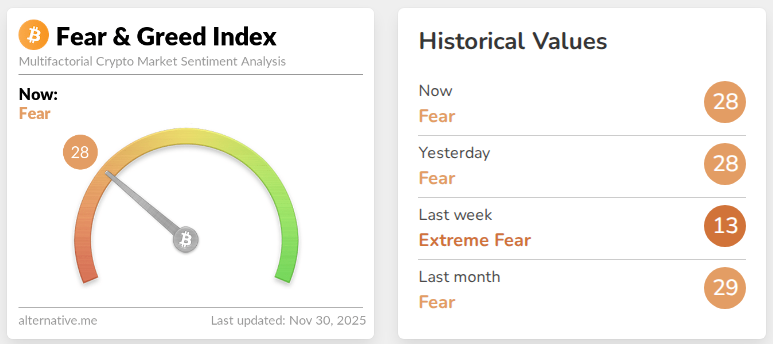
The Crypto Fear & Greed Index, a key barometer for market sentiment, languished in a state of "Extreme Fear" for eighteen consecutive days. On November 22, the index touched a yearly nadir of 10, a level that analysts often associate with capitulation. This streak of low readings created a vacuum of confidence, as retail participants exited positions in response to Bitcoin’s retreat from its October highs of $126,000.
By late November, the index had marginally improved to 20, technically climbing out of the deepest trough of "Extreme Fear." However, for many market observers, the sentiment remained fractured. Analysts like Matthew Hyland characterized this stretch as the "most extreme fear level" of the current cycle, arguing that the quantitative data might actually be understating the psychological exhaustion felt by long-term holders.
Supporting Data: The Anatomy of a Market Stalled
Bitcoin, currently oscillating around the $91,780 mark, finds itself in a precarious middle ground. While the asset remains significantly elevated from its 2024 lows of approximately $40,000, the narrative has shifted from "bull market euphoria" to "defensive positioning."

The Altcoin Drought
Data from the Altcoin Season Index, which currently sits at a measly 22/100, underscores a fundamental shift in investor behavior. When the index is this low, it serves as a definitive signal that the market is favoring capital preservation over speculative risk-taking. Traders are retreating to the relative safety of Bitcoin or stablecoins, effectively starving the altcoin sector of the liquidity required for a sustained rally.
The Coinbase Premium Pivot
One of the few rays of light in the current data landscape is the recovery of the Bitcoin Coinbase Premium. After 29 days of persistent negative readings—which indicated that US-based selling pressure was consistently suppressing global prices—the premium flipped back into positive territory at 0.0255% on November 30.
In the architecture of crypto markets, the Coinbase Premium is a proxy for institutional appetite. A positive reading suggests that US buyers are once again willing to pay a slight premium over the global average, potentially signaling a return of institutional confidence, improved dollar liquidity, and a tentative stabilization of the domestic investor base.
Market Psychology Overrules Technical Indicators
The reaction to CZ’s tweet was immediate, highlighting a recurring theme in digital asset history: the disconnect between theoretical logic and human behavior.
In the wake of his post, social media forums were flooded with discourse regarding the "paradox of participation." Many traders conceded that while the logic of buying during maximum fear is irrefutable, the visceral reality of doing so is profoundly difficult. As one trader noted, "Markets move on psychology long before the charts confirm a trend."
This creates a structural "fear gap." Even when data suggests a bottom is forming, the fear of "catching a falling knife" prevents institutional and retail players from executing on their own strategy. This psychological friction is precisely why such moments—like the one observed throughout November—often mark the point of maximum capitulation.
The Macro-Economic Shadow: A Warning to the Bulls
While history offers a roadmap, it does not guarantee a destination. Nicola Duke, a prominent market analyst, noted that over the last five years, Bitcoin has historically found a "local bottom" within weeks of hitting peak extreme fear. However, analysts are quick to caveat this observation with the current macroeconomic climate.
Bitwise researcher André Dragosch has emerged as a voice of caution, warning that the current pricing environment is not merely a reflection of crypto-specific volatility, but a broader global growth contraction. Dragosch highlights that the global economic outlook is currently the most bearish it has been since the 2020 pandemic and the 2022 inflationary spike.
This presents a unique challenge: if the "fear" in the market is driven by systemic, recession-level threats rather than just crypto-leverage blowouts, the traditional "bottoming" process may be significantly delayed. Investors are forced to decide whether the Bitcoin price is discounting a temporary dip or a long-term shift in global monetary policy.
Implications for the Future: A New Era of Maturity
The current market environment serves as a litmus test for the maturation of the cryptocurrency sector. We are witnessing a transition where Bitcoin is no longer trading in a vacuum, but is inextricably linked to US institutional flows and global macro indicators.
1. The Institutionalization of Volatility
The fact that the market is paying such close attention to the Coinbase Premium suggests that the "Wild West" era of crypto trading is fading. Institutional players are increasingly the primary drivers of price action. Consequently, the "maximum fear" levels of 2025 are different from those of 2020; they are no longer just about retail panic, but about the risk-off behavior of major capital allocators.
2. The Return of the Long-Term View
CZ’s message reinforces a long-term philosophy that is often lost in the noise of daily volatility. For the average investor, the implications are clear: the current environment requires a decoupling of price action from sentiment. Those who can identify the difference between "market noise" and "systemic failure" are those most likely to navigate the current cycle successfully.
3. The Risk of Ignoring History
While the bearish macroeconomic headwinds are real, ignoring the historical frequency of recovery after periods of "extreme fear" carries its own risk. The data—the Coinbase premium turning positive, the extended duration of the fear index—suggests that the market is reaching a point of exhaustion. Historically, the end of such exhaustion periods is followed by a period of quiet accumulation before the next cycle begins.
Conclusion
Changpeng Zhao’s blunt advice served as a wake-up call to a market that had become paralyzed by its own anxiety. Whether or not his words prove prophetic remains to be seen, but the data—ranging from the positive shift in the Coinbase premium to the stabilization of sentiment indices—suggests that the market is at a critical inflection point.
The coming weeks will be decisive. If the positive US premium holds and the global growth outlook does not deteriorate further, the current "maximum fear" may indeed be remembered as the foundation of the next bull run. However, until the broader macroeconomic climate clarifies, the market remains in a state of fragile equilibrium. For the disciplined investor, the message remains unchanged: fortune rarely favors the fearful, but it almost always rewards the patient.